
Held at: | Private Collection |
Reference: | RS |
Source: | Research |
Title: | Golden Valley Railway: The Extension to Monmouth |
Place name: | Golden Valley |
Date: | 1865 - 1898 |
Description:
|
|
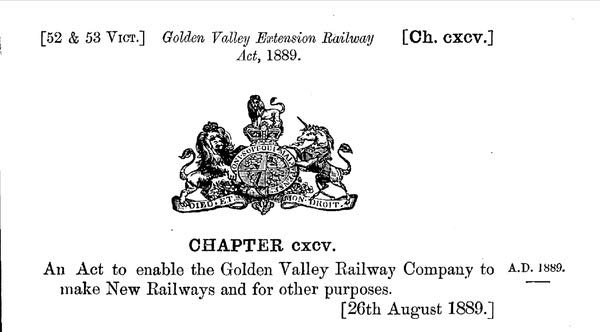
When the Golden Valley Extension Railway Act 1889 was approved by Parliament on 26th August 1889, it represented the culmination of a long-held and hard fought-for dream for the Directors of the Golden Valley Railway Company and in particular for their Chairman Sir Richard Dansey Green-Price. According to them, the plan to extend their railway from Pontrilas to Monmouth was the key to unlock a highly lucrative direct railway through route between two of the greatest and busiest ports in the British Empire - Liverpool and Bristol. The riches of the Empire would flow along their lines and create a bonanza for their lucky investors. Or so their share prospectus claimed. However, the glittering proposition concealed some inconvenient truths, not least that their existing ‘light railway’ line from Pontrilas to Hay was unsuitable to handle such heavy traffic and that their Company was in any case by that time in dire financial straits close to bankruptcy.
The concept that a railway between Pontrilas and Monmouth might provide a profitable means to link Liverpool and the industrial heartlands of the North with the port of Bristol was not a new one. Some 25 years earlier similar calculations had been made by local businessmen, including Crawshay Bailey who was one of the wealthiest entrepreneurs of his time with widespread interests in iron making, coal mining and railways throughout South Wales. Plans drawn up for the 1865 proposal, to be known as The Monnow Valley Railway, showed that the railway would follow a route through Rockfield, Skenfrith, Grosmont and Llangua, before joining the Newport, Abergavenny and Hereford [Great Western] line just south of Pontrilas station. The route would need five bridges each with a span of 60 feet, two tunnels including one at Skenfrith 475 yards long, and substantial other works for roads to pass over or under the proposed line. A guest contribution on this website gives a detailed description of the proposed Monnow Valley Railway of 1865 .
The economics of the proposed line at that time were at best optimistic, and a financial crash in the City of London in 1866 quickly put paid to any prospect of attracting investment into the Monnow Valley Railway scheme, which was shelved. A brief flurry of renewed interest emerged in 1876, fuelled by rivalries between two competing proposals for access to Bristol; the Severn Railway Bridge from Lydney to Sharpness authorised in 1872 and the Severn Tunnel commissioned by the Great Western Railway in 1873. Local landowners felt that a Monnow Valley connection could by-pass the Severn Tunnel and take advantage of a shorter route for trade from the Midlands and North via the Severn Bridge, but the proposition again failed to attract the necessary investment. And so matters remained until the intervention of the Golden Valley Railway Company in 1889.
In the event the Monmouth extension to the Golden Valley Railway was never built. Attempts to raise the investment needed when the parent company was already running at a loss and mired in debt proved fruitless, and the economic predictions in the share prospectus itself came under attack as fraudulent. The project was formally abandoned when the Golden Valley Railway Company fell into bankruptcy in 1898, the story of which can be found here .
Ref: rs_gdv_0247