
Held at: | Private Collection |
Reference: | RS |
Source: | Original Document |
Title: | Guest Contribution: The Will and Funeral of Lucia Rosher |
Place name: | Walterstone, Golden Valley |
Date: | 1830 - 1927 |
Description:
The article below was written by Miriam Griffiths and first published in 2022 by the Llanthony Valley & District History Group. It is reproduced here with her kind permission.
Ewyas Lacy Study Group
No mourning, no pall, no shroud, no symbolical flowers and an 8 cwt coffin: the will and funeral of Lucia Anne Maria Rosher, 1830-1927.
Miriam Griffiths.
In September 1925 Lucia Anne Maria Rosher of Pandy in Monmouthshire made her will. Detailed instructions for her funeral made up half the will and reports about the funeral in May 1927 show that most of her instructions were implemented. The funeral attracted some press attention, then when Probate was granted in January 1929, the will entered the public domain, journalists recognised a good story and a flurry of publicity about the unusual funeral instructions ensued; the focus was more on the perceived oddity of the funeral plans than on the woman herself. There are indications in her 1927 obituary in The Times that Lucia had an interesting life (spanning nearly 100 years) which I’m looking into. Meanwhile, this piece focusses on her will and funeral, which give a few glimpses of the Pandy community nearly 100 years ago, as well as some hints about Lucia’s life, interests and personality.
Biographical backdrop
In June 1861 at Llanfihangel Crucorney parish church, Lucia Anne Maria Morgan of Glanhonddu, Pandy, aged 31, married the local squire from nearby Trewyn manor, Jeremiah Burch Rosher, aged 68; she was his third, or possibly fourth, wife and the age difference did not go unremarked. He was a wealthy man, the sixth in a line of seven consecutive ‘Jeremiah’ Roshers. The preceding five Jeremiahs had built up successful family businesses mainly on the Thames estuary outside London - timber, quarrying, lime, cement and concrete. Jeremiah Burch’s grandfather (the fourth Jeremiah) acquired Trewyn in 1775 and it remained in the Rosher family till 1895.
|
|
|
|
| Rosher products 1860s/7 |
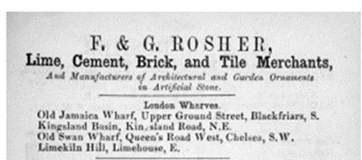
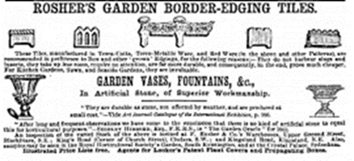
Lucia Anne Maria was the only child of Anne and Theophilus Morgan who, like his father Morgan Morgan, was Vicar of Walterstone and Rector of Oldcastle; so Lucia came from a clerical family of longstanding respectability in the local community. Marrying into the gentry would have changed Lucia’s life in various ways, including enhancing her wealth and social standing. She was born in Pandy in 1830 at the Morgan family home, Glanhonddu (which later became the Park Hotel) and was baptised at St Mary’s church in Abergavenny. Her 1861 marriage to Jeremiah Burch Rosher lasted 13 years; he died in 1874 and she subsequently moved back to Glanhonddu, as her husband’s son from his first marriage, Jeremiah Lilburn Rosher (the seventh Jeremiah) inherited Trewyn. As customary, the widowed dowager mother made way for the son (in this case, her stepson) to take control of the family home and estate. Lucia lived in her Morgan family home until her death in 1927.
A detailed marriage settlement, including an annuity for Lucia, was drawn up for the 1861 marriage. In 1874 Jeremiah Burch’s problematic will gave rise to a protracted family legal dispute about the extent to which Lucia retained any powers of control over the Trewyn estate after her husband’s death; eventually in 1884 a court ruled in favour of the son, Jeremiah Lilburn Rosher.
For only 13 years of Lucia’s nearly 100 years lifespan she lived at Trewyn as a county squire’s wife. Her role in her community as the late squire’s widow can be seen in local press cuttings where she appears giving prizes at ploughing matches and village shows, being involved with the Red Cross, the Soldiers’ Tobacco Fund and schools and contributing to charities, as one might expect. The Times obituary doesn’t mention the funeral but does mention her “ rather expensive” taste for building projects.
Lucia’s building works
A number of buildings in Pandy bear initials on external walls – eg LAMR or IBR. LAMR is Lucia but IBR’s identity is unclear. Lucia’s initials appear on one Pandy house, Min Honddu, together with her father’s initials, TM; the two dates (1869 and 1892) suggest two episodes of building activity by father and daughter. I’ve found reference to Lucia having workers’ dwellings built in Pandy and her will mentions two freehold properties she owns, Rhos Rhudd and Rhos Gwyn. Those cottages and Min Honddu are likely to have been on the Morgan family’s land in the village while buildings where IBR appears are likely to have been Rosher property. One woman with those initials (and of the right generation) in the Rosher family tree is Isabella Belinda Rosher (nee Staff, 1807 – 1881) sister- in- law of Jeremiah Burch Rosher. The listed building report for Trewyn House (1956 updated 1998) states that an ‘Isobel Bernadette Rosher’ had a hand in some alterations of Trewyn House in the 1870s. Was this a mistaken reference to Isabella Belinda Rosher? What is clear is that two Rosher women were involved in building developments in Pandy in the later 1800s.
|
|
|
|
| |
| Some initials on Pandy houses | |
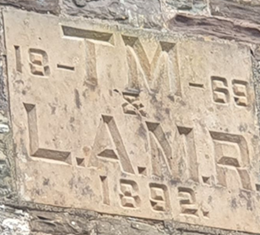
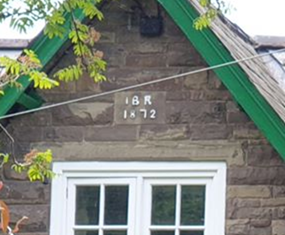

Lucia’s active interest in house building and improvement is clearly indicated in Jeremiah Burch Rosher’s will, relating to his property Ty Derlwyn at the north end of Pandy. It’s evident that Lucia played a big part in the redevelopment of that house as in her husband’s will she is bequeathed several life-time rights of use and decision-making at Ty Derlwyn, including the right to decide any changes, even very small changes such as removing shrubs from the garden, and the right to live there; in fact, she chose to live at Glanhonddu, her family home.
Press coverage of Lucia’s funeral
Press reports about Lucia’s funeral in May 1927 mention some of the funeral arrangements that were stipulated in her will. For example, the Western Mail picked out a few salient features:
| |
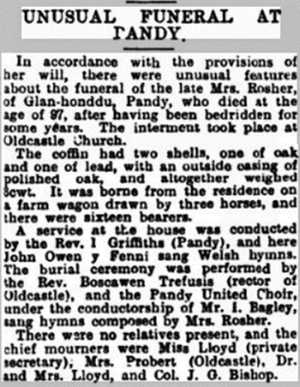
Other further-afield press items about the funeral appeared around that time, of which the following from the Shields Daily News (Tyneside) is fairly typical:
|
|
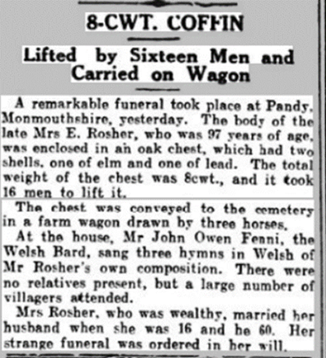
The exaggerated age discrepancy, the sloppy misprint of her initial, ‘Mr’ rather than ‘Mrs’ and the epithet “strange” all give away the sensationalist intentions of the journalist. This sensationalism appeared again in 1929 when press coverage like that popped up in local newspapers in Britain and the colonies, for example in Sheffield, Leicester, Londonderry and Australia, to name a few . Here are a couple of examples of typical headlines:
|
|
| Leicester Eve Mail Mon 4 Feb 1929 |
|
|
| Londonderry Sentinel Sat 9 Feb 1929 |
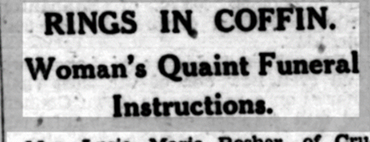
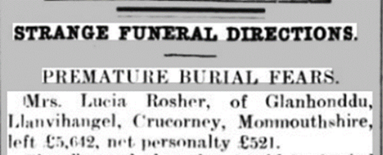
These press cuttings are useful in highlighting some of the features of the will and funeral that were deemed newsworthy, but there are quite a few errors and plenty of hype. I decided to compare the will itself with the fullest account I have of the funeral, a detailed report sent to me a few years ago by the late Pandy resident and local historian, Richard Davies. The information sources for that report aren’t given, but it contains local details that strongly suggest the sources were from within the local community. The comparison shows that the funeral mainly followed Lucia’s requirements and that the funeral included elements that don’t appear in the will. We also hear mention of some members of the local community and the roles they played in the funeral.
Comparing Lucia’s will and her funeral
The will states that she is to be buried at Oldcastle church with her husband and gives the precise additional wording to be engraved on the pink granite grave slab; a visit to the graveyard has confirmed that this was done.
|
|
| The two matching pink granite graves of (foreground) Jeremiah Burch and Lucia AM Rosher (and added memorial to Jeremiah Lilburn Rosher) and (background) of Theophilus and Anne Morgan, at Oldcastle church (now a private dwelling). |
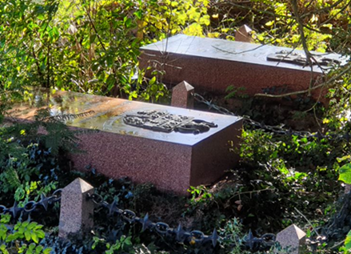
By stipulating ‘no mourning’ in her will, Lucia appeared to be avoiding ostentation, implying that she didn’t want to be remembered in a showy or fancy style. The will was made, with an eye on quality and simplicity, by an individual who knew exactly what she wanted. The detailed funeral report commends the way that everything was plain and solid without ornament or fuss
The final journey
Regarding the coffin, Lucia states that a plain, antique-shaped outer shell should be made out of heart of oak by Lewis John Parry, with strong handles and no ornaments, with additional shells of elm and lead and she stipulates 12 pall bearers from the neighbourhood, each to be paid 10 shillings. No wonder the funeral report records that in fact 16 pall bearers were needed (all individually named) to carry the 8 cwt coffin; they all duly received their 10 shillings. (In the 1911 census Lewis John Parry, the coffin maker, is a ‘builder’ living at Ty Newydd, Pandy.) The will says that strong rings were to be screwed on the inside of the coffin opposite ankles and waist to fasten a scarf through and across to prevent movement of her body during the uphill journey to the church, a detail of interest to journalists but not mentioned in the local funeral report.
Lucia’s will expresses her wish to be buried without a shroud but in a plain black dress and nothing on her head; the funeral report doesn’t mention these details. Some other descriptions of the funeral say that Lucia had asked for a Monmouth Cap to be placed on the coffin; that was a plain knitted woolen cap worn by soldiers, sailors and other workers since Shakespeare’s time, the history of which garment can be found in an online article which mentions Lucia’s funeral .
For the external dressing of the coffin and its journey to Oldcastle from Glanhonddu, Lucia stipulates there should be no pall covering the casket and that the vehicle – which should not be a hearse –should be covered by fir tree branches from Glanhonddu and flowers, which are not to be made into any symbolical design. The funeral report confirms that a four-wheeled wagon drawn by three horses (owned by Joseph Griffiths, Werngifford) conveyed the casket from Glandhonddu to Oldcastle church. (This was probably a farm wagon as Joseph Griffiths appears in the 1911 census as a farmer at Werngifford.) The wagon was covered with fir branches and evergreens from Glanhonddu and many floral tributes; some of these are described and certainly do not conform to the will’s stipulation to avoid symbolism in the flower arrangements. For example Emily Lloyd, Lucia’s companion (and main beneficiary of the will) provided a floral tribute in the shape of a harp with broken strings made from red and white roses intermingled with rosemary. (Emily was born in Llanfihangel Crucorney in about 1887 and appears in the 1901 census as a housemaid at Glanhonddu; by 1927 she had evidently progressed within the Glanhonddu household as in the will Lucia says that Emily was for many years her devoted and loving companion.)
Music
The will requests that the Pandy United Choir is to attend and each member to be paid 5 shillings. The funeral report confirms the choir’s role on the day: before proceeding to Oldcastle church there was a service at the house where the choir, conducted by Isaac Bagley, Ty-ronnen, sang Welsh hymns. One press clipping mentions that some of the hymns were Lucia’s own compositions. ( Isaac Bagley turns up in the 1911 census living at Llwynon in Pandy and working as a steel-works stocktaker -but it seems he was also a village choir master.) At Oldcastle the choir sang the Welsh air ‘Men of Harlech’ while the coffin was being carried from the wagon into the church where the Rector, Rev. Boscawen Trefusis, conducted a full service; the will states that the Rector is to be paid a £25 fee for arrangements and the service at Oldcastle. The choir also gave a rendering of the old Welsh ballad ‘Lwynon’(the Ash Grove) at the graveside. There was a strong inter-denominational element to the funeral which involved two ministers as well as Oldcastle’s Rector. At Glanhonddu, before the funeral cortege set out for Oldcastle, Pandy’s Zoar Chapel Baptist Minister Rev Isaac Griffiths delivered an eloquent oration and then Rev E Doughton Evans, Minister at Hope Presbyterian Chapel read from the scriptures. Neither minister is mentioned in the will but at the funeral we get a hint of Lucia’s standing within different social and faith groups in the neighbourhood.
An allusion to Lucia’s musical interests (mentioned in the 1927 obituary) appears in the report which tells us that, according to the deceased’s wishes (but not mentioned in the will), the Abergavenny Welsh harpist (and man of multiple talents and interests) John Owen Y fenni played and sang verses from ‘Lwynon’ , and that Lucia had been taught the Welsh harp by the eminent harpist John Thomas, Pencerdd Gwalia . This suggests a personal touch to Emily Lloyd’s harp-shaped flower arrangement. Some of the 1927 news clippings also say that some of the hymns were composed by Lucia, though this isn’t mentioned in the detailed local funeral report.
Finally, a detailed direction in the will shows that Lucia had a fear of being buried alive: several members of her family, she says, had narrowly escaped this fate. She stresses that the coffin lid should not be closed until the first signs of dissolution appear, the burial should not take place until at least seven days after issue of the death certificate, the body having been seen by two qualified doctors. While this personal anxiety is not mentioned in the detailed funeral report, it does crop up in some of the 1929 press clippings about the will. In these careful stipulations there may be a glimpse of aspects of Lucia’s personality. We also get a sense of her local presence in the community as the funeral report says hundreds of people attended, paying tribute to a gracious, kind and gifted woman; possibly there’s a little exaggeration in the figure here. On the other hand it seems appropriate to picture the final part of the proceedings according to the funeral report: the full congregation at Oldcastle singing ‘Abide With Me’ at the graveside.
November 2022.
---------------------
[1] The Times Obituary May 25 1927 http://www.ewyaslacy.org.uk/Trewyn-Walterstone/Press-Cutting-Obituary-Notice-of-Mrs-Lucia-Rosher/1927/gc_ewy_3068 ( Researching details of her life is an ongoing project.)
[1] Press cuttings seen on www.britishnewspaperarchive.co.uk
[1] Monmouth Cap: http://www.reenactor.ru/ARH/PDF/Buckland.pdf
[1] Information about the two harpists is at: https://biography.wales/article/s2-OWEN-JOH-1867 and
https://biography.wales/article/s-THOM-JOH-1826
Ref: rs_wal_0126