
Held at: | Private Collection |
Reference: | RS |
Source: | Original document |
Title: | Guest Contribution: Historical Development of Maescoed Farm |
Place name: | Newton |
Date: | 1600 – 1900 |
Description:
Maescoed Farmhouse and Associated Buildings
1. Introduction
Maescoed Farmhouse represents an example of vernacular domestic architecture in the border counties, illustrating the evolution of a rural Herefordshire dwelling from its sub-medieval origins (c.1600) through successive adaptations in the 17th, 18th, and 19th centuries.
Its survival provides a valuable insight into the changing social, architectural, and agricultural character of the region over more than four centuries.
Beyond its architectural qualities, Maescoed is significant for what it tells us about local life and landholding. Once part of the Abergavenny Estate, it was sold off in the early 20th century when many large estates were broken up, allowing tenant farmers to become independent landowners. Families such as the Roberts and Watkins appear in 19th-century tithe and census records, providing a human link to this evolving landscape.
Together with its associated stable and cow house, Maescoed forms part of a historic farmstead that reflects the continuity of farming life in the “border country” a region long shaped by mixed agriculture, strong vernacular traditions, and modest architectural refinement.
2. Historic Development
Phase 1 – c.1600 (Sub-Medieval Core)
The earliest part of Maescoed dates to around 1600, during the sub-medieval period, a transitional phase between the medieval vernacular and the more formal architecture of the 17th century.
The house follows the gable-end entry plan, typical of rural houses across west Herefordshire, Monmouthshire, and Breconshire. The original entrance, located beside the chimney stack, is now internalised by later additions.
Internally, the property was divided into hall, solar, and parlour spaces using finely made plank-and-muntin screens, which remain in good condition. At first-floor level, lath and plaster partitions follow the same divisions, with some 19th-century modifications such as new fire surrounds and doors. These features show the gradual shift from purely functional construction to a more domestic interior character.
Phase 2 – Late 17th Century (Kitchen Addition)
Later in the 17th century, a kitchen wing was added to the north-east corner. It retains its flagstone flooring, an original southern window opening, and a later northern window of 19th-century character.
The large chimney was altered in the Victorian period, refaced in brick and fitted with a simple 19th-century mantle. The roof structure preserves 17th-century carpentry, while traces of limewash and lime render survive on internal walls, evidence of traditional finishes and maintenance practices.
Phase 3 – Early 19th Century (North Range and Hall)
In the early 19th century, the house was expanded southwards with a north range and new main entrance hall. The junctions between this phase and the earlier structure remain visible on the north-east and north-west elevations.
Inside, a timber screen divides the hall from the adjoining room, possibly used for salting or storage, explaining the wear to the lime plaster in this area. Floors are of flagstone, and ceilings finished in lath and lime plaster.
The first floor continues above the earlier kitchen with a hipped roof and a simple metal casement window, accessed via a later doorway from the main stair compartment.
Phase 4 – Late 19th Century (Southern Extension and General Upgrading)
The farmhouse was extended again to the south in the late 19th century, a phase noted in both the RCHME (1931) and the Historic England list description. The contrast in stonework and window form clearly distinguishes this addition from earlier work.
This phase introduced a cellar beneath the south range, new internal connections to the older structure, and a programme of general improvements: upgraded joinery, Victorian fire surrounds, cupboards in chimney recesses, and renewed plasterwork.
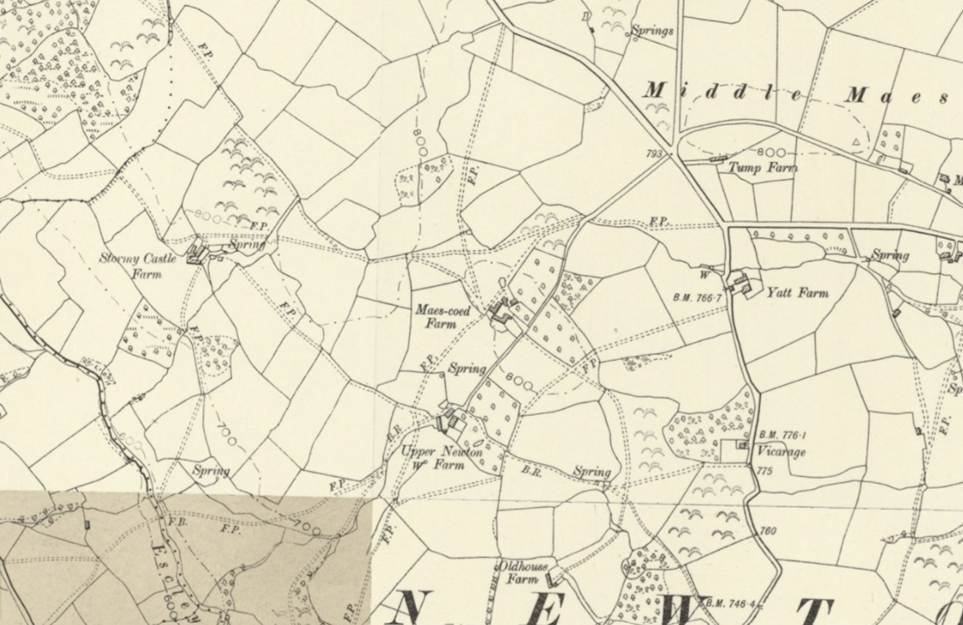
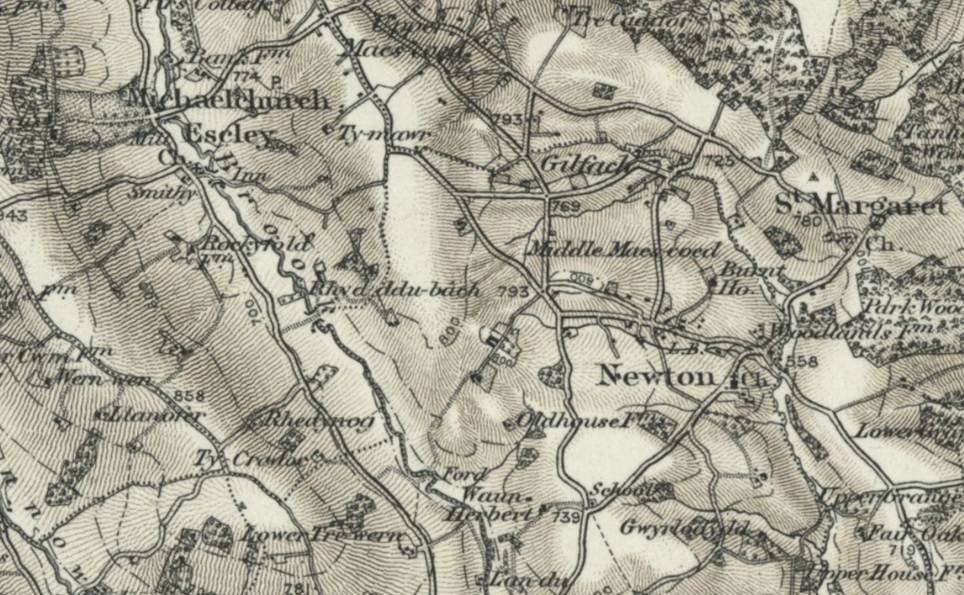
Mapping suggests that this addition may have replaced an earlier structure, preserving the overall footprint visible on early 19th-century maps. Since this time, Maescoed has seen little alteration, aside from roof recovery and limited window replacement.
3. Stable and Cow House
The stable block, located immediately south of the farmhouse, predates the 19th-century extension but remains detached. Dating to the late 18th century, it is built of coursed rubble stone with a broadly symmetrical north-facing elevation. Originally roofed in stone slates, it was re-covered in concrete tiles in the later 20th century (post-1984). Though simple, the stable’s form and materials complement the farmhouse and illustrate the functional, agricultural life of the property. Together, they form a cohesive historic group, reflecting the working layout of a traditional Herefordshire farmstead.
4. Significance and Local Context
Maescoed Farmhouse is listed Grade II for its special architectural and historic interest. It embodies key aspects of Herefordshire’s vernacular building tradition, the use of local stone, lime-based finishes, timber screens, and evolving plan forms.
Its layered development encapsulates four centuries of rural adaptation: from the 17th-century yeoman house, through 18th-century improvement, to the 19th-century gentrified farmhouse.
Set within meadows, orchards, and enclosed fields, Maescoed retains its rural setting largely unchanged.
This setting, together with the farmhouse and its outbuildings, offers a vivid connection to the past and understanding of the evolution of borderland rural life.
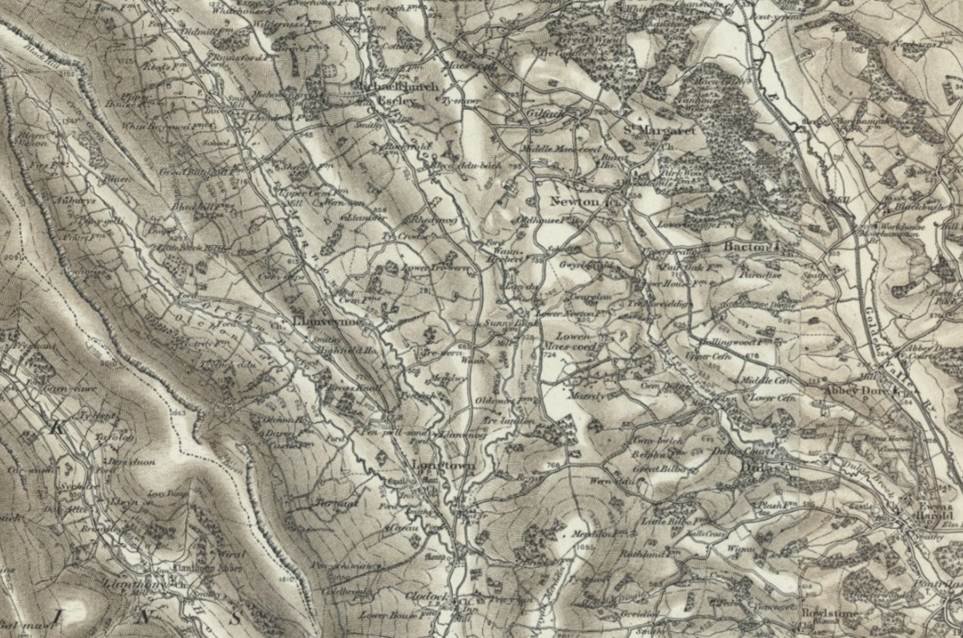
Early Maps
Observations:
This paper was written in 2025 by the owner of Maescoed Farm and is reproduced here with his kind permission.
Ref: rs_nwt_0082