
Title: | Digital Archive: Booklet “In the Shadow of the Back Mountains” Volume 1 |
Date: | 2007 |
Introduction:
This booklet was produced as part of an Oral History project sponsored by the National Lottery Heritage Fund and conducted by members of the Longtown and District Historical Society. It is reproduced here with their kind permission.
Ewyas Lacy Study Group
IN THE SHADOW
OF THE
BLACK MOUNTAINS
Memories of childhood
and schooldays
in the parishes of the Ewyas Lacy Hundred
of Herefordshire
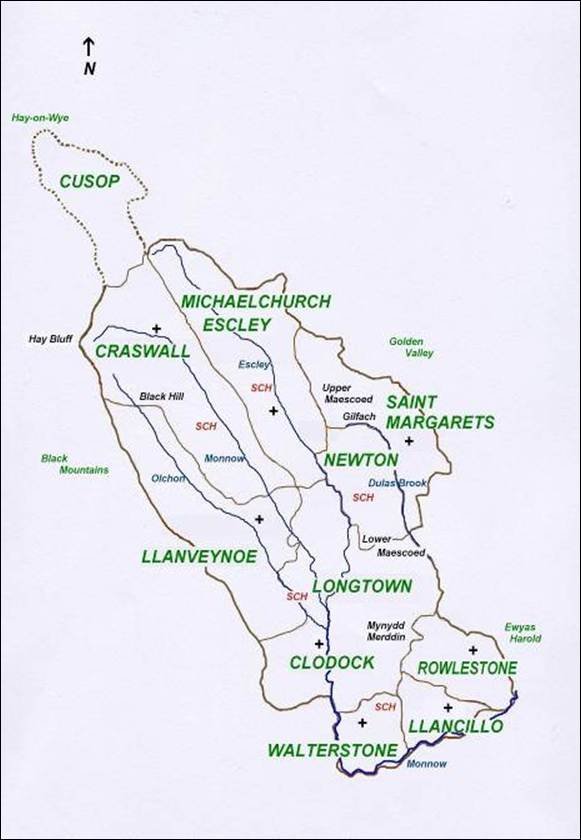
EWYAS LACY (Sketch map – not to scale)
IN THE SHADOW
OF THE
BLACK MOUNTAINS
VOLUME ONE
Memories of childhood
and schooldays
in the parishes of the Ewyas Lacy Hundred
of Herefordshire
Longtown & district historical society
oral history group
Published by
Longtown & District Historical Society
Sunny Bank Farm, Longtown,Herefordshire, HR2 0LY
United Kingdom
Copyright © Longtown & District Historical Society
First published 2007
ISBN 978-0-9557939-0-5
All rights reserved. No part of this publication may be reproduced, stored in a retrieval system, or transmitted in any form, by any means, electronic, mechanical, photocopying, recording, or otherwise, without the prior written permission of the publisher.
Longtown & District Historical Society has made every effort to trace the copyright holders of material reproduced in this publication, but should any copyright have inadvertently been infringed, then sincere apologies are offered.
Printed and bound by Print Plus, Widemarsh Street, Hereford HR4 9HN
“In the Shadow of the Black Mountains” is based on interviews carried out between 2004 - 2006 in the villages of Clodock, Craswall, Cusop, Llancillo, Llanveynoe, Longtown, Newton,
Michaelchurch Escley, Rowlestone,
St Margarets, and Walterstone, which were included in the former Herefordshire Hundred of Ewyas Lacy.
Produced in 2007 by the members of the Oral History Group:
Lynda Cecil, Bob Davies, Jenny Davies, Don Davies,
Christine Hortin, Jenny Houston, Pauline Jones, Ruth Parry,
Clive South, Graham Sprackling, Judith Stone, with the help of
Eric Locke, Graham Cole and Brian Wells and based in part on transcriptions by the late Beryl Turner, to whose memory
this book is dedicated.
It forms part of the
Longtown and District Historical Society Oral History Project,
which was funded by the
Heritage Lottery Fund.


LIST OF CONTRIBUTORS/INTERVIEWEES
Kathleen Ball, Gladys Christopher, Audrey Crowte,
Olwyn Fletcher, Phyllis Gwilliam, Olive Howells, Tom Howells,
Sylvia James, David Jenkins, Beattie Lewis, Bill Lloyd,
Jim Maddy, Joyce Moses, Marion Powell, Olive Powell,
Jack Pritchard, Mabel Pritchard, Winifred Reece,
Maggie Watkins, Peggy Watkins, Trevor Watkins,
Beris Williams, Cecil Williams, Gwen Williams,
Jim Williams, Valerie Wrigglesworth.
We express our thanks to all the above and also to the people who loaned the photographs and illustrations, thus helping to bring to life the world of school and childhood in our area around sixty years ago:
Julia Birley, Gladys Christopher, Olwyn Fletcher,
Phyllis Gwilliam, Jenny Houston, Sylvia Howard,
Marion & Brian Jones, Anna Lippett, Margaret Price,
Winifred Reece, Pat & David Smith, Hilda Watkins,
Beris Williams, Dolly Williams, Frances Williams.
CONTENTS
Introduction
Longtown School:
Mabel Pritchard, Gwen Williams,Jim Williams,
Marion Powell, Peggy Watkins, Cecil Williams,
Audrey Crowte, Valerie Wrigglesworth.
Newton School:
Maggie Watkins, Jack Pritchard, Joyce Moses,
Winifred Reece, Olive Powell.
Michaelchurch School:
Gladys Christopher, Phyllis Gwilliam,
Olive Howells, Sylvia James.
Craswall School:
Jim Maddy, Trevor Watkins, David Jenkins,
Beattie Lewis.
Walterstone School:
Bill Lloyd, Olwyn Fletcher, Kathleen Ball.
Non-attendees at the schools listed above:
Beris Williams, Tom Howells.
Out of School
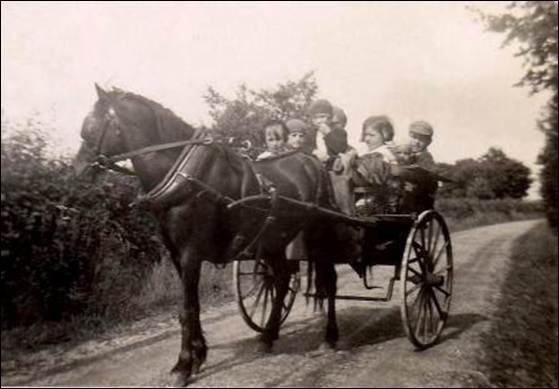
Front Cover: Mrs Watkins, Wigga Farm, Rowlestone and young passengers.
INTRODUCTION
For countless years people have farmed on the Herefordshire side of the Black Mountains and passed away, together with their memories. Rural life has changed rapidly over the last few years so, in 2004, the Longtown Historical Society applied for a grant from the Local Heritage Initiative to enable its Oral History Group to record what may be the last generation in the district to earn its living mainly from the land. The material resulting would be made available on CD and in booklet form. The group decided that its first publication would cover the period when those interviewed were growing up, effectively the years between 1920 and 1950, and would concentrate on their school days. There were village schools in Craswall, Longtown, Michaelchurch Escley, Newton, Walterstone and Cusop. Unfortunately we were unable to contact anyone who had been to the last mentioned. The accounts are presented in chronological order and use the words of those interviewed, although there has, inevitably, been some editing of material. The editors’ comments are in italics.
We include accounts from people whose interviews had been transcribed by December 2006. The next booklet will cover farming and working life, in which we hope to include the memories of the other participants. We would like to thank those who so readily agreed to let us record them and all those who loaned us their photographs.
RURAL LIFE IN THE PERIOD
The parishes we cover lie in the old Hundred of Ewyas Lacy, an area of some fifty square miles, with a population, in 1931, of only just over 2000. Many of our interviewees grew up on small mixed farms. They were expected to help, and for those who later took up farming, what they learned from their parents may have been as important as anything they were taught in school. They became used to looking after the sheep, cattle, poultry and pigs. Some worked with the horses, tilling the land for arable crops which included wheat, barley, oats, swedes and potatoes. Many of the products were used for animal feed on the farms, which were largely self-sufficient. To the modern eye this way of life might seem idyllic, but in fact, earning a living was not easy, for farming went through very difficult times for much of the period.
The 1937 Kelly’s Directory shows that nearly all the villages had craftsmen of some kind to supply the needs of the farming community. There were blacksmiths, boot makers, butchers, carpenters, tailors, threshing machine proprietors, wheelwrights, and the County’s only listed licensed travelling hawker, George Cook, lived at St Margarets. Several mills were mentioned, including Charles Lewis’s at Michaelchurch (phone Peterchurch 54), Richard Bridgewater’s at Pontynys and Oliver Davies’s at Rowlestone. Longtown had the greatest variety of trades and, in the pre-supermarket days, its general stores supplied the villagers with goods. Three Longtown shops are mentioned, run by James Wheeler, Elizabeth Prothero, and Warren Lewis (the Post Office). There were rather more pubs than there are now, including the “Three Horse Shoes” in Craswall, the “Sun Inn” at St Margarets, two “New Inns” and the “Greyhound” in Longtown. Medical services were provided by the celebrated Dr William Holmes Morgan, or the equally well-known Dr George Boraston McMichael of Vowchurch, son of a famous local doctor whose family practice dated from 1896. District Nurses were also familiar figures; one of the best remembered being Nurse Mabel Cook. The influence of Chapel and Church of England was very strong. Sunday School was important in the social life of many of the younger children, though the Young Farmers’ Clubs were of more interest to the teenagers.
Although change may have come more slowly to rural areas than to urban centres, new technology was beginning to alter people’s lives in the Black Mountains. Today we take so many of these developments for granted that it is easy to underestimate the impact they had when they first appeared. Improved transport was, for example, very important. Bus services had begun to operate some years before, making the traditional carriers redundant. The bus opened up job opportunities in local towns, at least for those in some of the villages. By 1941 there was a garage in Longtown to cater for the growing number of private cars, though for young people the bicycle was much more important than the car in ensuring a good social life. The provision of mains electricity and water supplies was still twenty years away for the majority, but in Longtown there was a hint of what was to come, for the Dore and Bredwardine District Council was supplying water by 1941. Traditional production methods were changing too. To take one example, figures from the 1941 Kelly‘s Directory suggest that the number of water mills in the county had halved since 1913.
The biggest stimulus to change was the Second World War, which even affected places as remote as this. The war years saw many local women going out to work for the first time. New opportunities arose at, for example, the munitions factory at Rotherwas, the Pontrilas Munitions Depot, and Madley aerodrome. At Bacton there was an assembly line for the imported Allis-Chalmers tractors that were to revolutionize the rural way of life during and after the war. A major upheaval was caused by the arrival of evacuee children. To begin with, some came by private arrangement, such as the two who arrived in Newton from Abertillery on 11 September 1939 to stay “till the war’s over.” The official organised groups came later. The majority of the children came from Bootle near Liverpool, the subject of major air raids from August 1940 onwards. The bombing of early May 1941 led to the greatest influx. The Newton school logbook shows that forty-five arrived from Bootle on 12 May 1941, together with three teachers. Miss Menard was in charge, and with her came Miss Keeley and Miss Moore. Eventually there were 68 evacuee children in Newton. On 13 May eleven pupils from Bootle came to Craswall and were admitted to the school on 15 May. The encounter was an eye-opening experience for both sets of children.
THE SCHOOLS
Each school had at least two classes and three teachers. Although built for between 60 (Walterstone) and 110 (Longtown), by our period the average attendance was much lower, though increasing in wartime to include evacuees. The basic curriculum consisted of the 3Rs, plus some practical subjects such as woodwork, cookery and needlework. Some history and geography was taught; natural history was important and there was an emphasis on scripture. His Majesty’s Inspectors for Schools (HMI) visited regularly to report on progress and their comments give an indication of what their expectations were for rural children.
A 1934 HMI report for Newton said that reading and writing standards were good. There had been development of craft and flower gardening. Younger boys were taught geometry. It criticised the lack of cookery for the older girls. This situation was partly remedied on 12 October 1937 when eight older girls began a short cookery course at the Cottage Room, Michaelchurch. The HMI report in 1937 was more critical. The children were not up to scratch in arithmetic. Their recitation skills were poor and they found it hard to recite poems, or to discuss their reading. It was suggested that listening to more wireless talks might help. Their English, reading, and drawing skills were good. A report for Craswall (1937) stated “the boys and girls of the district are getting a training adapted to their needs. The girls now receive a course of cookery at a centre, but there is as yet no handicraft instruction for boys beyond that which the Headmistress is able to give.” The Inspectors commented on the fact that part of the playground had been resurfaced and that the boys had worked on a project which made the approach to the school attractive. They also noted that each child had been provided with a towel and toothbrush that were used daily under supervision. The Director of Education liked the report and praised the teachers, Mrs Wright and Mrs Proctor.
The Longtown school logbook gives an indication of other aspects of school life at the time. A striking feature is the record of poor attendance, predominantly through bad weather and illnesses, which included measles, mumps, chicken pox, influenza, whooping cough, scarlet fever and diphtheria. The Medical Officer closed the school for a fortnight when there was an epidemic. This seemed to be a regular occurrence. HMI reports: “school work is being seriously interfered with”. There was always poor attendance on Abergavenny Fair Day in May, at haymaking time and “feathering week”.
The above highlights two important aspects of school life. Firstly, the risk of illness meant that hygiene was seen as very important, and the log books note frequent visits by nurses and the much feared dentists. Secondly, parents everywhere kept their children at home to help at busy times. The result was that Mr James Tovey, the attendance officer appointed in 1926, was a very familiar figure in the area!
During the period covered, some eleven-year-olds had gone to secondary schools in Hereford or other towns, but most pupils had stayed in their village schools until they left at the age of fourteen. The 1944 Education Act not only raised the leaving age to fifteen, but also led to the creation of secondary schools for all, though progress was slow in south-west Herefordshire. The building to house Fairfield High School, Peterchurch, was purchased in 1946, but the school only opened in 1951 with Mr Baxendale as its first Head. Kingstone opened in the same year. In the interim, the teaching of the older pupils was concentrated in selected village schools to ensure they got an appropriate education. However, as will be seen later, not all children attended school.
Our material covers only a short period, but the young people had lived through dramatic times. We hope you will enjoy reading their recollections, as much as we have enjoyed listening to them.
The story begins with accounts from children who attended Longtown school.
LONGTOWN SCHOOL
There was a school in the church in Longtown in the eighteenth century. The ‘old’ school, now converted into houses, was built c1869 by subscription, with control vested in six managers. There was space for 110. The infants’ room was extended in 1895. The maximum number on the roll during the period 1921-1937 was 86 (1922) and the minimum 61 (1928). Mr Belfield was head during most of the inter-war years. Mr Crowte's period of office was 1941 -1961. He was replaced by Mr Flawith who transferred from Newton School on its closure. Miss Florence May Lewis (who later became Mrs Gwillim), a “Trained Certificated Teacher”, joined the school in October 1922 and left in 1961. She is the one who is in the photo of girls swimming in the river. The old building served the village well until the present school was built. An entry in the school logbook, circled in red, reads: “March 12th, 1979, children enter new school building”. There were 52 children attending the school in September 2006 from a catchment area of Longtown, Clodock, Lower Maescoed, Llanveynoe and part of Craswall. Some children walked or cycled but the majority were brought to school by car.
MABEL PRITCHARD (born 1899 at Pen-y-park, Michaelchurch):
Her family moved to the Brooks, Longtown when she was three or four. Mabel’s earliest memory of the move was ‘the cats making a noise in sacks as the old yellow wagon bounced about on the bad roads.’
Schooldays
Like most of the people we talked to, Mabel walked to school. ‘I walked there across down by the Tan House. It took over fifteen minutes. It was downhill going, but uphill coming back, so it took longer coming home‘. ‘There were about 110 children in school and I was there until I was thirteen. I could read and write and add up. We had sewing lessons which I loved, but no cooking lessons.’
On leaving school Mabel went to work on a farm to look after the children. She returned home to help her parents when her brother had to go into the army during the First World War.
JIM WILLIAMS (born 1918 at Upper Turnant, the oldest in a family of nine. Lessons didn‘t figure much in Jim‘s memories, but he seems to have enjoyed games!)
Getting to School
‘We had to walk to school a mile across fields over Olchon Valley via Cayo Bridge. Sixteen kiddies came to school over that bridge. Many were poor children and they were never all there because they worked on farms. The Head Teacher said they would have a party or a day off if they all turned up. I used to catch moles for different people on the way to school and they would give me two pennies for every tail that I showed. I would be late sometimes and the Schoolmaster said “I wish you would be finished with them mole traps“. In winter we used to take a penny on a Monday morning for a cup of cocoa. Ones off the farm had a drop of milk and some a bit of sugar. The biggest mistake was that I wasn’t sent to school enough, but I was kept at home to work in them days. I was telling someone about my father being summoned twice for not sending me to school, and he said “I can beat you. My father was summoned three times for not sending me to school“. Judge at Abbeydore fined him 5/- (25p) the first time, 7/6d (371p) the next time and said ... “Don’t you think you’re making a mistake not sending these boys to school?” His father said “Leave it to me, I’ll educate the young b**rs“. We had to learn the hard way.’
However, one pupil at least, never missed a day and possibly was rewarded with a watch!
Lessons
‘There were 130 children in the school, with four teachers. The Head Teacher was Mr Belfield and there was a teacher named Miss Florrie Lewis. The school had two gardens. There was ten to twelve spades, and the big boys were sent outside to dig these gardens and grow a lot of vegetables. There were four boys from Clodock who came to school who never had any dinner and Mrs Belfield cooked the vegetables for their dinner.’
Games
‘There was enough of us boys for two football teams, eleven on each side, and we went out once or twice a week. The schoolmaster played on the one side. Mrs Lewis had enough girls for a hockey team. We had one hour for dinner and in summertime the girls mostly went to the one brook and we went to the other - either the Olchon brook or the Escley brook and dived in without any clothes. The boys mostly went to the Monnow where we bathed in the millpond. Sometimes if we both went together, we got into trouble with the girls for bathing in their brook.’
‘Now and again, the schoolmaster had a game of Fox and Hounds. He picked four of the biggest boys to go fox right across the countryside, giving them ten to fifteen minutes start. They used the alphabet cards from the classroom - about 6 inches square - for the scent of the foxes. You started off with A and when you turned off the road or went over a different stile, you dropped one as a scent for the hounds who had to find them.’
Horses loomed large in Jim’s life, so it is not surprising that he enjoyed another activity, not approved by school. ‘Something we wasn’t supposed to do was riding unbroken horses at dinnertime. George Johnsoncame from Llanwonnog with his father and brought down a lot of working horses, and Wilfred Powell from Dolward. Three or four of us boys went up in Penbailey Meadow behind the police station in Longtown and drive these horses into a shed, shut the door on them, get up on a big rack, jump on each other onto the horses, and just loose them out the door. One day one went over the top of the hedge and fell on top of me and my foot has never been right since.’
The War Years
‘I can remember the evacuees came into Pontrilas on the train from Bootle and other big towns. Mrs Barker had been round before, and she come to the lady I was working for, Mrs Welson (Wernddu) who was then 80 years old, and she didn’t have any of the evacuees; she was too old and couldn’t look after them. I didn’t blame her. I remember Mrs Barker taking them to adjoining farms, dropping a few here and a few there at all different places. My neighbour down here said there were too many up round the school at Newton so they sent teachers to teach them and had school in two shifts. Local children in the morning and in the afternoon other teachers took over to teach the evacuees and this went on throughout the war.’
Jim worked on the farm while still at school. He continued to do so after leaving and also helped to bring up the other children after his mother died. He left home when he was eighteen.
MARION POWELL (nee Wheeler, born 1922 at Glyneath House, Longtown):
Lessons
‘There were two teachers, plus one supply teacher for the infants. There were 98 children in the school ... as we got older we used to help in the infant class when there was a new intake and some of them were a bit difficult. We used to help with the reading and that sort of thing. There were about thirty children in the class; the Headmaster kept us all in control. They were very happy days. My best subject was needlework with Mrs Gwillim (then Miss Lewis). I didn’t like arithmetic very much, but I liked history.’
Games and Outings
‘There were two yards at the school; one for the boys and one for the girls and we used to play on the Green. We had to be careful crossing the road, but it didn’t matter too much then as it was mostly horse traffic on the roads and a few motorbikes dashing up and down. We used to skip rope across the road and there was cricket and hockey on the Green and the boys used to play football in the winter - a bit rough, not proper football to my knowledge. The school had a home-made maypole and we had wonderful times with that. Miss Lewis used to teach us how to do plaiting. I don’t think it was very successful but we used to enjoy it. We used to have a day up the mountain. We would take our food and cups to have a drink. When we got to the top of the mountain we lit a fire and boiled the kettle. We picked whimberries but did not take many home! It was a wonderful day out - lots of fun. Not every year, but up until I was twelve or thirteen. They put the cups and utensils in what we called a washing basket - a wicker basket with handles at each side and my friend and I were carrying this basket, which was heavy. Some of the boys used to get up to some quite awful pranks and of course the bracken was very high then in the summer, and this particular boy hid in the bracken and jumped out at us and we dropped the basket and tipped all the cups and plates out. It was very steep and the plates and cups were going down the path and we were mortified. Some of the cups and plates were broken. We threw them in the bracken and gathered up the remains. I don’t think anyone realised what had happened and we didn’t get into any trouble!’
The War Years
‘Longtown was full of evacuees from Bootle, Liverpool, as it was bombed very heavy there. The evacuees fitted in very well. A few of them have come back at different times. There weren’t any problems with them. Rev Loadman at Llanveynoe Vicarage had a house full of evacuees. He used to bring their ration books down in his little suitcase to get their rations from mother at the shop. They were all nice children. Mrs Johnson at the Sun had some, Mrs Thomas who had no children, she took some in, and Jones at Ponthendre had three, Mrs Johnson had three boys there. One of the boys had asthma very badly. He looked awful when he arrived here, and by the time he went back home, he looked a different child. Good home cooked food and home made cakes and all the rest of it. Being in this area had a good effect on the health of the evacuees.’
Marion left school at fourteen to help at home and at her grandmother’s guesthouse.
PEGGY WATKINS (nee Margaret Williams, born c1925. Peggy lived at Middle Ponthendre until her marriage. She had two sisters and a brother, and she was the youngest. The four of them walked to Longtown School):
At School
‘We had different teachers of course in the infants. They seemed to come and go quite a bit, but the other teachers were Miss Lewis and Mr Belfield [Headmaster] and he was a very strict sort of man ... very much on your manners, and how you behaved. He didn’t teach us a terrible lot, or he didn't teach me a terrible lot, otherwise. There was a junior teacher first and then you went into Mrs Lewis’s class, and then on up into Mr Belfield's, and then of course Mr Belfield retired and Mr Crowte came as Head Teacher. ‘On a Tuesday we used to go rambling. This was with Mr Belfield, and we used to go all up around, and all up the mountain road, and he was very much into that kind of thing, going nature, better than teaching us I think. We were getting out of school weren’t we, and learning? Mr Belfield seemed to know about everything it seemed to us.’ She did not enjoy arithmetic much. ‘You had to learn your tables, that was the most important thing. If you didn’t know your tables you couldn’t do your sums in those days.’ Failure to learn brought a telling off. She never had the cane but did have “a few flips.”
The War Years
‘I think they (the evacuees) came to Pandy by train, and they were ferried up to Longtown by bus up to the hall, and all the locals were there, the mothers anyway, ... and they were allocated out, according to how many you could manage in your home. They looked at how big your house was. I know we were allocated three, a family of three, elder girl, then a boy and then a little girl. She was only about five, she was quite young; they went back within two years, I would think. They took a lot of settling but their parents did come to see them occasionally, they were a good family, but I suppose the time to come and the expense ... and everything. They came when they could and stayed with us.’ After a while the evacuees settled in, and both Peggy and her husband Trevor agreed that their respective families had enjoyed having them, but it was ‘More work. They did have money to keep them. More washing and everything, no washing machines, (just) the old copper. You got the boiler going. You got the sticks.’
Teaching arrangements for evacuee children varied - the following system was used in Longtown: ‘They went to school in the hall. They were a whole lot of children ... they would be a hundred or more probably. I don’t know the figures. Their desks came, and three teachers and they had their schooling in the hall. It was set up as a school.’
Peggy left school when she was fourteen, and went to work for Mrs Lewis at the post office for 7/6d (371p) a week. Her duties included delivering telegrams, which sometimes concerned the evacuee children. Sometimes she had to go to help people use the new phone kiosk outside the shop, for new technology proved daunting to some. Later she worked at a children’s home at Hoarwithy for a year, catching the bus at Pandy.
GWEN WILLIAMS (born 1925 at Mynyddferdyn):
Getting to School
‘I went to school down in Longtown ... about three and a half miles away. In the winter months we had a nice closed-in stove with an iron guard rail round it. If we were early we’d stand around there and have a warm before lessons began.’
Lessons
‘There were three classrooms, I think. There was the Infants Room for the first stages and then the middle class. I’m not sure what that was called, and then the top class. The teachers were excellent I would say. Miss Florrie Lewis was an excellent teacher ... quite strict but very, very good. We always went for nature walks, when we were a bit older, in the top class. And if we were coming over this way Mr Belfield were very good, he let us come on home and not go back to school then back again. I think writing or reading was my favourite lesson. I was never an expert at maths. I used to do them but I didn’t enjoy them.’
Games and Outings
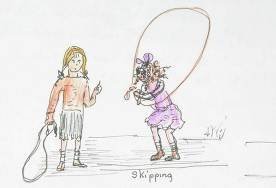
‘We had proper games with Miss Florrie Lewis ... hockey for girls. I used to love playing hockey, that was one of my favourite games ... and cricket also. The girls used to like to play the boys at that. When we played at dinnertime, we would play hopscotch and tag. There used to be a little stone at the end of the school wall where one used to hide their eyes and count to one hundred or whatever. We used to take a bit of money each week when we were going on a trip. Months ahead we used to save it up, a few pence it would be in that day and age, tuppence, three pence or sixpence at the most and then when the trip came we’d have our kitty ready to go on the outing. We went to the chocolate factory (Cadbury’s) once upon a time and Dudley Zoo and Max Factor. We went to the three places in one day, Tewkesbury, Cheltenham and Gloucester, England’s Glory matches.’
The War Years
‘I can remember rationing when we used to have coupons for sugar. I haven’t got a lot of terrible memories. I had a brother in the air force. Clothes were rationed. We made butter.’
After leaving school Gwen eventually became a postwoman.
CECIL WILLIAMS (born 1927 at Quarry House. Cecil was interviewed with his sister Gwen, above):
Lessons
‘I was quite happy at school ... some lessons I enjoyed and some I didn’t. Reading was my favourite and geography was my worst. When the war started in 1939 Mr Belfield said that everyone had to ‘Dig for Victory’ and we took an eighth of an acre of a field of Mr Pritchard’s, Pen-y-dre. We converted it into a garden and planted potatoes. I think we grew about a ton and we sold them around the village. The garden was very hard work. It was at the back of the castle and it was very rocky ground and we dug it a yard at a time. There was a teacher, Mr Crowte, that some of the boys didn’t enjoy the lessons of, so he got them to look after a pig. They would let him loose so that they could spend lots of time getting him back and avoid lessons.’
The War Years
‘We had evacuees who came from Liverpool. There were woodwork classes in the Hall at Longtown but when the evacuees arrived these stopped because the Hall was needed as another school. They brought their own teachers and some of the teachers taught me and my class. They were very good teachers. We went to school all day still as we had the extra classrooms in the Hall. I don’t think the evacuees enjoyed their stay here as they were a different class of people. They were nice but they didn’t like our way of life. I’ll tell you what they were good at - they were good at cricket. They were miles better than us. We got on OK with them but some were homesick and sneaked off home. The billeting people came round our houses to see how much space we had. Some had one, some two - it was very crowded.’
As it was wartime, Cecil was allowed to leave school at thirteen to work on the farm.
AUDREY CROWTE (born 1936, was the Headmaster’s daughter):
‘As a family we came to Longtown in 1941. My father had been evacuated to Derbyshire with school children and then he got the opportunity to come to Longtown so that our family could be together. My father was the Headmaster of the village school so we lived in the school house.’
Lessons
‘The school had three classrooms but two of them could be joined together because it had a concertina-type wall which could be moved backwards and forwards. I was five years old when we moved to Longtown so I was in the infants’ class. My first teacher was Miss Musker. After that I went to the evacuee teacher Mrs Mercer and after that to Mrs Gwillim who had been there before we moved to Longtown and went on there until she retired, and after that of course I went into my father’s class. We had our PE lessons on the village green. I made lots of friends amongst the children at the school and they were very happy days.’
The War Years
‘At the time there were a lot of evacuees from Bootle living in homes in Longtown, so the school became quite big. Mrs Mercer, the evacuee teacher lived at the vicarage and she used to come to another house to have her meals. There were three classes in the school itself but at one stage we had two extra classes in the village hall. The two classes had to sit back to back so that we didn’t disturb each other. I can’t remember any kinds of upheavals - big punishments - although there were one or two of the evacuee boys who were perhaps a little bit hard to manage sometimes because in those days of course the children were there until they were fourteen years old. Longtown did their bit towards the war in that many people opened their homes to evacuees, and of course they were in Longtown school when my father arrived. I made friends with a lot of the evacuees and we all lived together happily. There was nothing between the children, we all gelled together very well.’
Audrey went on to train to be a teacher in London. After two years teaching in London, she returned to teach in Hereford.
VALERIE WRIGGLESWORTH (nee Watkins, born 1939. Moved to Beili Bach, Llanveynoe in 1944):
Getting to School
By the time Valerie started school in 1944 the authorities had arranged some transport: ‘We had to walk over a mile to a spot where they picked us up in a car. It was an old taxi. Mr Powell from the garage in Longtown owned the taxi. I can see it now - a very dark blue with a seat in the front, but the seats we sat on were two benches, but they weren’t fixed to the floor - but happy days! Later on the walk was shortened to the farm at Glandwr where Mr Arthur Watkins lived. We would change our Wellington boots and put our shoes on there, because it was all rough roads and a few of us had to go across fields.’
Lessons
‘The Head Teacher was Mr Crowte, and Mrs Gwillim ... and Miss Prosser (now Mrs Williams) taught the infants. The Headmaster was a very happy man. The playground was at the back of the school, where the toilets were. They were water closets because there was a stream running at the back there, but the main playing area was on the village green. The castle was immediately behind the school and we were taken for walks around there and around the lanes. Mrs Gwillim was particularly good teaching us about nature and flowers and all the rest of it that children in the country would learn.’
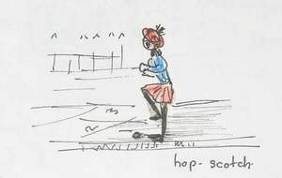
NEWTON SCHOOL
The school was built in 1870 for 120 children, with residence for a master. The children who attended came from Newton, Bacton, Dulas and St Margarets. Average attendance was 44 in 1932 and 46 in 1933. In May 1941 there were 51 local children and 56 evacuees. Among the long-serving teachers were May Jordan (1910-1937), Annie Dunabin, Headmistress (1932-1940) and Miss F Evelyn Willetts, Headmistress (1940-1945). The school closed in September 1961 and has since been converted into houses.
MAGGIE WATKINS (born 1925, started school at Ewyas Harold but transferred to Newton School in the Thirties when the family moved to Shop Vach at Lower Maescoed, where her father farmed, and ploughed for other farmers with his team of horses):
Getting to School
Maggie walked to school from the common. She and her friends walked in all weathers. ‘When it was fine we’d go across the fields. When it was raining or snowing we hardly ever missed a day - you had to go and have your mark even if you was sent straight back home - we used to walk all the way round the road then to Oldcourt turn, all across the top.’
Lessons
‘Well, I think you do go up to about Standard 4 and that was it. You had two rooms. The one room was for the little ones Miss Jordan used to teach; she was a lovely woman, oh! she was. I got on with her like a house on fire but after, you go up into the other room, Standard 1 or something. Then you did all muck in together, like. There would be at least three classes that they’d have to teach all at the same time (sat at long desks). I reckon when I think about it, some of them teachers was good to manage it, weren’t they? I mean today they’ve got different teachers for different subjects for different classes haven’t they? I do think sometimes that those teachers must have been excellent to manage it all through. Nature Study, we used to go for a walk across somewhere to do the nature course, but on the other hand, a lot of children was up to nature because they was reared in it, weren’t they? I know girls when I went out when the war was on, they didn’t even know what a primrose was! We was reared up with all that, we knew what every thing was, so I suppose it’s a way of life. I wasn’t very good at maths, I can tell you that, although I used to do it.
I loved school; if my mother wanted me to stay at home to help her with summat I’d fret ‘cos I wanted to go to school. They used to go down to Pontrilas market and if there was something she wanted looking after at home she’d want me to stop home like, but it didn’t go down very good to me when I couldn’t go to school. I know a lot of children then didn’t like school and I didn’t know why. My youngest sister didn’t like school. I did try to do my best but my best wouldn’t be good enough I don’t suppose.’ Maggie remembers: ‘We did all muck in together. There was no “cliqueyness” like there is today. There was Edwin Smith, he was from Newton but of course he died a year or two (ago) now. There was another boy, Jack Pritchard. I remember meeting him in Ewyas Harold and we was talking. He said “do you know there isn’t hardly anyone left in the class you and me was in, they’ve all died out except us two.” I left at fourteen. Well, once I had my fourteenth birthday, I was at home working! I wasn’t supposed to be - not ‘til the end of term.’
Games and Outings
In the playground: ‘We did have a long rope and get quite a few in the middle, then you used to jump out and then jump in without stopping the rope. Trips were ‘very rare. We went to the Three Counties Show. They give the school two or three tickets and I was one who had a ticket. We went on the bus. My father had to come with me, he wouldn’t allow me on the bus on my own. I don’t think we went on many trips. Children at Longtown used to go on a lot more, but for some unknown reason we didn’t. I suppose it’s up to the schoolteachers, the schoolmaster at Longtown, Belfield. I heard my husband saying about him he used to take them on trips. Now we never had that so much at Newton. We had Sports Days - that was another thing I used to love - sports. My grandchildren now, oh! they didn’t like sports, didn’t like running. I said I used to love it! I did, you know, the jumping, sack races ... ’
JACK PRITCHARD (a contemporary of Maggie Watkins, they attended Newton School together):
Getting to School
Jack walked from Middle Rock: ‘I’m pretty sure I went from the old house to the school for a while. I’m not honestly real sure about Cae Garw because things happened quite quickly - in about twelve months (Cae Garw was next to the school) oh yes, quite a difference. I can remember walking - it was more than a mile and wearing my shoes out, kicking an old rag to school, an old rag ball - kicked my shoes out as well and having it repaired by the local shoemaker, Mr Ruck, who was there at the time. He lived in Newton look, close to the chapel, the place that belongs to Mr Pool and Mr Price, New House. He was the local cobbler - and I used to kick the toe off and he used to put a big lump back on and I’d kick it off about the first hundred yards on the next journey to school. It looked very good before I put it on but I soon had it off and a few remarks off father that went with it like! These things come to mind - a lady teacher, Mrs Dunabin was the Head Teacher (and her assistant was) a local lady, Miss Jordan from close to St Margaret’s Church, the Fountain we called it then, I don’t know what they call it now - on the bad bend. Bill Jordan - he’s just died - his mother kept the pub. Miss Jordan was definitely a relative, though I don’t think it was a sister but possibly more an auntie, I’m not sure. But that’s my first memory of going to school. We used to walk together. She used to come down by The Rocks where we lived, my old home then, where I was born and we walked together, so we were in good company!’
Lessons
Jack experienced the iron hand of Mrs Dunabin: ‘I had the cane occasionally; I just forget what (for). I wrote on somebody’s book one day and had it for that. She was pretty strict, this good lady was really ... She just did it on the hand (the cane) as close to the end of the fingers as possible - not across the hand actually. I used to like writing and sketching, they were the two things I liked. I wasn’t any good at mathematics. They were good old days! We had a maypole amongst other things, and that was a bit of a laugh. If we wound it up correctly we wouldn’t unwind it so - you know. That was something I remember, we’d possibly wind it up hopefully correctly - a proper manoeuvre to get a proper pattern on it - but it had to be unwound as well. If someone made one mistake and you’d bottle it all up, it was cancelled then until it was unravelled.’
Jack kept in contact with some of his schoolmates after starting work, but as the years have passed, he comments: ‘Some went a distance away - I haven’t seen them since and some of course aren’t here any more, they’ve gone on. They are getting rather less now to visit or see. There’s Dible (Gwilliam) from the Tan House; he lives at Pontrilas now. He sent me a photograph when I was about, I don’t know what age. He said he thought it was bound to be a photograph of myself, and it was ‘cos I’ve got a photograph here like it. That’s the last recollection I have of being in touch with any schoolmates.’
JOYCE MOSES (born 1931 at Pontys Mill where she still lives):
Getting to School
‘I started at Newton School when I was six. We had to be there at nine, and we had to walk about two miles, most of it uphill. There was no transport, and if it was raining, you just had to walk and get on with it, rain or shine. They had a bell outside on the school which rang at 8:50, and if you were half a mile away, you had to put your best foot forward. We all used to go together, some faster than others. We could go over the fields, because our ground goes up to the top of the hill, and if it was fine we did go over the fields, and sometimes if our father was with us, we used to go with him because he went to the top of the hill to milk the cows. My grandparents lived at the little cottage by the school and they used to watch out for us to make sure we did not hang about as we were “dead keen” to go!’
Lessons
‘We took sandwiches, and when we got to school the first thing we did was Assembly; prayers and someone did a reading from the Bible, and then we had a hymn - nowadays I don’t think they have much. After that we probably had arithmetic. My favourite subject was English - I was quite good at writing compositions. There were three classes. Class 3 was the infants, and Class 2 and Class 1 were both in the same room. We had two rooms and three teachers. The one room was quite big and it would be very cold in the morning. It was heated by a big stove. Mrs Pritchard, the lady that lived up there, came every morning to light the stove. It was one of those big tall stoves; by about mid-day it would be red hot in the wintertime. If you’d got wet, your clothes had to dry over the guard of the big stove. It always smelt a bit.’ The stove was a feature of school that many children remembered. It didn’t just warm them. They dried their clothes on its guard, warmed their drinks and even baked their potatoes! ‘We had one playtime, about quarter of an hour, we played games. To get to the toilet, you had to go outside, down the yard, round the corner. There were no indoor toilets. We were there until we were fourteen. We didn’t have homework in those days. If you weren’t very bright, you were left behind.’
Games
‘We used to have a lot of PT - arms stretch - I used to be quite good at that, but not racing. I was too slow; nearly always last. We had games - rounders, girls did a lot of skipping, hopscotch, played conkers, boys and girls. We used to celebrate Empire Day, and they sold little flags for that, and we used to always recognize all the different occasions.’
Discipline
‘The Head Teacher was a lady - Miss Willetts (married name Tovey). She was lovely. When I first started school Mrs Dunabin was there. We never had a Master; always a lady teacher. Always a lady Headmistress and she could whop the cane on you if you didn’t behave. I didn’t have the cane. I was pretty quiet. Too afraid to say anything. But she managed the children quite well. The discipline was spot on. She wouldn’t have no messing; of course. They didn’t in those days did they? Children had more discipline, they weren’t so cheeky.’
The War Years
‘When the evacuees came, we only went to school half days because there were too many for the school so one week we went in the morning and one week in the afternoon. They came from Bootle and we got on all right with them. A lot of them didn’t quite know where they had landed. They stayed a long time; teachers and all came with them. One named Miss Keeley used to walk up and down among the desks and if you didn’t behave yourself, that ruler would come down across your hands. We were all mixed together at school and got on pretty well. We used to have some kind of gauze stuff to put on the windows during the War to stop the glass shattering if a bomb fell. We had gas mask practice and all that business, under the desks, and what have you. You could write with the gas masks but you couldn’t see nothing, the window of the mask used to fog up.’ (An entry in Newton School logbook for May 1940 refers to an assistant teacher “allowing her pupils to pile their gas masks in a heap on a table, not close to them under their desks. She could give no satisfactory explanation of this disregard of rules.”)
When Joyce left school her first job was at Longtown Post Office where she earned 12/6d (62p) for a six day week.
WINIFRED REECE (formerly Jenkins, was born at Fern Verrow on the smallholding where her grandparents lived. She remembers Miss Powell, now Mrs Pettitt, the infants teacher):
‘She was an unqualified teacher in those days; she is 90 now and living in Hereford and still teaches the violin in the chapels and also sings. Miss Willetts was the Head Teacher; she was very good. In the school there was one little room and one big one with wood or coal burning stoves in both rooms. The kids used to stand around the stoves. Miss Powell taught in the little room and Miss Willetts in the big room. Mr Tovey used to visit Miss Willetts quite often, staying for a long, long time. Later he did marry Miss Willetts. We used to do National Savings collecting and various things for the teacher during the War, including knitting baby clothes and things for the soldiers.’
The War Years
‘The evacuees came from Bootle. They went to Newton School, but because there were so many children, we either went every other day, or some in the morning and some in the afternoon. I don’t know how our education went on, but we couldn’t all go together when the evacuees came to school because there was a great number of them. I can remember most of them were Catholics and a Catholic teacher came with them. I can remember seeing a pile of Catholic books on the table and some bigger girls sorting through them and throwing them about which I thought was awful. Of course, Catholic to us would be completely strange. There were a great number of children from Lower Maescoed come past our house to school and I did have a friend called Elizabeth Swanson. I think she went back but I never kept in touch with her. Funnily enough, at college our names and addresses were written up on the board, and one of the girls that had been an evacuee here, living about a mile away at the Woodlands, came to see me and to her amazement, I came from the area where she had been evacuated, but she was a London girl. I think one or two of the evacuees came privately, but most came from Bootle.’
Although Winifred failed the eleven-plus examination, she was fortunate in passing a scholarship that enabled her to take the School Certificate at Ledbury Grammar School:
‘Just after the War when I was about twelve or thirteen, there was a great boost for teachers. Teachers were very much wanted then. The young men came out of the forces and I think they only had to do a year’s worth of college. Apparently they had a spare attic room at the Grammar School, which was an old house, so they decided to have a scholarship for eleven to thirteen year olds to encourage them to be teachers and hoping the children would carry on to become teachers. There was about fifteen of us thirteen to fifteen year olds so we did our School Certificate in four years. There were five or six boys, who were a bit brighter than us girls, and they were pushed through in three years. Some became teachers, but one who went with me who became a teacher was David Smith’s brother (Ivan Smith). It was called “The Remove” in the Grammar School. I left college when I was seventeen or eighteen and worked as a unqualified teacher at Upton Bishop School where I taught infants. I then went to college. I didn’t get in at first at Wall Hall College, Hertfordshire, but I liked it so much I stayed on another year teaching at Upton Bishop, and then went to Wall Hall and after two years I came as a qualified teacher and taught at Bredwardine for three or four years.’
OLIVE POWELL (nee Prosser):
Getting to School
‘On the way to school there was a Mr Watkins who had a goat that used to chase us. And one day it could hear the children and came running up, so lots of us climbed the nearest tree. We were like birds on all the branches and this goat came and he’d got his front feet on the trunk and course when it came time to go into school and the headmistress rang the bell there were all these children missing so she had to come and rescue us. She had to get a dog from somewhere. The goat was really frightened of the dog. And that’s how we got back in school.’
Lessons
‘I enjoyed lessons but we also did knitting, sewing and cooking. The boys did woodwork. I went on to full time ... fifteen. You could stay on. You could do really what you liked. It depended on the Headmistress, really.’
The War Years
‘I remember about the evacuees mostly because my father was on the parish council and I remember him having to go to Longtown village hall because these buses were bringing all these evacuees. But before that everyone had to give an account of how big their houses were and how many spare bedrooms they’d got and how many evacuees they could take. Everybody came to the hall who were expecting evacuees and my father and Tom Ellis were in charge of the billeting of who went where. Some were very happy and some weren’t. I know of one family who are still friends and camp out where they had been billeted. I think they came from Liverpool.’
After leaving school, Olive worked at home on the farm for a while, then was accepted by a London hospital for training as a nurse. She worked at hospitals during the Blitz which was quite a change for a young girl used to country life. But she also had lots of fun and enjoyed her time in the big city.
MICHAELCHURCH SCHOOL
Originally built for 100 children, with a master’s house. Average attendance was 28 in 1913. The school was burnt down in 1938, was rebuilt and still exists today.
GLADYS CHRISTOPHER (born 1916 at New House in Michaelchurch Escley, now living at Rockfield House, Michaelchurch. Gladys started school at Michaelchurch at Easter 1921):
Getting to School
In common with most schoolchildren in the area, Gladys would walk to school across the fields with girls from the neighbouring farm. ‘My mother, she prepared me for school. When they were working in the fields by the road, she used to say: “Go down to the gate and wait for the children coming up from school“, because they all made a fuss of me, and I longed to go to school. When I was older and my mother let me come up the road from school with all the other children, we had lots of adventures then, picking apples out of people’s fields and things like that, and the boys would be going and pulling a swede out and eating the swede on the way home. Well, some of them walked a few miles to school; they’d be hungry I think.’
At School
Until she moved away, Miss Howard was Gladys’s teacher: ‘She was from St Margarets, a local person. And in the summer holidays, she invited us all over to her house to tea. We had games in the fields in St Margarets. That was lovely.’ Gladys remembered two rooms, one for the infants and a big room for the over sevens. ‘We had long desks in those days and benches - we sat on benches, and we had ink in the ink wells. And one of the boys - I had two plaits, and he pulled my plait and put it in the ink well. My mother wasn’t very pleased! He’s not with us any more, but he was a local boy.’
Lessons
‘I can remember the map of the world because I was always very interested in geography, and the parts that belonged to the Commonwealth were in pink, and of course the blackboards and chalk. We did more subjects when we got to [seven]. I don’t think we did history nor much about geography, I don’t think, before we were seven. I remember repeating my tables, and I still know my tables. Because, of course, they don’t learn their tables now, not like we used to, do they? Not up here they don’t. But if you weren’t ready, you stayed down …Yes, you had a sort of little exam, and if you weren’t ready you stayed down another year. Some of them didn’t get very far up, I’m afraid, which was rather - well, for them it was hard to have to stay down with the younger children, but that happened. I suppose the headmistress had so many pupils - she had more in the primary part.’
The children were split into different groups called ‘Standards’. ‘... If you got to Standard 6 you were quite good ... And the teacher that came when I was ten stayed at Michaelchurch for thirty years, and she left when my son was ten ... Miss Isherwood. She was from Manchester. And when she came here, she had a companion, who’d been through the First War, and she had shell shock, and she was shaking very badly. But when there was a vacancy in the classroom, she applied and she got the job. So there were the two of them in the school, which was lovely. And she was Miss Halliday her name was, and they were … one from Manchester and the other from Birkenhead. (They lived) in the school house. All the teachers then lived in the school houses.’ Gladys loved school and cried when she left. She considered she was passable at her schoolwork, her favourite subjects being maths, English and geography, but not sports! ‘We used to play cricket, and I hated it. I can remember feeling that ball now. I wasn’t too keen on any sport really ... strangely enough, I didn’t mind PE ... and I quite liked cross country - if we ever had it, but we didn’t get it very often - because that took us out of school a little way.’
SYLVIA JAMES (nee Howard, born Upper Crossways, 1926. Sylvia had three brothers; her father was a tailor and also ran a smallholding):
At School
Sylvia remembered her first day: ‘There was one little task I had to do: we had threads of wool, different coloured wool to sort out. We had to put all these threads into the same coloured heaps. I suppose that was to test our intelligence, when you think about it. However, at the time, when I had sorted my little lot of wool out into its separate colours, the teacher took them from us and mixed them all up again, and I didn’t think that was very much sense.’ Sylvia couldn’t remember having anything to drink except, possibly water. However ‘there did come a stage-I think it must have been in wartime - when we took bottles of milk, and we put these in front of an open fire - it was guarded of course - but we used to stand all our bottles in front of the fire to take the chill off.’
Lessons
She liked cookery which was taken by peripatetic staff. ‘What progressed my cooking interest was the school cookery classes, and I happened to catch two sessions. I caught one when I was just old enough to take it, and the other was just before I left school.’
In 1938 the school burned down. ‘It was quite exciting because the headmistress ... stoked the stove up for the evening, and it became so hot in the roof from the pipe from the stove that it went on fire. And the school was burnt down. The first news I had it was the baker came along on his travels, discovered it, and he told my father and mother, and I was picking stones up in one of the meadows at the time. And I’m afraid I was delighted. They got it arranged that we were able to attend what had been an old school many years ago. Part of it was underground. It was the Cottage Room at Michaelchurch which has been demolished now. It was called the Old School. So we attended there while the new school was built.’
‘When (the school) was re-opened, the first day we were in school, everyone was busy getting all the new things sorted out. And it happened that one of the younger ones, a seven-year old, was filling up her ink well and she spilled ink on the brand new floor, and I’m afraid it was too much for the Headmistress. The cane was one of the things that had been saved from the fire, unfortunately, and the desk had been saved - the cane had been in this desk. She broke the cane - I expect p’raps it was a little brittle from the fire -she broke the cane on this little seven year old, and I was up this time, having not been a favourite ever, I did think in my mind what I ought to do about it. But anyway, I would think p’raps it was the expression on my face, but the last six months I was in school, I was favourite.’
Games
She recalled a game they played. ‘I can’t remember the name of it ... where one person would lean against the wall and hide their eyes, and then the whole crowd of us would creep as quietly as we could, and they’d swing round and they had to catch us moving. If you were caught moving you were out.’
Sylvia commented on her school days, which ended in April 1940: ‘I didn’t really enjoy school too much. I enjoyed the company but I didn’t enjoy the Headmistress’s discipline.’
PHYLLIS GWILLIAM (nee Yeomans, born 1931 and lived at Coed-poeth, started school in 1935. The dramatic event of the burning down of the school in 1938 made quite an impression on her):
‘Something went wrong with the boiler or something, and the school burnt down in the evening about 5 o’clock. They took me to watch the fire from the aerodrome (the Traffords’ landing strip) and I didn’t know what to make of that. It frightened me, and Granny said I was sick next morning. It was quite a shock.’ Phyllis relates how the school was then held in the Cottage Room, a little lower down. ‘It was quite nice inside with one big room, but they was able to part it off. The infant teacher was Mrs Cole. I can remember down there. We had physical training out on the road, doing sort of exercises. We could play games out in the field. The Head Teacher was Miss Isherwood.’ Phyllis was not the only child to remember Miss Isherwood’s strictness: ‘You’d got to do as you were told or you got the cane. I got the cane once on the hand. If you were good and did good work, she might brag us up a bit. I remember being called out once because I was laughing, and of course I shouldn’t have been, and I had to stand in front of the class for quite a while. I think she had forgotten me. Then she said “Oh go and sit down, I’m sick of the sight of you.” I was a silly little clown.
I don’t recall how long we were in the Cottage Room. A new school was built quite quickly. It was the same as before, but the door going in was different. We were back to having two rooms and a playground.’ When the new school re-opened Phyllis recalled: ‘The Head Teacher gathered us all together there and told us it was all new, clean and tidy, and it was to be kept that way. We had to start everything from scratch. Arthur Jones was caned for spilling ink on the floor. There was no official opening. I don’t think the school was used for anything else, except maybe for WI meetings. On a Monday the boys used to go to woodwork class at Newton School. The girls did cookery, but I didn’t have cookery there because I went to this other school when I was twelve or thirteen.’
OLIVE HOWELLS (nee Travers, born 1933 at The Blainey, Cusop):
Getting to School
‘I started at Michaelchurch School in 1939 when I were six year old. I should have started at five but there was no transport as we lived in Cusop and it was a long way to travel, so I had to wait until the education people could organise transport. The first taxi that we travelled in was Price the Blainey (Michaelchurch Escley). I think that was the first car I ever had a ride in, or we had seen. It was a Morris. I can remember it very well. You used to fold the back door over and then put it back up. It was very old fashioned. The road had been improved because they had put down stone, but it was not very good. It wasn’t tarmac. I don’t think it was. It was a big snow we had in 1947/8 and I went to school for only two days between Christmas and Easter - the last two days before we broke up for Easter. It was completely shut because we had snow up over the gates and up over the fences and it was never opened.’
Lessons
‘I was at Michaelchurch the whole time. We had a very strict Head Teacher, Miss Isherwood. She used to keep us on our toes. There’s one thing I can say about it, there was discipline, there was discipline (sic). She used to say you’ve got to look after the school; you haven’t got to vandalise it. She was very strict but she was good. I started at the Cottage Room down below Michaelchurch. It’s not there now; it’s been taken down. I was there about a year, and then the new school was built and finished in 1939, rebuilt on the same site as the one that had burnt down. There were fifty odd pupils at the school all through my time there. I started at six and left at fourteen in 1948. The only things I can recall was when I was in school, Mrs Capper (Michaelchurch Court), who was living up here, used to come to the school regularly. If we did needlework and things like that, she used to come and inspect it. She was quite involved with the school.’
Olive left school at fourteen to do farm work. She met her husband, Tom, while working at Abbey Farm, Craswall
.
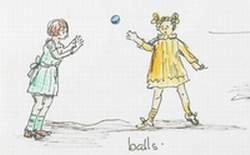
CRASWALL SCHOOL
Built 1876. Enlarged 1898 for 90 children. Average attendance was 35 in 1923, 30 in 1939. In September 1940 there were 26 children and six evacuees. Margaret Lilian Wright (Headmistress from 1923) and Dorothy Jane Proctor (appointed 1933) were two well-remembered staff. The school closed on 20 December 1957 and is now the Village Hall.
JIM MADDY (born 1920 at Little Cefn, Michaelchurch. Moved to Craswall Court, now Gilberts Place, in 1927):
Early Memories
‘My earliest memory now were when we were at Little Cefn. We went down to get some firewood out of the wood there and we took a bit of food on along and to this day I can see it being hung up in the tree in a little package, and my mother used to tell me I was two years of age, and I can only remember it because she used to remind me about it for a long time. She also told me that I was two-and-a-half when I started Sunday School and this was about the same time. And I can see this package up in the tree to this day. ... I know we moved over there (Craswall) when I was six, and I didn’t start school until I was six.’
Getting to School
‘I went down to Craswall, look - because we had to walk three and a half miles. My sister didn’t start until she was six … because of the walking. No traffic on the road then. I don’t think there was a car in Craswall. I’m pretty certain there wasn’t. I think there were two cars in Michaelchurch Escley - the Squire, Randolph Trafford, and Uncle George Cole, Bank (Farm). I would think they were the only two cars in Michaelchurch. Oh, Price the Blainey perhaps. I can remember my sister’s first day - I had to take her down - I don’t remember my first day. I didn’t like school to start with, and I was ten years of age before I went a full week. I only went every other day ... because Father said it was too far for me to walk - outside the 3 miles which we were compelled to go ... We were three and a half miles from school. (No one went round to see him) I don’t remember this, but perhaps because I was getting behind … I didn’t like it. But once I got to go every day I really liked school.’
At School
Jim didn‘t find schoolwork difficult: ‘No, I was a fairly good scholar. I didn’t seem to get behind all that much. I don’t say I was a brilliant scholar, but fair.’ He considered his teacher, Mrs Wright, to be excellent. ‘Before she was married she was Miss Prickard. She was superb. We had, I presume it was a coke fire in the middle of the room, and a curtain to divide the juniors from the seniors, and ‘cos we all walked to school, our clothes would get wet and they (were) hung round the guard, around the stove to dry. [We were divided into] two classes … I suppose the juniors would be from five up until perhaps eight or nine, and eight or nine until fourteen …Two teachers ... Our first junior teacher was a lady by the name of Miss Cockerell (teacher 1931-1932). Her photo was in the Hereford Times not long ago. To follow Miss Cockerell we had Jane Proctor. She was the sister of Jim the Woodlands. And I remember us having a bit of a session, and she said something to me, tried to tell me off or something, and I told her I would run her up the poker with the garden path in my hand! And another incident I can remember. I was in the big room now, and Mrs Wright, our Head Teacher, was at her desk, and we were having our lunch, and of course there would be a few crumbs about wouldn’t there? And I went like that with a crumb, and it bounced from one desk to the other, and eventually landed on her pad that she was writing on. And of course, everyone looked up at me like and she said: “Jim Maddy! What happened?” and I said “Please Ma’am, a crumb fled.” I didn’t get caned; I think it was all too funny … She was a real good ’un ... We did have the cane but not a lot. She was very highly respected, and of course kids were fairly well brought up. We had a bit of respect then, didn’t we? It’s disappeared now ... ‘
The Head Teacher lived in the school house ... Miss Cockerell lodged at the Upper Cwm, with, I think, George Watkins, who would be John’s dad, Davy’s dad, and Miss Proctor (assistant teacher), her home was, I think, Great Cwm. I think I must have been thirteen [when I left school] because my birthday is 23 December isn’t it? I wasn’t much concerned either way - leaving or not leaving. But I did like school.’
Games and Outings
‘I can never remember having a school outing ... I could remember that I was the best footballer in school, because Mrs Proctor, our under-teacher, she used to come out. She was pretty good at that sort of thing, and she used to be the second best player. She was second pick for the other side. But my side nearly always won. Now, there were two or three boys who were very good at cricket, but I was hopeless, absolutely hopeless, and our school attendance officer was a keen cricketer, and he was a chap by the name of Mr Tovey. He didn't come to us that was outside the distance, see. Outside three miles you were exempt from going to school ... No transport then. We had concerts, a few good concerts. I could read or recite fairly well, but singing was out because I had no singing voice, ... or act in a sketch. We did a lot of sketches. One concert each winter. We had a Christmas party of course. We had some fun and games ... all in the school. I know the parents used to find some refreshments or do something towards the refreshments. We used to have to write these letters. They were worded, of course, put together by the teacher. At the end of this letter, I can remember it was: “Thanking you in anticipation” - hoping that we were going to get something from home to lay this party on. I used to enjoy it. We played games ... We had a little bit of a prize, but I can't remember what I had then.’
Getting About
‘The bus used to come to the Bulls Head in Craswall on a Tuesday to go to Abergavenny. The bus did come to take us on Sunday School trips - to the Quaker Turn in Michaelchurch. …They didn’t come there many times. The driver then (of the Craswall bus) was Graham Penydre’s dad, Wilfred. Wilfred’s bus. Wilfred Pritchard’s bus … No (Ididn’t go to Abergavenny) very seldom. Even to this day I can see Wilfred Pritchard driving the bus. Oh, not only Wilfred Pritchard. Perhaps he didn’t always. Dick Watkins - he drove the bus sometimes ... I don’t think there were any other motorised transport in the valley … I think he ran trips. I think he picked us up at the Quaker Turn in Michaelchurch to go on Sunday School trips … All I can remember … I don’t know what year it would be, we had the first Sunday School trip from Llanrosser, but it would be before I left school of course, between the age of six and fourteen anyway.’
After leaving school Jim’s first employment was with Mr Baden Powell of Llanigon. Later he went to the hiring fair at Hay, and found employment near Brecon. Jim had no idea what sort of place he was going to. This didn‘t concern him - what he wanted was a bit of excitement and adventure. He only stayed there twelve months.
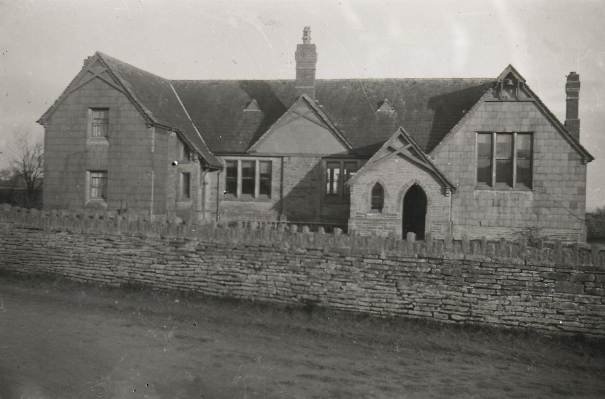
Newton School c.1920.
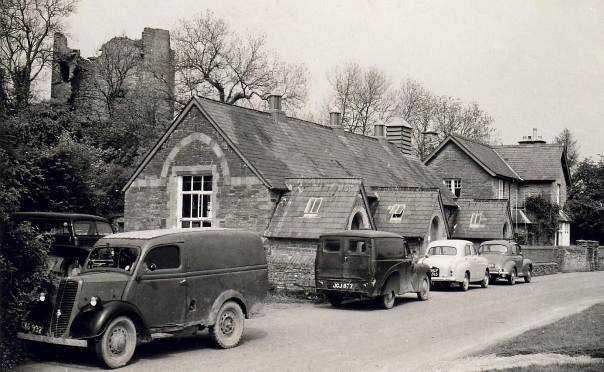
Longtown School, late 1960s.
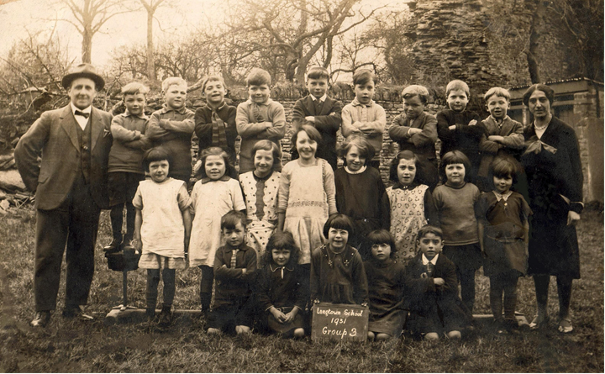
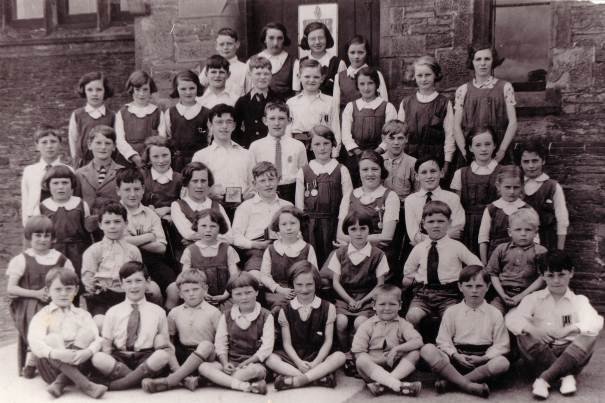
Michaelchurch Escley School c.1935.
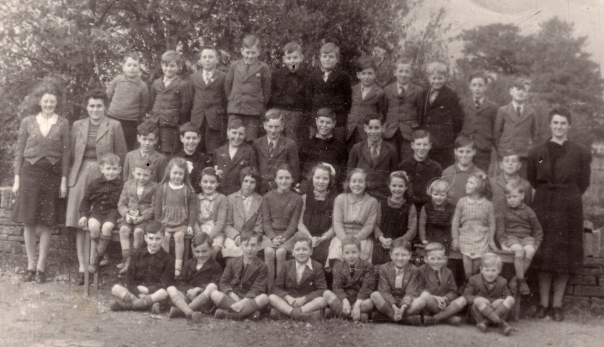
Newton School c.1947.
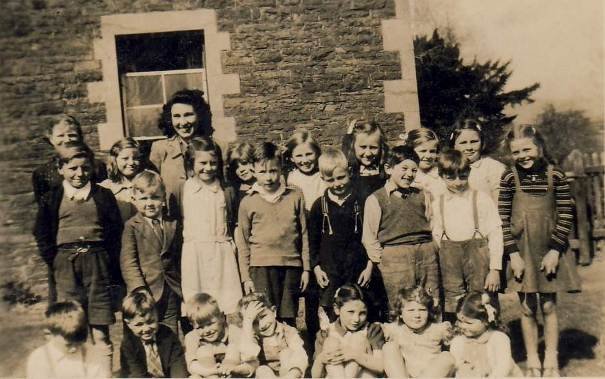
Walterstone School 1947
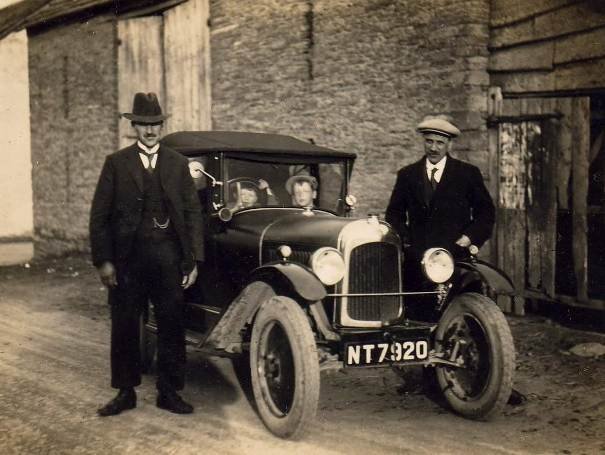
School Transport – Arthur Howard’s Citroen car.
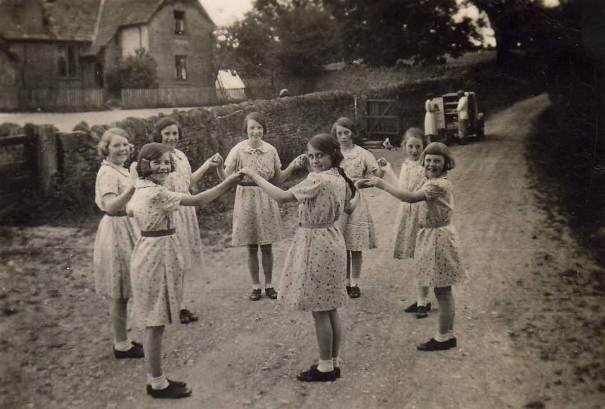
Outside Michaelchurch School c.1936.
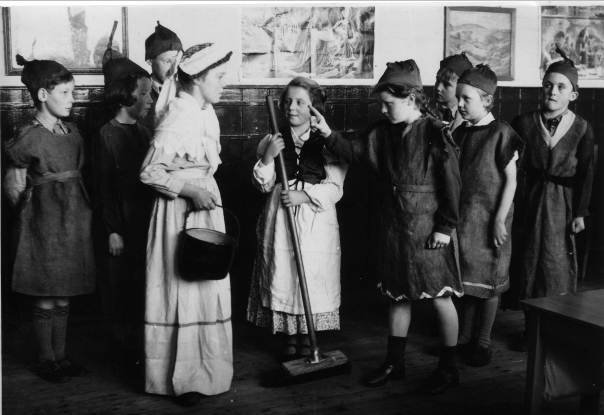
Craswall School Play, 1953.
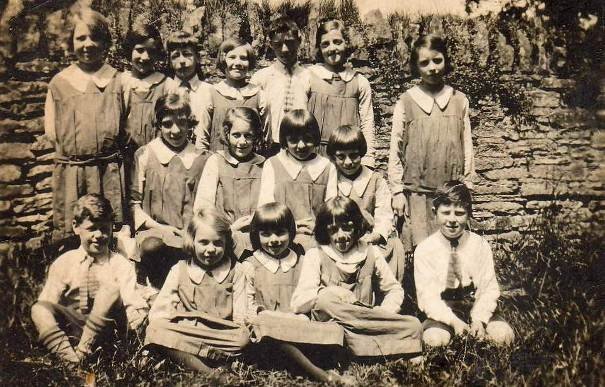
Michaelchurch Pupils 1930s.
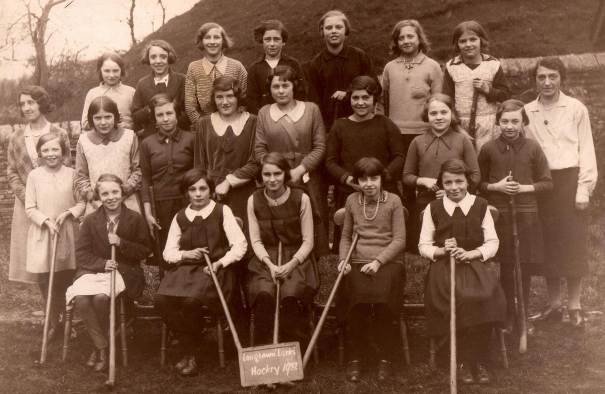
Longtown Larks Hockey Team, 1932
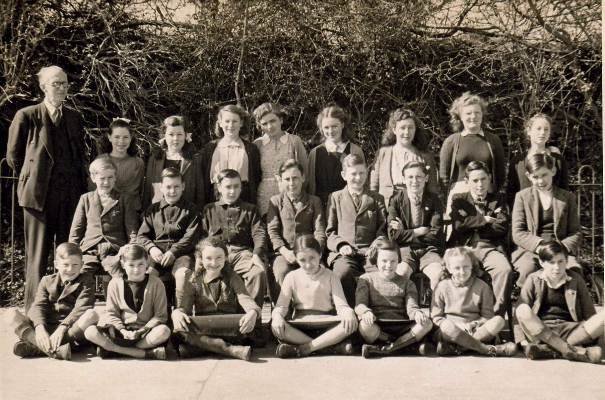
Longtown School c.1958. Headmaster Mr Crowte on left; Mrs Crowte 2nd from left
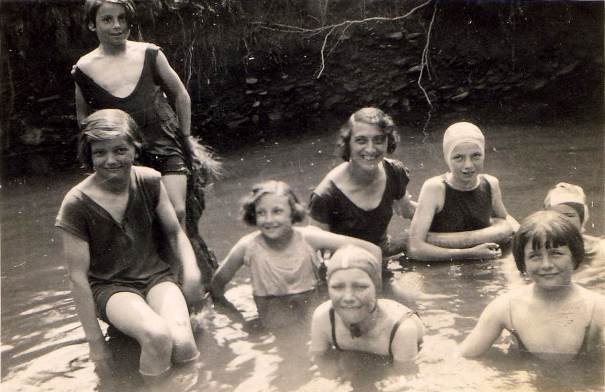
Longtown: Swimming in the River Monnow
Longtown schoolgirls with teacher Florrie Lewis (later Mrs Gwillim, Clodock Mill)
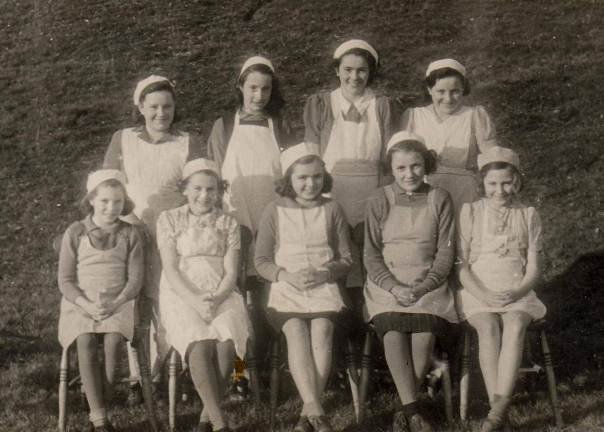
Longtown: Participants in special cookery class held in Longtown Village Hall, 1945.
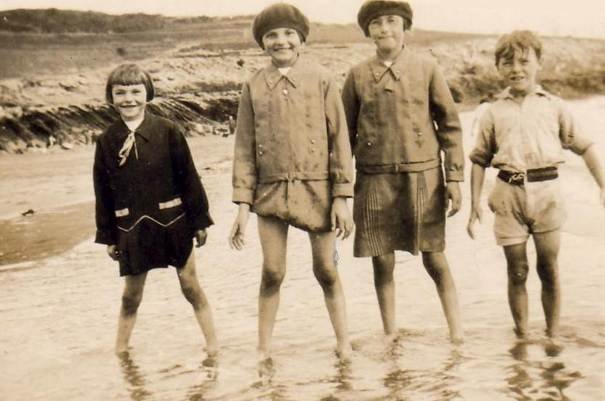
Michaelchurch Seaside Trip
Violet, Hilda and Gwen Watkins (Maerdy), and Denzil Gwiliam
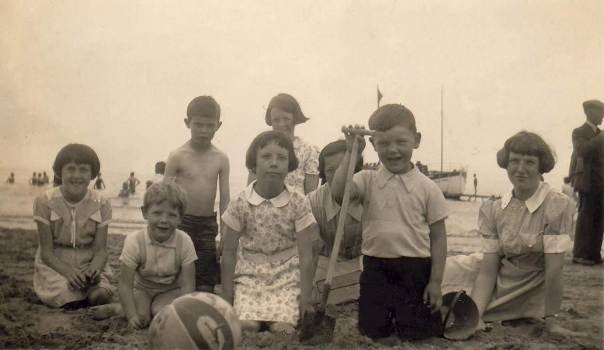
Rowlestone Seaside Trip c.1938
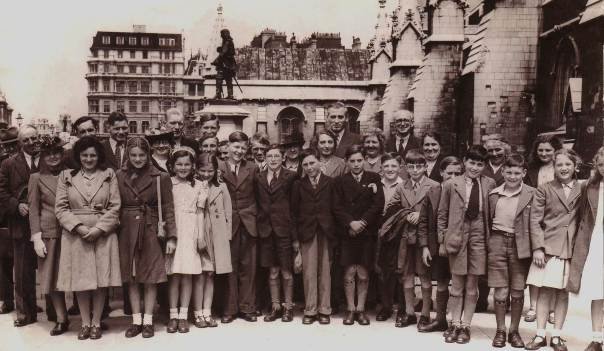
Longtown Trip to London, 1948. Outside Parliament.
TREVOR WATKINS (born 1925 in Craswall at Gworlodefain. His father’s side of the family had been in the area for many years, at Llandraw. He moved to the Shawls farm when he was six and stayed there until he retired. His mother’s family had lived at White Haywood farm. His father died when he was seven leaving his mother, Olive, to look after the farm):
Getting to school
‘(I started school) from Gworlodefain which was quite a distance. It was all the way across the fields then, which seemed quite a long walk for me then. So far on my own, and then you met up with another person, another young lad, and we came together. It did seem such a long way in those days. The main thing I remember was that I was mostly behind time, and having to run all the way. You got told off for being late. Mrs Wright was the Head Teacher, and Mrs Cockerell. (Mrs Wright) lived in the school house; she (Mrs Cockerell) lodged at a farm. She wasn’t there many years.’
At School
‘The school was very much the same as it is now. Just one big room and a curtain across the middle dividing the infants from the tops. In those days there was this big stove in the middle, there was rails all round it which one of the lads had to fill up with coal every dinnertime. It got red hot if you put enough on it. [Later] they came to the conclusion ... it was dangerous and they done away with it.’ Trevor thought that there wasn’t a great deal about his schooldays that stood out. ‘Just the usual run-of-the-mill kind of thing. It changed quite a bit over the years in the education side. The council got these big ideas of teaching us from the radio and that sort of thing. When I came up into the older class we had so many lessons off the radio ... and we had the little pamphlets and that with it all in. It was all right. Then the council had another big idea on this PE business, you know. They was very keen on that, and all this physical exercise out in the yards we used to do (in all weathers.) I enjoyed it. Council got their bee in a bonnet about certain things all of a sudden.’
The Craswall school logbook confirms that the education committee was interested in promoting the use of radio and in encouraging PE. On 10 June 1938 E G Francis, Regional Education Officer for the BBC, visited the school to discuss the use of broadcasts in lessons. On 11 November the children listened to the Armistice Day Broadcast. In September of the same year C A G Williams, county PE organiser, visited. He was happy with what he saw. There were 24 pupils on the school roll then.
The War Years
Trevor and his future wife, Peggy Williams, were teenagers when the evacuees from Bootle arrived, so that they have a different perspective from many of our interviewees. Trevor’s family had a boy from Birmingham by a private arrangement, and a brother and sister from Bootle. ‘We had a girl come first with the schools, and then her brother came after. She would be seven or eight, something like that. She was a frightened little thing when she came, and the rumble of the plane and Lynne was under the table straight away. I think ours settled in very well. Some didn’t. They’d got brothers and sisters come down to see them quite often. One brother was in the forces and every time he had leave - he’d got a car - he’d manage to scrounge enough petrol and he’d come down. They seemed to be worried about the little girl and they did come down quite a bit to see her. Then she got braver as she got older. She settled quite well. Mother made a fuss of her. With the girl and her brother we’ve kept up a relation and they’ve come back to visit us regularly over the years and brought their children back. There were some that were homesick and didn’t settle. I suppose it made a difference on what sort of life they’d got in whatever house they were in. My mother made a big fuss of them which made a lot of difference.’ Peggy said that his mother was a much-liked person, known as “Aunty Olive” all round the village.
Each school seems to have had different arrangements for teaching the evacuee children. ‘The Craswall children, they mixed in with the rest of the children in the school, and the same teachers just took them on.’
DAVID JENKINS (born Middle Blackhill):
Getting to School
‘Well, when I went to school when I was five years old, I was taken to school by my sisters, ’cos our mother had died and left five girls including a little sister, Joyce. Mother died when I was eight and I had five sisters; Mary, Rachel, Gertie, Annie, then me and Joyce. My father though, lived a long life and was 89 when he died. Mrs Wright was our Head Teacher and Mrs Proctor in those days was Infant Teacher and there were about sixty kids going to Craswall School then. We lived on a farm, Middle Black Hill at Craswall. On my first day at school I didn’t want to go and my father came and picked me up and slapped me on the backside and said “You’re going to school, you little b***”. So I went to school. I had to walk a mile and a half each way to school, took sandwiches for dinner and it was warm because there was a big stove in the middle of the school. We took some milk and Mrs Wright put it all together in a saucepan on the stove and warmed it up for us for winter.’
Lessons
‘Mrs Wright disciplined us good, if her told you to order you had order - her kept slicing her stick ... cutting the desk and “Quiet Please” and cut again and you’d got to keep quiet otherwise you’d get a cut across the backside. I had it and it hurt. I didn’t have a favourite lesson but Thursday was the best day because we used to read poetry and I Iiked that. I still read poetry now when I can see to read. We had a playground and in those days it was parted off with rails up the middle and the boys played that side and the girls the other side. When they took the rails away from the yard it made it bigger and the boys and girls could play together. If it was fine and dry there was a big field at the side which Mr Watkins used to let us go in after school to play football, cricket or anything like that. The toilets were outside and if we didn’t like something we would ask to go to the toilet and we would sit out there until someone came to see where we was.’ There were some special days including: ’ ... a Christmas party every year with a present for each child. My father used to be Father Christmas, but we didn’t know it was him, because once when he was cutting holly he cut his thumb badly and he put gloves on, otherwise we would have said it was our father.’
BEATTIE LEWIS (born 1926 at the Bull‘s Head, Craswall. She is the only surviving child out of a family of thirteen. She is one of the Gane family):
At School
‘I attended Craswall School until I was fourteen. There were two classrooms, three classes. There was a teacher named Miss Cole and one named Miss Cockerell and Mrs Smith. We had religious studies in school. We were taught a little cooking in school. Occasionally we had school plays; the older children said they did more before I was there.’
The War Years
‘Most farms had one or two evacuees. We had two - one from Liverpool and one from Manchester. They came by train and bus, and were taken to the school where we had to go and pick them up. I felt very sorry for them as they were in a terrible state.’
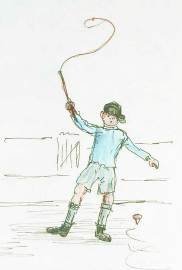
WALTERSTONE SCHOOL
Built in 1877 with residence for a master and mistress attached, for sixty children. In 1913 the average attendance was sixty and the children attended from Llancillo, Rowlestone and Clodock. From the mid 1940’s children went to Longtown at age thirteen. Closed 1957 and is now the Village Hall.
BILL LLOYD (born 1925):
‘I went to Walterstone School until I was fourteen, and never missed a day in nine years. I started school there when I was five. I was one of the lucky ones really as I never got ill and didn’t miss a day in nine years. I had a medal for five years and a music case for seven, and watch for nine. I’ve still got the medal. The music case was gone - I used to play the violin but I didn’t practise very much and this was stopped on me. We were quite happy youngsters and we had the evacuees during the War. Miss Colley taught the small ones and Mrs Watkins the bigger ones. The schoolroom was divided by a curtain. Miss Colley was very good, but Mrs Watkins wasn’t quite the same. We used to wind her up a bit. Our favourite occupation - we used to go sliding in the winter on a big pool not very far away. Nobody ever watched up and by the time you got back, school was half over and the first thing that happened - out come the cane, and you had to line up for a good slash with the warning “Come back on time the next time”. Oh yes, she caned you and it hurt. She would lay it on, no messing, and I suppose we had done something to deserve it. You would steel yourself and hope for the best, but I wasn’t really frightened of it. Miss Colley lodged with us for a long time. She was very nice. She is still alive, and I guess must be in her 80s. I’m not sure when they moved us up to the big class, probably when they thought you were ready. There were fifty or sixty children in the school. It was difficult with so many children of different ages, but I think we turned out a few geniuses. There’s not many of us left now; we used to call ourselves the ‘Local University’.’
The War Years
‘Billeting the evacuees was part of the service of the Area Warden. I remember these evacuees. There was this boy Charlie O’Gorman came with the rest of the Gang. He was with Mrs Watkins at the Greenway and she was very kind to this boy. When it came time for him to go back to Bootle, Charlie didn’t want to go. But of course, he had to go back and Mrs Watkins gave him some money, even though she was really skint, and told him it was money for the train if he decided to come back. Charlie went the one day and he come back the next day, and is still here now. He came from Bootle. Another evacuee was Jim Burke. He used to come down to us at Lodge Farm. We had a caravan site at one time and he used to come down every year to stop in the caravan. We were busy on harvesting one day when his wife came running down to me, and she said “I’m in terrible trouble. I can’t wake Jim.” So I went down to have a look and he was sat in the chair dead. We had to get the police and an ambulance, and we put her up for the night and all the rest of it. It was pretty terrible. She appreciated what we had done and wrote some nice letters afterwards.’
Closure
Walterstone School closed in 1957. The educational authorities closed it probably for economic reasons. They put in a new kitchen and they were doing meals, although I don’t think they cooked them there. They came down from Longtown and were dished up in the kitchen. And not very long after, in their wisdom, they closed it. Families moved away and not so many were attending the school by then. None of my children went. The school was left empty for some time. The Parish eventually bought the school and sold the school house off.’
When Bill was fourteen he went on to attend Hereford Cathedral School for two years: ‘I quite enjoyed it. It was very different there, with a lot of boys more brainy than me. We used to sing every morning because we had to get in the Lady Chapel in the Cathedral for morning service and you had to sing whether you liked it or not. I enjoyed singing but wasn’t in the choir. I didn’t get on very well with the Latin master, but it wasn’t too bad.’
KATHLEEN BALL (born 1926, Lower House Farm, Rowlestone. She was one of five children):
Getting to School
Kathleen walked to school, a journey of three miles. Sometimes the children made a stop: ‘There was a little shop up on the top of the common, by the chapel. (The owner) had a post office, but she also had a little shop by the side of it. Her little front room she’d got it as a shop. She’d got two boxes with sweets in. There was things for a halfpenny, and there was things for a penny ... that was a big treat.’
One day she was taken ill on the way home.
‘I can’t have been very old, about ten or eleven, and I was bad one afternoon coming home. I couldn’t walk and my friends and sisters carried me between them. I’d got rheumatic fever in my arms and legs. We had Dr Morgan. He wrapped my legs in cotton wool. I had to stop in bed three weeks. I had some horrible medicine which took all the coating of my teeth off nearly. They went all black.’ Fortunately she recovered completely. One of her earliest memories is the death of her little sister, aged one month, from meningitis. Children’s lives were threatened by many diseases then.
At School
‘(The school) had two rooms, one (for) infants and one for the older children, and just a curtain between the two. I can see it now. Miss Colley taught the little ones, and Mrs Watkins (the Headmistress) taught the older ones. There was a school house that she lived in.’ Discipline could be harsh at times. ‘I remember once, my brother had just started at school then, and we used to play fox and hounds and so we went down across the fields, and we were quite a long time coming back, and we all had to line up, and my little brother had the cane just the same as us and he’d just started to school.’ Not all the children accepted the discipline. She remembers what one particularly disruptive twelve-year-old boy did. ‘Once he just took the cane off her and broke it on his legs. She said “You’d better go back and sit down“.
Lessons
They did all the usual lessons, and she liked most of them, especially writing and nature studies ‘I liked nature. We had to fetch things in, different flowers and things. It was a pleasant little stroll.’ She did not enjoy knitting, and this gave her an embarrassing moment. ‘I remember one day (my knitting) had got a hole in it, and this teacher held it up in front of everybody to show it, you know, and I felt dreadful.’ The older boys and girls were given extra lessons. ‘We went to cookery. The boys went to woodwork over at Longtown, and the girls went to cookery down in Pontrilas. (We learned) to cook cakes and pies and things. Mr Morgan, the Garage, used to take us down and bring us back, and he had a biggish car. I was a hopeless traveller. I used to feel sick as soon as I got in there.’
The War Years
While she was in school the Second World War started. She remembers the declaration of war vividly. ‘We didn’t have a radio but the old lady down below us had one and we went down to listen to it, and I remember hearing Chamberlain when he said as “we are at war with Germany.“ I remember going home and I was really frightened.’ She also remembers how awful the gas masks were. ‘We had to take them every day to school. We had them in a little box thing. They were dreadful things. They were around your face. You thought you were smothering.’
When Kathleen left school she worked at home, doing many farm jobs, working with the horses and hoeing mangolds and swedes. However, her sisters didn’t stay on the farm. One became a nurse in Stoke-on Trent, while the other worked in Ewyas Harold, at Smith and Warrens’ grocery shop. Kathleen married when she was nineteen.
OLWYN FLETCHER (nee Sevenoaks, born Skenfrith 1935, but moved up to the Greidol in time to start at Walterstone School at the start of the war. She is one of eight children):
Getting to School
‘We walked to school. I think it is three miles round to the Common. I started when I was five. My Dad stopped me going then because my shoes rubbed from walking such a long way. We’d go past the Rogers’ so they’d come with us. They used to feel sorry for me. The one Rogers boy put me on his bike. It rubbed my ankles sore so my Dad didn’t send me for twelve months, because it rubbed my feet so walking down the road.’ Later they took a different route. ‘We went a much shorter way now. There would be a lot of children. We went down past Great Hunt House, which is Joyce Ellaway’s (Williams then) ... She would come as well. Somebody from Trelandon. We would pick them up on the way. The smaller children came with the older children, and us older children would guard the smaller ones, and take them on to school. We would go ... up by old Mrs Duggan’s that lived to be a 100 ... We would try to get her apples.’
On the way home they dropped the little ones off at their homes, making sure they got there safely. There must have been some very kind children in the school, for Olwyn mentioned that the older ones comforted the little ones if they were sad.
Lessons
Her teachers included Mrs Crowte from Longtown, and Miss Colley. The latter was a talented artist, and some of her drawings still exist (see cover). ‘We had three classes. First thing in the morning you had to sit and say your name, and I think you had a number and called that out. ... I had a sister and she would not say her name or number, or what she was ... she never said it for twelve months. We had a lot of good learning (though not all pupils were able to take it in.) We loved doing the tables ... you always learnt your tables, “once two is two.” We did all that.’ Not that all lessons went quite as planned. ‘Nature study was a terrific thing. Miss Colley was a great nature person. She took us up on the common one day. We were all thrilled to get out to do that. She didn’t know she was sat on an ant’s nest. So you can imagine the laugh that there was then when we were trying to get the ants off her, ‘cos they’d all gone and stung her.’
Food
‘We had to take sandwiches to school in the start. It wasn’t until later that they brought dinners from Longtown. They cooked them in the canteen at Longtown, and brought the dinners round. There was a big old heater there that you threw all the coal and everything on it, and I think that they used to do a lot of their food on the top of this, warm up something, baked potatoes you know.’ The big round iron guard had another use on wet days, for drying clothes. ‘When you got to school you’d probably be soaking wet, and you’d have to stay in those clothes.’ Someone living next door to the school gave them extra food. ‘The lady next to the school, (later Bill Lloyd’s) she used to collect the apples for us, and then in the real winter she’d stand by the wall and we’d all queue round, and she would peel an apple, and some were bad and some were good. She would give us bites, and we all enjoyed it. I can remember that lady being evicted out of her house, ’cos she couldn’t pay the rent. We were all so sad because her bed was put out on the common. Sad Molly they called her. It really was hard days when you really think of it. She was such a lovely lady.’
The School Dentist
‘We can always remember the dentist, ’cos we were frightened, terribly frightened of the dentist. Russell Jones ... went in first. He came out screaming, with his hands like this, and blood coming through his fingers, and so of course the rest of us were really frightened, and he was screaming and shouting “Mam,” “Mam.” ... and immediately they let him go straight home. My turn to go, I had two taken out, and ... I went straight home, when I had mine out and of course from the cold wind, not knowing, I got (ill).’
The nurse also carried out health checks, and at one point there was a serious problem with nits. Some blamed this on the evacuees. The attendance officer, Mr Tovey, visited the school regularly too. He sometimes came to the Greidol, for Mr Sevenoaks occasionally sometimes kept his eldest son at home, as did many farmers. He was threatened with a summons and joked that he might have a lovely time in prison, but that remark scared the children.
Olwyn also had to stay off school sometimes to look after smaller siblings while her mother and father went to Hereford market. ‘I was only ten, and I would be looking after my baby sister on a Wednesday. My brother had to be in charge because we were not allowed to stay without having somebody older.’
Outings
Once a year the school went to Barry Island or Porthcawl by bus: ‘The bus trip was a great event. We would get our shoes the night before. We all had new shoes. Smith and Warrens was our grocer and I can remember mother had ordered us new sandals (with a little star on the front), so I took them up to bed with me. I can always remember this, and hid them under my pillow. It was so special to have those sandals. We’d have to take the food for the day, so the night before Rene Johnson, she’s 94 now, she would come up and help mum with the making of the sandwiches.’
The War Years
‘When we were in school the war broke out, and a lot of evacuees came to Walterstone. We had two staying at Crossways, one at the shop right opposite the pub, the “Carpenter’s Arms,” one staying at Road Farm Cottage, one staying at Price’s Ty Canol, and one staying at Mr and Mrs Poores on the Common. Those who had only got one or two children had to have an evacuee.’ Olwyn pointed out that great care was taken to try to keep families together.
Many of the evacuees were soon homesick. The countryside was a new experience. Some of them had never even seen a sheep. before. This led to escape attempts by the evacuee children. ‘One day they decided they were all going to run home. We all thought we’d go and get them back. They thought we were running them, ’cos they went down over the bank to Pandy to the railway, nearly trying to get back to the station ... We all went after them from the school, and we wanted to tell them we weren’t running them to go home. We wanted them to come back, but they all wanted to leave. They all wanted to get back to Liverpool.’
Parcels came for the evacuees. Inquisitive children wanted to know what was in them. ‘They would have parcels. I can always remember one morning, a very cold snowy morning, and this one had got a lovely parcel from Bootle, and we said “open it now.” Of course he didn’t want to open it, because it was full of chocolate and all us kids wanted some off him. I don’t know how he’d got a bit of chocolate.’ One evacuee made her first day at school memorable: ‘I can remember the first day I started. I got my sandwich and I was so excited, and Charlie O’Gorman, he caught hold of it and he bit a piece out of it, and I was upset. I realised after that he was only tasting it.’ Generally they got on very well once they settled in. ‘They made great friends of all of us, and there were lovely girls, we had more girls than boys. Some of the bigger boys used to like to get with the older girls if they could, but they didn’t allow it of course. They were very pretty girls.’
Leaving Walterstone
After the 1944 Education Act local authorities began to create new secondary schools to take the older children, but since money and materials were in short supply this was a slow process. To overcome the problem of providing an adequate education for teenagers it was decided to concentrate teaching in a few selected village schools until Fairfield and Kingstone were ready. Walterstone children went to Longtown; Olwyn, her brother John and Vera Grenow from the “Carpenter’s Arms” were among those who went. The education committee provided them with a taxi, a big Rolls Royce, from Powell’s garage at Longtown. Bicycles were also provided. Girls took precedence over boys, so that John sometimes had to bike to school when the taxi was full, even though he was younger than some of the girls. Among the new subjects Olwyn studied at Longtown was basketwork, and she remembers having to soak her cane overnight to make baskets.
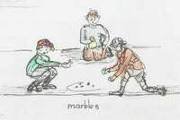
Other schools
BERIS WILLIAMS (born 1933 at Court Farm, Rowlestone):
Beris began school just before the outbreak of the Second World War. His parents moved to Rowlestone Court in early 1932 from Upper Chapel, near Brecon. Beris attended school in Ewyas Harold, like other children from Rowlestone. Our survey does not include Ewyas Harold, so that no details of his school life there are included. He went to secondary school in Hereford and we have included his description of his time there, as an illustration of the post-eleven education of many pupils from our area.
Getting to School
Beris gave a vivid description of his journey to Ewyas Harold School. ‘(Father) took me to school in the car for the first day, and that was the last day he took me as well. I walked thereafter. All the children from Rowlestone walked. There was about four Gwatkin boys, and another big family living down the Cwm called Fortes, and Oliver Davies from Rowlestone Mill. Beryl Williams used to ride her pony and keep it in the stable of the “Temple” all day before she rode it back home again. Mother used to say “bring a loaf of bread from Ernie Ireland.” He had a bakery shop, and of course we got about as far as the Prill and we’d start on the one corner. Quite a large hole by the time I got home. Going home took a lot of meandering around. Summer time we walked up over the fields, but when it was wet we usually walked up the hill road. We always seemed to go home together, but going to school we all seemed to go at different times. I can remember in the summer ... going up across the fields, and in those days there were bents, old meadow grass stalks left, and, of course, if you got a nice morning it was all covered with cobwebs, like walking through a carpet. I can well remember that, and I can remember the old grasses and ... everywhere there was scores of grasshoppers. Where they went to I don’t know, because we didn’t do anything special to get rid of them.’
Beris remembered the medical inspections that were carried out, and recalled that Nurse Mabel Cook, who had delivered him, always used to say to him “Ah, you’re my boy.” Hair was examined regularly for nits. Beris recalled that, even though the school was in England, the children always went around to the church to celebrate St David’s Day.
Secondary School, Hereford High School for Boys
Many children from our area went to Grammar School in Hereford. Beris remembered being in school with some of the Gane family from Craswall, and Michael and Pat Powell from the garage, among others. Lessons with different teachers, and in specialised rooms, provided an experience far different from that of children who remained in the country schools.
Like a lot of his contemporaries, he remembers the journey to school better than many of the lessons. ‘They (Longtown children) all went by bus. We went by train. We were the elite, I think. I never ever went to assembly because the train always got in just before 9 o’clock and they were always in assembly when we got there ... despite being pursued by prefects saying we could have made it. We actually couldn’t have made it. In those days my mother gave me pocket money to buy the “Daily Mail” and I read that during assembly, and I have always been an avid paper reader ever since.’
Behaviour on the trains, which usually had no corridors, was not very good, as Beris recalls. ‘It was a wrestling match. (When) Stuart Addis and I were going to school I could always tell when we were going to have a wrestling match just by the look in his eyes, all the way from Hereford home.’
Getting into the Boys’ school doesn’t appear just to have involved passing an entrance exam. ‘Perhaps I was lucky to get in ... I was good at cricket and I went to the second examination where Mr Ruscoe (Headmaster) quizzed us on our cricket abilities, and which was a leg stump and which was an off stump, and I knew everything, ‘cos I was very keen on cricket. Cricket was a thing I could do, and so I got into 2B.’ Later on Beris played cricket for the school, and he was also a good rugby player.
For some pupils from small country schools the experience of being in a large town school could be rather frightening at first. Beris never had any problems, even surviving a traditional initiation ceremony without damage. ‘Of course you all had this initiation ceremony as they did in those days, and probably still do. Ours was to be debagged once in your life. But I was a pretty strong kid and it took about four or five of them to overwhelm me, and only once.’
Beris recalled one incident that caused him some embarrassment though. ‘There was something that embarrassed me greatly. There was a Geography master (“Doughy” Baker) who came from Newport ... who used to play Rugby for Newport ... and he had relations living up the road from me at Wernddu, and he found out. He had a new baby and he (wanted) some fresh eggs and he asked me if I could get him some, and this was a great embarrassment to try to smuggle the eggs without all the other kids knowing because they thought it would be favouritism or something. I did get on with him rather well. I did get ... the Geography prize the first year I was at school and the last year I was at school so I must have liked Geography anyway.’
Sometimes pupils took part in extra-curricular activities. Cinema visits were a break in the routine, though they didn’t necessarily go the way staff planned.
‘At school I can remember seeing the 1948 Olympics. We all got taken en masse to see that. I thought it was something else! We went to see (Romeo and Juliet). When Vivien Leigh fell down and showed a bit of leg all the kids went (appreciative sound), and up got Bill Witts, the English master, and walked out through the door. He wasn’t having any of that. That upset him enormously, that did.’
Beris was very lucky to survive his school days. To understand what follows it is necessary to remember that the utilities did not come to southwest Herefordshire until the late 1950s. ‘I also had a little episode with electricity which I knew nothing about. I stuck my finger into an empty light socket in the toilet, and it nearly knocked my arm off.’
After leaving school Beris helped at home. He did his National Service in the R.A.F and then returned to the farm which his family still runs in Rowlestone.
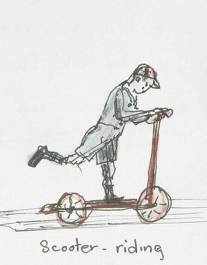
SOME ESCAPED SCHOOL –
WHAT DID THEY MISS?
TOM HOWELLS (born 1921 at Caeiron Farm. He and his sister didn’t go to school; they were educated at home by their mother):
‘I don’t know why mother kept us at home. There was no other children up there, only we two, and there was no road. We’d have to walk the distance of about four miles, yes, and the road was rough, no tarmac, just a green path. The only thing that could get through was a horse and cart. The road was impassable beyond the school. Everything mother knowed she tried to interest us in, and we were interested to learn, like. It makes a difference if you be interested to learn something don’t it? I learned to read and write and do maths, but now it’s computers I’m lost again. My sister and I never got lonely being on our own because if you be interested in doing something you don’t get lonely. Mother wasn’t a teacher. We used to do our work on slates, using slate pencils. My father used to help. Dealers used to come round before going to market seeing stock. He would want to sell his lambs, twenty to thirty lambs, and he’d say: “You count those for me and you get it right.”
Tom began his working life at Abbey Farm, Craswall, mainly working with 2,500 sheep and ploughing. He was able to buy his own farm, Lower House Farm, Michaelchurch in 1955 and still farms there after fifty years.
OUT OF SCHOOL
In the days before television and computer games, children had to make their own amusements. As would be expected in a remote rural area, children spent a great deal of their out of school time outdoors in the usual country child’s pursuits of fishing, climbing trees, bird nesting and, as they still do today, helping on the farm. Girls helped their mothers with the baking, feeding the chickens and fetching and carrying. Treats were rare and were things to remember, such as a Sunday School or school outing, or a visit to the market. Cricket and football were popular with both girls and boys, but there was no mention of favourite teams.
MABEL PRITCHARD
‘I had to fetch in morning sticks and blocks, and shut up the fowl houses. I had two brothers and sisters but we always had lots of work to do, because we kept a lot of poultry. We got ordinary water from a spring coming out of a bank across the yard. The clean water we carried from the well, which was up a little path from the house and was covered in so we had to ladle it up with a scoop. We had a bath once a week in a big tin washing bath. The water was heated in a furnace over an open fire.‘
Sunday School
‘The chapel used to be a tremendous place. On the Anniversary Day the place would be full and the gallery and they would all be outside in the yard. The Rev Dafis (died 1925) was the minister at Longtown. ... We made a regular habit of going to chapel, the children went to Sunday School and we rarely missed a Sunday. People dressed up and sang well. We always walked to chapel. We used to go to the seaside on chapel outings, on a bus that used to come to the school by the green. We would fill it up and off we would go. In years before the bus John Lewis would take us in his lorry to Pandy station to catch a train to Penarth or Barry or Weston and collect us from Pandy in the evening. The lorry was used to carry sacks of stuff around. In those days everybody knew everybody well and there were lots of relations around. We all helped each other.’
JIM WILLIAMS
‘We played with a hoop and guider; if it broke down it was down to the blacksmith to repair it. We were always swapping things with other boys, which caused trouble sometimes. Played conkers as well when the conkers were about.’ His grandmother also played a big part in his home life. ‘My mother died in 1932 when times was real bad ... Father had to do the baking and the washing and all different things. Grandmother came to we in about twelve months. My grandmother was an oldish lady then, and she did just manage to keep all the wee kiddies, and look after us and tell us what to do. We used to help father on the farm at Upper Turnant. We used to go in to wash the sheep by hand in those days, do the shearing.’
Jim also remembered that there were only two cars in Longtown when he was in school. There were also two buses. He had vivid memories of a bus journey to Hay Fair. As the driver, Mr Pritchard, was about to leave with a very crowded last bus home the police arrived and told him to order some passengers off. This was done, but Mr Pritchard told the big boys to walk to a spot outside the town, where they were picked up but had to ride on the roof. The bus wasn’t powerful enough to get up some of the hills with such a full load, so a few passengers had to get off and walk to the top.
DAVID JENKINS
‘I didn’t have much spare time. We had horses on the farm and I was about thirteen when I started working with them and if you ploughed an acre a day, you were doing well. We used to grow crops as well, oats, barley and wheat. One farm I worked on, he grew beans and they was good food, like, but ... to thrash them you had to wear goggles.’
Sunday School
‘We went to Cwm Chapel about half a mile away ... They took us on outings, mostly to Barry and that was a big day out. Rose Gane (still alive, I think) ... used to walk from Michaelchurch, down by our place to teach Sunday School at Cwm Chapel for many years.’
BILL LLOYD
‘We didn’t have any holidays or breaks. There was no transport, so what could you do? The only trips we went on were to Barry or somewhere like that with the Sunday school on the bus. We never went anywhere on a train.’
MAGGIE WATKINS
‘In the fruit picking season, ‘cos there was a lot of apple trees and plum and pear trees, we used to have our tea and you know, my mother was very good, she always tried to cook us a tea when we came back ... I remember picking these blooming pears, you know, to go to Bulmer’s - you get down and pick buckets and buckets after you’ve been to school. We used to pick blackberries for my mother to take to Pontrilas market - ha’penny a pound! The blackberries was very nice there, they were big and you could find a bush as was good. I’ve picked pounds and pounds of blackberries for a ha’penny a pound. The market was a big old shed then. You used to go and put your stuff on the tables. I think they built bungalows through the back of it now, but it was a big shed then. There was a dealer or two used to come from Merthyr down on the train and she did buy quite a lot of it. That died out when the War came, really.’
A young Maggie was impressed by Dulas Court: ‘I remember going to Dulas Court for the Christmas party when we was young and I was so disappointed in the place when I’ve been there since. I remember going into this hall and we had a lovely Christmas tree, and I used to think well, there’s a lovely big Christmas tree. Well, I go into the hall now, and I do think, oh gosh! this isn’t the same place! It’s funny isn’t it? I did have a present. I had it when I was up at Hunthouse, autograph book as I had as a present from Dulas but in the moving and all that, it disappeared.’
TREVOR WATKINS
‘I lost my father when I was seven. I suppose I was spoiled a little bit because I’d lost my father and brother, so I was farmed out to various ones of our family, this aunty and that aunty and uncle ... over Newton and down Longtown to various ones ... just playing with the other kids, bows and arrows, and football and things like that.’ After her husband died Mrs Olive Watkins looked after the farm. Trevor was a willing helper long before he left school. ‘She managed to do the work. My uncles used to come occasionally to help with the harvest and things like that. I used to help a bit. I’d got to do more work as I got older ... You got the various jobs harvesting, mowing and raking and things. I was doing jobs like that quite a long time before I left school. I was kind of put to do it, and that was that. I had to get wood and that sort of thing, do a bit of fencing. (I was taught) by my uncle chiefly. He was inclined to force you into doing these things. He would stick you on the mower (a Bamford horse mower) and he would say “well, you go on now.” And that was it, and you’d got to do it.’
Trevor was interviewed at the same time as his wife, Peggy. Some things relating to his teenage years are covered in her description of growing up in the area. Like his future wife he cycled to events some distance away. He said that living in Craswall, where there was nothing except the pub, left them all with little choice. He got his cycles second hand, though sometimes he improved them, and sold them on. He cycled as far as Hereford and Abergavenny. ‘We didn’t think anything of it then, everyone else was on a bike so you didn’t mind being on a bike.’ I used to go round quite a few of the sports off at a bit of a distance for the good reason that I was fairly good at running and I could pick up a nice few pounds. In those days a man’s wages was about £4 a week. Well I used to go to sports and probably pick up £10. It was worth going for. I started when I was in school, and followed on going round the sports.’ Later he had a motorbike, but Peggy hated him using it. He did not have a car. In the pre-war days there were few cars in the area. Trevor and Peggy were able to give the names of some of those who had them; they included Mrs Wright, Howells at Craswall, and George Powell at the garage.
Trevor left school at fourteen, and began work at home. He was there until he retired, except for a short period when he worked at Michaelchurch Court, in about 1941.
PEGGY WATKINS
School was “all right“, but holidays were better for then they could “play, play…”
‘We’d got wild imagination as children then. I don’t think they have it today, you know those play houses as we used to call them. You’d have the old pots and pans as was thrown out, and make mud pies. And your friends used to come, and you used to go to them, and it was all so much different to the way of things today.’ You didn’t argue with your parents ‘When it was time for bed you had to go to bed and that was it. Mother said “bed” and bed it was.’
‘You had to help a bit, do a few jobs. As I was the youngest I got away quite easy really, spoilt a bit I expect. My sisters did the chores, with a bit of luck. I would think it was a hard time. As children you don’t think about things like that. Money was scarce and if you hadn’t got things to sell you didn’t have any money to buy. But of course farms got their own food then. You grew it, and you had chickens and apples and plums. We had all that at Ponthendre you know. Mother used to make jam. There was always something on the table. But it was hard. You didn’t have a lot of money. (As a child) ‘if you had a penny in the week you were doing pretty well. I’d go to the shop and you could have things for half a penny. You had to make it last.’ Peggy recalled the four shops she went to. She particularly remembers the pinafores in a shop owned by an old lady at Glan Olchon. She also helped get things together for market. ‘I used to pick flowers out of the garden. We used to have lots of narcissi and daffodils, and bunch them up and sell them. We didn’t have time off school (to go with) our parents. We lived by the bridge, and we had to go out with the baskets to put along the bridge. When Mr Morris (in the bus) or Mrs Williams (came) off mother would go ... to market. The war came and that altered quite a lot of things.’
Peggy enjoyed cycling. Many children had bikes. She remembers that some of the boys rode their bikes over the parapet of Ponthendre Bridge and, if they fell off ‘They didn’t make much of it. (They) had to put up with it. You were tough in those days.’
When they went shopping their choice of clothes depended on their destination. Going to Hereford was special and so they dressed up. They did not take so much care when going to Abergavenny.
Social Life
‘Mr Crowte organised a Youth Club for all the young kids and every week on a Monday evening after school there’d be Youth Club. Games, table tennis, just a social evening for the children of the village to get together, I think really.’ There were a lot of local events. which increased in the war as villages tried to raise money for the war effort. ‘Well when it came to wartime a lot used to happen in the hall in Longtown, the old water works that was, dances every week, socials, concerts, things like that. There seemed to be something on every night of the week. I wasn’t really allowed (to go to dances) but they used to have these social evenings. Dancing was coming in quite a bit, and that was great, so that was when I first started dancing.’ Before long she was cycling to dances in places as far apart as Mardy, Cwmyoy, Peterchurch and Ewyas Harold. She went with a group. ‘(There could be) about ten or twelve all going together. You might be only six going. You did go with all the other ones, your friends in the village. I borrowed my sister’s bike, she was in the forces, so of course she didn’t use it, so if I looked after it I was allowed to ride. It was nothing to go to Peterchurch.’
Longtown youths were not very happy about boys from other villages coming to their hall. ‘Boys from Longtown didn’t like the boys from Michaelchurch or Walterstone or Ewyas Harold coming ... on their territory, poaching their girls.’ Not that there was much trouble, and when it came it was from outside the county. ‘(We) used to get some from Abergavenny that were a little bit on the fighting side, and they came out there after the Longtown and all the local girls. The boys in Longtown didn’t want us, mind, but they didn’t want anybody else to come. It was funny really.’ Craswall boys must have been accepted. It was at a youth social evening that Peggy met Trevor, and they celebrated their Golden Wedding in 2005.
SYLVIA JAMES
Sylvia remembered the weekend, for Saturday was ‘syrup of figs day ... and the sad thing about it, I quite liked the taste of syrup of figs, which was my misfortune, only I didn’t realise it at the time, so one only recovered by Saturday evening.’
Sylvia’s father owned a rather unusual car, ‘a three-seater car - a Citroen - and he had it ... when I was four years old I think. He‘d had four sisters and they had all died. And probably, I think, there must have been a little bit of money. When it was very wet, he would come and fetch me from school, but he would collect all the rest of the children going the same way. It was so amazingly sort of built. There were two lockers at the back, one on each side, and he would have a bit of material - one of his rolls of material across ... which made a seat. There was a little well in the middle where one put one’s feet. It was really only a three-seater ... but ... I think he had eleven children in there sometimes coming home.’
Evenings at Home
‘My father had a smallholding, but he was a tailor. This is where a little bit of privilege came in, and inasmuch as we lived on the crossroads, and it was possibly that that got him involved in committee works. So we had a lot of visitors in the house of an evening. There would be people coming in to have a chat about something, and I had to be seen and not heard, but ... I enjoyed listening. They would be ... our neighbours who would come to bring their poultry to take on the bus the next morning, to Abergavenny or Hereford... Abergavenny mostly. And so that was the time when my father would take advantage of the men folk who would bring their baskets the night before. He liked to have a game of cards, so he would invite the carriers of the baskets to have a game of cards with him.
‘The wives would come the next morning and go with the baskets to Abergavenny. The bus would come and it had steps up the back to a rail on the top.’ The top was filled ‘ with egg boxes and baskets of dressed poultry and all things for sale ... butter, I don’t remember much cheese, but then I didn’t see what was in the baskets. The baskets were always covered with these beautiful white cloths. But there was a time when there was a wind and the bus would take off and the top layers of egg boxes would fly in the wind.’
JOYCE MOSES
‘After school we would have to carry drinking water from the wood if mother hadn’t got it. There was a stone stile. More often than not we would spill some of it. We would have a bucket each, and if we tipped out too much, we would have to go back and get another bucketful. This would take a bit of time. We had washing water coming along the millrace; it came down a spout into a big tub. There was always water running down there because it came along from the weir. We had to help our mother. Me and my sister, we could cook and iron etc. before we were any age. On a Saturday afternoon we would always make cakes for Sunday; mother used to do the bread. We were usually at school when she did most of the baking. Father used to help her with the baking. We used to rush home from school on baking day because we could have a little bun with homemade butter. We did the washing with a scrubbing board and a bar of soap, and a mangle. The sheets in them days were all heavy twill, not flimsy stuff like today. We used to knit and sew by candlelight or paraffin lamp until the Tilley lamps came along.
It is surprising what we used to do. We used to play a bit of football. We never had a football, a proper football. What happened was when the pig was killed you had the pig’s bladder. You used to blow that up and leave it dry, and that was our football as long as it lasted. Climbing trees was another pastime. I wasn’t too good at climbing trees - I could get up but couldn’t get back down. We were out in the countryside doing all sorts of daft things; just walking about like, looking for bird’s nests and picking wild strawberries, and seeing what wildflowers you could find. We knew where all the bird’s nests were and what they were. We never took any eggs, just waited and when we went back, they would be gone. The birds would have hatched. The boys used to go fishing quite a lot. They would have a worm on the end of a stick and be sitting in the room like and fish from an upstairs window. I used to look under the stones and get the fish. There was always something to do like. I used to help dig the garden. We each had a little piece in the garden to grow spuds and lettuces, beans and peas, beetroot. I don’t think we ever did eat our own meat from the farm. We had a butcher come round with the beef. But we used to eat a lot of chickens which we reared.
We had the Eisteddfod. Never competed, but I used to go there. My sister and I had music lessons when we were kids. I’ve got a piano now, but I can’t play. I didn’t keep it up. What happened was we used to go to Longtown for lessons from Miss Williams. On Saturday she would come to us on her bike and give us lessons, and the next one we would go down there. She left to go to the London College of Music when I was about fourteen, so I never went on from there. But I didn’t have an ear for music. I went to Abergavenny to pass my Junior exam. We had to ride our bike to Pandy, me and another girl. I shall always remember the piece I had to play - phew. Well!!! I can’t remember what it was called. It was the London College of Music I was aiming for!! I got one certificate so I did make a bit of a start.’
They never had proper holidays, though as they got older they went to Hereford to stay with aunts who kept pubs in Hereford. In the war this had some advantages. ‘When the Americans were about we used to go there and stay, and we always had stacks of sweets from them. They would come to the pub ... and we got to know them and they would bring a lot of sweets so we were well away. There were black and white Americans but they didn’t go into the pub together.’
Sunday School
‘We always went to Sunday School after dinner. Mrs Polly Farr taught Sunday School and her son, John. They used to walk down from the top of the Bryn because they didn’t have any transport. There was quite a number at Sunday School - from the Groves and the four girls from up the Buildings used to come, and we had a little ticket and when you had 48 tickets you used to get a religious book. I still have several books now. When John Farr came we did used to misbehave ourselves a bit - we were a bit unruly and took advantage of him, but not when his mother came. I always had a new straw hat for Sunday School anniversaries, and we stayed down there all day. Mrs Powell, the Garage, used to do tea on the lawn before we’d go into the next session like.’
OLIVE POWELL
‘You were never short of a job. We didn’t have electricity. We had a pump in the house. Our morning job was to get sticks to light the fire to boil the kettle. The kettle was hung on a rail over the top of the open fire. That was our job. And then of course our mother baked. There was a big baking oven and we always had to get branches to go in the oven and she always baked on Monday. And of course when we came from school there was this wonderful smell. And apart from bread there was tarts and puddings and scones, all that sort of thing ... which lasted the week. There was lots to do because we had several men and they had big appetites in those days ... like one living in or two living in and helpers because there were so many horses in those days you needed such a lot of help. There was always those to look after and haymaking time you would take their tea out in the field. But it was great fun because they used to roll this hay up into cocks and we had great fun jumping the cocks and there would be trouble.
‘Another big day out was whimberry picking. We used to go on the mountain some time before the Glorious Twelfth, of course, and we used to go for a day. It was an event. We used to take food and drink the lovely water that was on the mountain and we would pick whimberries all day. We’d walk from Oldcourt to Longtown, up Penrhewy Lane, go up the Rhiw and on top of the mountain and just work hard all day, come down the same way and my mother would make these whimberry turnovers and they were devoured in about two minutes.’
Note: “Whimberry” is a local pronunciation of “whinberry.”
CECIL WILLIAMS
‘I had to do a few jobs at home. I was quite busy but when you’ve got twelve or thirteen at home you have to help. When you come home of an evening you get wood for the fire or fetch the cows in. We worked at weekends, too, but we always found time to play a bit, kick a ball about, football or what have you. Sometimes after school we would go to a fair or into town occasionally, but not all that often really. I used to go to the Abergavenny market with my mother. A great market that used to be. We went to Sunday School and every Sunday that we went we got a stamp to say that you had attended. Every summer there was a flower festival and our thanks for doing that was a tea party at the vicarage.’
GWEN WILLIAMS
Rowlestone C of E Church had its own Sunday School which was for a time run by the vicar’s wife, Mrs Thomas. Several children had pleasant memories of the parties.
‘We used to go to parties at Rowlestone, Christmas parties - they were wonderful. We used to enjoy that every Christmas. Each one had to say a piece or sing - well, they didn’t have to - they could if they wanted to. There was a Christmas tree and everyone had a present. It was something to look forward to. I went down to the Sunday School for many years, to Rowlestone church - that was our family church. Mother used to walk us to church.’
BERIS WILLIAMS
Beris went to the Sunday School in Rowlestone too. He enjoyed taking an active part, even playing the Archangel Gabriel in a play. Like most of the children he remembered the Christmas parties, and here he recalls one incident. ‘We had a Christmas party in the hall and we all had a book, and I had a book that I lent to Christopher Evans, and about three years ago he moved and he came and gave me the book back and my name was in it. He’d kept it for sixty years.’
The children always looked forward to the annual trip. The usual destinations were Barry Island or Porthcawl, but occasionally they went to Weston or Aberystwyth. Things did not always go smoothly. The Revd Thomas, a former Eighth Army chaplain needed to call on all his experience to sort out a food problem in Porthcawl. ‘Vicar Thomas had organised the food. We were all going to eat. Well they charge us 3/6d (171p)each, and that was a disaster, like. That was too much altogether. I can remember he had a terrible row with the people and the service and something.’
Amusements
Children showed a lot of imagination in their play in those days. ‘All the little crazes we had. Bows and arrows (was one) and then that would fall through. There was a big go at stilt walking once. Used to get orders from the kids in Ewyas Harold who hadn’t got a wood!’ Beris was especially fond of cricket. ‘Christopher Evans used to come up. He was the only chap for miles about with a cricket bat, an old brown bat. We had people like Harry Prosser cutting bats out of planks you know. But eventually when I was really into cricket, in ‘47 or ‘48 and playing for the High School, my mother went to stay in London ... and I insisted she brought me a cricket bat back. We used to practise every Sunday. I played many a cricket match with just Sid Walker or Alfie Gwatkin, and whoever hit the ball had to go and fetch it back because we only had one ball. So we had a cricket team; and we had a football team. We cut the posts for the goals out of the wood. My old chap used to play in goal.’
Sometimes he played in more organised cricket matches. ‘I played up at Llanveynoe. It was a bit of a job to find anywhere flat. There was a bit of flat for the pitch but if you hit it downhill it went all the way down to the brook.’ However this happy state of affairs did not continue. Beris’ father always let the cowman have the weekend off so he was expected to help with the milking. The other boys still played but all Beris could do was watch through the cowshed window. Milking finished many a cricket career.
A popular amusement for boys at harvest time was rabbit catching. ‘Of course the big sport in those days, when anybody was cutting a field of corn was rabbiting. All the local boys came for miles because all the rabbits went into the middle, till the last half acre, and if there was a lot about there was some sort of running and shouting and diving on rabbits, ’cos they went and hid under sheaves. Later on somebody brought a gun, but I remember somebody got a pellet in the knee so we stopped that. If you saw somebody cutting a field of corn on the bank half a mile away you all took off when you saw it coming to an end. All the boys anyway. There weren’t any girls in Rowlestone.’
Young Farmers’ Club
The Young Farmers’ clubs provided much of the social life for young people in the countryside, where youths and girls could meet. Beris found life very quiet after he left the High School. The local YFC, which he joined when he was twelve, was a valuable social outlet. ‘I was desperate to get out and join Young Farmers. There were a lot more restrictions on what youths did (then) I think. Mother and father wouldn’t let me out to go down to the village to hobnob round there. When I came home from school I was sixteen. Gosh it was quiet. I was stuck up here. When I was twelve I joined Young Farmers and that was quite a help. It’s been a jolly good organisation. I learnt how to drink a bit maybe. “Sonny” West introduced me to gin and orange. I hated it. Everybody has to learn. I think we were under age.’
He liked going to the dances. At that time the ones at Longtown and Little Birch were regarded as the best. There were plenty of girls at Longtown. He also remembered going with Glyn James to a Young Farmers’ party at Welsh Newton where he had some of the best trifle he has ever eaten!
OLIVE HOWELLS
‘I used to go (to Michaelchurch mill) about once a week, when we ran out of bread. We used to live so much higher up in those days, a long way from the baker, and they used to bake bread down at the mill, and Mrs Lewis (Warren Lewis’s mother and father were living there) used to bake the bread and she baked lovely big 8lb loaves, big doubles. I used to walk down in the dinner hour from school and probably come back with two loaves, once a week possibly. I don’t think the mill was functioning then. I’m not sure when it finished. I think that people were still taking corn down there to be ground, so it may have been.’
OLWYN FLETCHER
Olwyn remembers some of the jobs she did on the farm. She helped to turn the corn in the attic, and she cut up the salt to cure the pig. She also delivered milk to Mrs Rogers on the way to school.
Sunday School
‘We went to church and chapel. Mrs Addis, Llancillo Hall, and Mrs Langford ... they were the Sunday School teachers at Walterstone at the chapel, so we would go there on a Sunday morning because my Dad said “well, we will try to help them with the little (Methodist) chapel.” We went there and another Sunday we’d go to Walterstone church, because it was at the same time, 11 o’ clock.’ The vicar noticed what they were doing. ‘The vicar (Revd Gates) would meet us, ’cos he’d be going around Greidol corner. He would say, “Where are you going girls?” because sometimes we would be going to the chapel to the Sunday School. He wouldn’t give us a ride unless we were going to church. So we’d have to be truthful and say “well we’re going to Sunday School today.” Right, he’d shut the door. He wouldn’t give us a ride. He would take us to church though. We smiled at that.’
She was confirmed when she was about twelve.
‘We were all going to be confirmed (at Madley) so there were 35 children from this area going to be confirmed, so they said would my Dad take them all in the stock lorry? My Dad said that that wouldn‘t be very good, so they would have to get a bus.’
There were plenty of social activities at Sunday School to look forward to. They had picnics and sports in the summer, and a party at Christmas. Some of these were at Llancillo Hall, whose owner, Mrs Addis, got very worried on one occasion when some of the children went to swim in the river. Once the Sevenoaks children could not go. Afterwards Mrs Addis told them that she wouldn’t have a party without them again, because she had had to think of all the things to do. The large Sevenoaks family was used to organising their own fun and took the lead at parties.
Holidays
They did not have many holidays. Their mother took them if they went anywhere. Day visits were usually to Barry. Stays were more often at Weston-super-Mare. ‘I can remember taking my younger sister and my little brother, that we lost, to the station ... I could go along (to the station) but I couldn’t go because only two could go with Mum. She couldn’t take more than two, and that would be their day out, to Barry. Us older ones would have to stop, and yet we weren’t very old. I’d only be eight or nine. Mother did have a holiday. My Dad would say “Ollie’s not very well.” I used to faint a lot, so she’d say I needed a holiday. But I think more than anything dear Mum needed a holiday, because I never liked going away. Dad would treat her to it, and it was £7 for the whole week, to stay in this hotel for me and my two little sisters and Mum. But it was only as we got older that we were allowed. She could only take the two small ones and me, and we did enjoy that. Well I didn’t. I missed being at home on the farm, I’d rather have stayed at home. The lady of the guesthouse got friendly, and she used to come back to stay with us.’
Young Farmers’ Club
Young Farmers played a big part in the social life of the family. Olwyn went to quizzes and concerts, and once they put on a pantomime. Some of her friends went on exchange visits. One of the highlights of the year was the annual county rally. Olwyn’s brother was allowed to go because he was stock judging. Olwyn did not go, as her father only allowed those taking part to travel. Her father was also strict when it came to the girls going to dances. ‘He said “you’re a lot too young.” One evening their father was out, so their mother let them go on condition they returned early, before their father got home. On the way back they were nearly run over by a stolen lorry. The following morning the police turned up to ask what they had seen. Explaining things to their father proved difficult.
AUDREY CROWTE
‘We played rounders and imaginary games; we just made up our own fun really. The grass was short because there was one family that let their cows wander on the village green, and we had a village donkey that belonged to the same family. It was a great place for getting together. I can remember when we used to have double Summer Time. I used to be called in to practise the piano and everyone else was out playing on the village green - I used to hate it. The freedom of the place was wonderful - there was hardly any traffic. We used to love playing with a ball against the wall. There was one particular house that had a lovely wall and we used to spend hours playing ‘sevenses’ and ‘tenses’ I remember. We used to go down to the river and paddle. There was one part of the river where you could actually swim.’
VALERIE WRIGGLESWORTH
‘After school we had to feed the chickens. We had fun in the meadow and down by the river. Valerie remembers the bad winter of 1947, also remembered by Olive Howells, who attended Michaelchurch School: ‘It was a deep, deep snow and we didn’t go to school for weeks - easily six to eight weeks. But of course it was seventh heaven for us children, no school, out each day making snowmen. It was so hard you could walk on top of the snow and I remember my father showing me and my cousin how the snow was so frozen and hard that we were able to cut out blocks of ice, and to make an igloo in the garden. We were allowed to go inside the igloo with candles, giving us an insight to how it was.’
PHYLLIS GWILLIAM
‘We always went to Sunday School, and then there was the Chapel trip for Anniversary, which I always had a new frock for. We used to go to Barry, Porthcawl and one of those local places. This has been going on for a long time. There were sports in a field near Newton, children’s sports and football matches. We didn’t go to Longtown Show as the parishes weren’t joined then and each parish tended to stick to their own. And people didn’t travel much before there were cars.’
Young Farmers’ Club
For Phyllis and many other young people the YFC was a social lifeline. ‘I used to go to the Young Farmers at Craswall School. I used to bike over there, two of us together. We had meetings, public speaking, and the rally, and we had events to raise money for charity. The Young Farmers also used to get a concert up at Craswall, singing and acting, which was good fun. This was well attended as there wasn’t much going on.‘
BEATTIE LEWIS
‘I was much happier outdoors playing games outside such as cricket and rounders. After school the teacher made us work in the school garden.’
KATHLEEN BALL
Like many of the children Kathleen enjoyed Sunday School. She remembers one Christmas party well.
‘They used to have lovely parties at Christmas. I remember this one year this Father Christmas came out and I thought “I know those wellies.” I said to somebody “that’s my Dad.” I knew his wellingtons. Black wellingtons [size 6] and this Father Christmas outfit.’
Family holidays were few, although they sometimes stayed in the Rhondda Valley. A highlight of the year was the Christmas visit to Hereford. ‘We used to go to Hereford at Christmas, towards Christmas Eve. We used to look in Greenlands (a large store). I don’t suppose we ever bought anything from there. I remember my mother took us in there and my sister saw this very posh little doll in there and she wanted it, and she cried because my mother wouldn’t let her have it.’ Her sister was punished for showing off.
Kathleen enjoyed reading.
‘I used to love reading. Still do. My mother had a lovely lot of old books. I bet we used to read them over and over.’ Mr Wheeler from Longtown, brought things to read, along with the groceries. ‘He used to bring us comics, because we didn’t have comics, but his daughters did, so they used to send them over. “Chicks Own” with a little black and a little yellow chick on them.’
The children helped on the farm. Sometimes they picked vegetables, which their mother took to sell in Abergavenny, going in on her pony-and-trap. Kathleen also enjoyed looking after her pet ferrets. Unfortunately her mother was frightened of them. Once some escaped and got into the house, creating panic. Kathleen had a way of earning money that a modern girl might not try. She caught the moles that were ‘mooting’around the farm. She explained that that was the dialect word they used to describe the damage the animals caused. ‘My Dad used to lay (mole) traps, and I used to lay some. We used to take them home and skin them and hang them (the skins) up on a door, like a stable door. And you had four or six nails, two there, two across the middle, and two at the back, and you’d stretch them out. Then we used to take them into Augustus C. Edwards (a Hereford draper). Dad always made more than me as his were stretched better than mine somehow. We did that for years and years.’
JIM MADDY
Sunday School
‘I can’t really remember going to Sunday School until I was bigger. (My mother) she always said I started at two-and-a-half, and I presume Father took me … I don’t remember him being the teacher; I don’t remember anybody else teaching; he was my only teacher whom I could remember, because we used to walk over the top after from Craswall Court - I can never remember going on horseback - walk over twice a day, Sunday School, and there was three services at Llanrosser then. There would be a half-past-two and a six service for the general public, and Sunday School was at eleven.
Jim remembers the teacher: ‘Jim Prosser ... He was ... son of Daniel Prosser the Glibes and he farmed at New House, Vivian Trewern’s dad. We used to read from the New Testament. ... according to the attendance record we got a prize, a bigger prize if we attended more than somebody else. We had Sunday School anniversaries where we used to have to stand up and read and sing or recite, and I think most of us were petrified. We didn’t like that’. This system appears to have been successful however, for Jim was able to quote from the New Testament: ‘My favourite text has always been Philippians Chapter 4 verse 11: “I have learned in whatsoever state I am therewith to be content” … Also: “In everything give thanks” - that’s first Thessalonians. I think that’s a wonderful verse because you should be thankful for everything. By Jove, some of us have a few things to be thankful for, haven’t we?’
With Jim’s words we leave our account of the early lives of the generation that grew up some sixty years ago. Not that the story ends there, for we shall be telling how our interviewees coped with the world of work and the Second World War in future publications.
* * * * *
____________________________________________________________
Ilustrations opposite: Local Wildflower and Plant Studies (watercolour)
by the late Margaret E.Colley, teacher at Walterstone School in the 1940’s
and later at Ewyas Harold School.
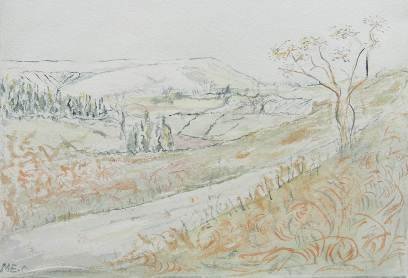
View to the Black Hill (M.E. Colley)
“In the Shadow of the Black Mountains” is based on interviews carried out between 2004 - 2007 in the Herefordshire villages of Clodock, Craswall, Longtown, Newton, Llancillo, Llanveynoe, Michaelchurch Escley, Rowlestone,
St Margarets, and Walterstone,
all part of the former Hundred of Ewyas Lacy.

Ref: rs_ewy_0375