
Title: | Randolph Trafford - The Flying Years, by James Baxendale O.B.E. |
Date: | 1927 - 1943 |
Introductory Note: Richard Randolph William Rawson Trafford was Lord of the Manor of a part of Ewyas Lacy by virtue of his ownership of the Michaelchurch Court Estate from 1910 until his death in 1943. His residence in Herefordshire was at Michaelchurch Court in the parish of Michaelchurch Escley, more details of which [and of the Trafford family history] are given elsewhere on the website. Between the World Wars Randolph Trafford became a well-known aviator, and his great-nephew, James Baxendale,OBE, has written an account of his life and times which is reproduced in full below with the author’s kind permission. The original article has been updated in 2018 to incorporate additional contemporary letters and other material that have lately come to light from the family archives.
Ewyas Lacy Study Group
RANDOLPH TRAFFORD
A PIONEER OF AVIATION IN HEREFORDSHIRE AND GENEVA
THE FLYING YEARS 1927-43
|
|
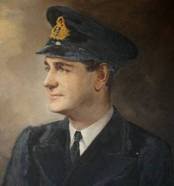
| Randolph Trafford, 1939[1]
|
|
|
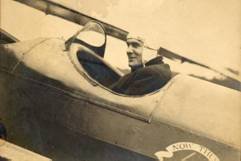
| Randolph in his Morane-Saulnier MS-137
|
|
|
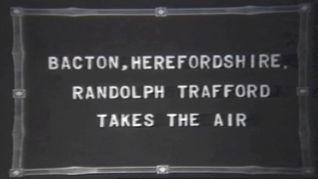
| Film of CH-184 at Bacton, June 1929: click image to view video |
Contents
1. Growing up
2. Switzerland in the 1920s: Mourane-Saulnier MS-137 CH-184
3. England in the 1930s: DH60G Gypsy Moth G-ABAM
4. Air Rallies
5. Cars and Travel
6. South of France: Randolph ’ s Yacht, Viva
7. Second World War
8. Epilogue
Once he flew for love and beauty
Then to fight all evil things
So that when he ’ s done his duty
He can smile and fold his wings [2]
1. Growing up
What did you do in the 1920s and 30s if you were young, wealthy and adventurous? If you were Randolph Trafford, you bought a plane, built you own airfield and flew.
Randolph was born into a well-off Herefordshire family in March 1907. His father died in 1910 when he was three, and as the only son – ‘the Squire ’ – he knew that he stood to inherit the estate when he reached twenty-one. A large portrait of him, painted in France in 1911, shows a slightly precocious four year old child in a blue page boy suit.
|
|
| Randolph Trafford by Charles Levy, 1911 |

It is clear that Randolph was bitten by the desire to fly at an early age. Following his father ’s death, in the sweltering summer of 1911, his mother took him and his elder sister, Margaret, to Trouville in France. There, aged four, he saw his first plane. Margaret, in her unpublished memoirs, recounts the event:
One day when we were on the beach, we saw an extraordinary sight – a Flying Machine (which we call an aeroplane today). It was one of the first and the pilot was obviously hoping to be able to fly to Le Havre – a distance across the sea of, possibly, twenty miles. He was one of the few and much talked about pilots of the time – a man called Vedrenne. Everyone stopped whatever they were doing and gaped at this amazing thing starting to go over the sea. It was still very near the beach when it crashed. The end of one wing was still sticking out of the sea and the people’s gasps of horror turned into cheers of delight when they saw the Pilot climb onto it. People rushed into the sea in their clothes and he was carried to the beach by several of the tallest men. On the beach everyone was crowding round him trying to touch just a bit of his coat. I joined the crowd and managed to do so!
…
It had made a great impression on little Randolph. From that time on he was determined he would be what was known as an ‘ airman ’ .[3]
|
|
|
| Jules Védrines, and his Morane-Borel, 1911 | |

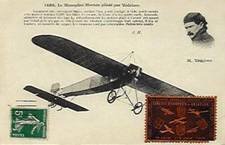
The pilot was Jules Védrines, the winner in May of that year of the Paris-Madrid Air Race. Védrines had only just returned from completing the Round Britain race earlier that month when he begun, on 13 August 1911, the first flight from Paris to Deauville, delivering parcels and newspapers. But on 16 August, flying from Paris, the engine of Védrines’ Morane-Borel Monoplane suddenly cut out just as he was about to land at Trouville, leading to him crashing in the sea – the event witnessed by Randolph and recounted years seventy years later by his sister.[4]
Védrines, in his own memoirs, described this defining event for Randolph as follows:
Just as I was to perform a beautiful loop before landing, my engine backfired a few times and suddenly stopped. … it was 12.30 and Trouville looked totally different to what it did at 6 o’clock in the morning. There was a mass of people and, arriving like a whirlwind in the middle of all this, I risked decapitating a dozen poor people …. So I had to take a decision in a tenth of a second and the result of this quick meditation was that I headed resolutely above the sea, having decided to drink a drop.
…
My plane was a better swimmer than I would have believed and I could hope that it would not become heavy immediately and could act as a refuge for me, until someone came to fetch me.
…
What bothered me the most, was to tell myself that, over there, on the beach, there was a flock of gentlemen and ladies who were in the middle of watching me drown. What must they be thinking of me?
…
Finally, at the very moment that my plane was about to leave me completely and disappear under the water, I was pulled from the unfortunate position I was in. … The little boat into which I had been put dropped me on the shore where several hundred people – to whom I have given a show worthy of Punch and Judy – were waiting for me.
…
When I wanted to walk, I noticed that in my fall, I had severely bruised my left arm and leg. I had to be supported in order to allow me to move forward.
…
My plane was equally fished out, but it was decided that it had suffered much more than I had in our common fall.[5]
The thought of flying did not leave Randolph throughout his childhood. On his death, in 1943, his sister Margaret wrote a poem in memory:
We see you now, a bright-eyed gold-haired child,
Demanding paper ships – then aeroplanes,
We hear you say you’ll some day sail a ship
And fly above the clouds, above the rains.[6]
In addition to planes, Randolph was also keen on sailing. In 1938, he bought a yacht and set sail for the Mediterranean.
|
|
| Randolph |
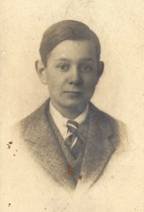
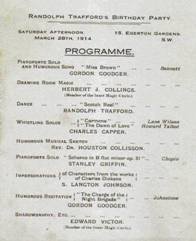
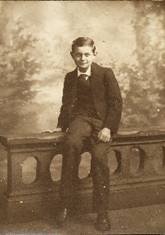
Randolph’s mother, Bettina, married a second time in 1913, Alfred Octavius Capper, a well-known entertainer and thought-reader. This second marriage did not, however, lessen Randolph’s importance in his mother’s eyes, she clearly continuing to adore and spoil him in equal measure. A smartly printed programme for Randolph’s seventh birthday, on the eve of the Great War, describes magicians, piano recitals, sketches and recitations, no doubt inspired in large measure by his new step-father.
|
|
|
| Programme for Randolph’s seventh birthday party | Randolph , aged circa 12 |
2. Switzerland : the 1920s: Mourane-Saulnier MS-137 CH-184
Randolph’s step-father, Alfred, died suddenly in 1921 on his way back from a tour in France raising funds for the waifs and strays (while Randolph was at school at Harrow). Alfred’s death, wrote Margaret,
was a terrific shock for my mother and eventually [Randolph] persuaded her to come and live in Switzerland for a time. He had heard there was good flying training there and so at last he would be able to take up flying.[7]
They moved to Switzerland in 1926. Randolph, aged just eighteen, was with his mother in Geneva and Italy from late December 1925-early March 1926 and again from the end of March to mid May (returning to England just after the General Strike had ended).[8] In December 1926, Randolph, still a minor, purchased a plot of land at Bellevue on the shore of Lake Geneva for Swiss francs 62,760, and had a house built.[9] The land was close to Geneva, just a couple of miles from the small Cointrin airport.
|
|
| Chalet at Bellevue, 1927
|
|
|
| Chalet at Bellevue, 1927[10] |

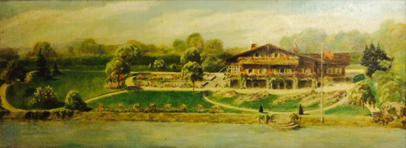
Photographs in Randolph’s photograph album for 1927-28 show not only his new aeroplane (his mother nearly always in the picture), but the recently built house, as well as a visit they made to the world-famous Vevey wine festival in August 1927.[11]
Morane-Saulnier MS-137 CH-184
|
|
|
| Morane-Saulnier MS-137 at Cointrin Airport, 1927 | |

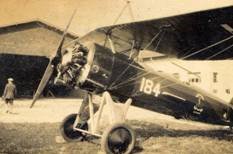
In 1927, turning down the prospect of joining the Welsh Guards, Randolph started to learn to fly.[12] He bought or leased a Morane-Saulnier MS-137. The MS-137 registered on 24 June 1927, bore the registration number CH-184.[13] First produced in 1927, the MS-137 was a trainer aircraft – a variation of the MS-138. It had a top speed of 87.5 mph or 140 km/h.[14] Randolph had his coat of arms, ‘Now Thus’, and initials, ‘R.R.W.R.T.’ painted on the side.
|
|
| Log book for CH-184 |

The log book for the CH-184 shows in detail Randolph’s training under his instructor, Marcel Weber. The initial flights, starting on 4 July 1927, were largely for durations of just 5 minutes. In an undated letter to his mother from Geneva, he wrote:
Yesterday I flew twice am and pm, most successful landings each time and I hope soon to go alone. You will have no occasion to worry however, as you know Weber would not allow me to go alone if it was not absolutely safe.[15]
His mother, however, was understandably anxious. In another undated letter, he wrote,
There is no need for you to get anxious about the flying because you know that I would not do anything stupid. I am much too serious minded for that. Nor would I do anything without M Weber’s permission, but you cannot always remain in the same place. And if you do not advance you go backward. I made three landings on Tuesday with Weber and as he was satisifed he sent me off alone. I took a friend up yesterday and he was delighted he had never been up before. I beg of you though not to be anxious because I really am not a fool. ...[16]
|
|
| Randolph ’s official Royal Aero Club photo 1928 |
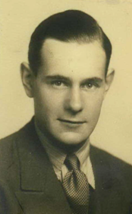
Randolph qualified as a pilot on 17 June 1928,[17] his licence being issued on 26 June.[18] In August, Randolph put forward his name to become a member of the Aéro-club de Genève. In January 1929, Randolph’s name appears for the first time on the annual list of qualified pilots in Switzerland. He held pilot licence number 72.[19] He was granted his aviator’s certificate (no 8460) by the Royal Aero Club on 12 December 1928, the club noting that he was a member of the Aéro Club Suisse.[20]
Cointrin Airfield, the Aéro-club de Genève and Marcel Weber
|
|
|
| Cointrin 1927 | Cointrin aerodrome, 1930 |


Cointrin airfield – now Geneva International Airport – was a small airfield at the time. In 1927, it had only one untarmaced runway, a house and a hangar. Just four private aeroplanes, including Randolph’s, were based there in 1929. Marcel Weber, who had learnt how to fly during the First World War, was in charge. Weber had been responsible for Cointrin airfield since 1922 and, from March 1926, became a flying instructor. Randolph, therefore, would likely have been one of the first people Weber taught to fly, since, at the start of 1929, only two other civilian pilots were based at Geneva, Frédéric A Dufaux and Marcel Geneux-Fox, both taught by Weber.
|
|
| Marcel Weber1933 |

Jean-Pierre Weber, Marcel’s son, although a child at the time (he was five in 1927), remembers Randolph as a tall man, overt et sympathique . He used to go to Randolph’s house in Bellevue with his parents and eat English delicacies, which were not found in Switzerland at the time.[21]
Marcel Weber may also have been influential in Randolph’s subsequent purchase of a Gypsy Moth. Weber bought a Gypsy Moth for the Aéro-club de Genève in October 1928, a second in March 1929 and a third in December 1929. In 1934, Weber became the official agent for de Havilland (which made Gypsy Moths) in Switzerland.
Family visit 1928
In May-June 1928, Randolph’s family came to stay at Bellevue for two weeks: his mother, grandmother, sister (Margaret), brother-in-law, aunt and uncle. They toured around in Randolph’s Rolls Royce Silver Ghost, which he had just bought, visiting Glion, and of course flew in Randolph’s plane. Margaret, in her memoirs, describes flying over the Alps (confusingly, recounting the episode as if it were Randolph talking):
My flying instructor would take them up daily in my little two seater plane – I refer to my sister and uncle, each one determined to go over higher mountains than the other. My sister won, going over the top of Mont Blanc the only time on their visit when the top was out of cloud. She said it was a wonderful sight to look down on it bathed in pink sunlight.[22]
The flying instructor was Marcel Weber.
|
|
| CH-184 flying over the Alps Stanley Orton Bradshaw, 1928 [23] |

They were also there when, on 29 May 1928, Dieudonné Costes and Joseph Le Brix visited Geneva in their famous Bréguet XIX, Nungessser-Coli , on their celebratory tour of Europe. Costes and Le Brix had just flown round the world, including making the first crossing of the south Atlantic from Senegal in Africa to Brazil. Randolph, his sister and her husband, Michael, went to their reception and dinner.[24] Photographs taken by Margaret show the plane at Geneva with Uncle Windy (Corbett-Winder) in the foreground.
|
|
| Costes and Le Brix at Geneva, Uncle Windy in the foreground, May 1928 |

At the end of June, Randolph drove back to England with his mother in the Rolls,[25] stopping off at Ypres to visit the World War One battlefields, as well as the grave of Randolph’s uncle, Dick Partridge, who had been killed in September 1918, at Beaumetz-les-Cambrai.[26]
Meetings and flying across the Channel
|
|
| Meeting at Planeyse (Neuchâtel, Swtizerland) 5-7 May 1928[27] |
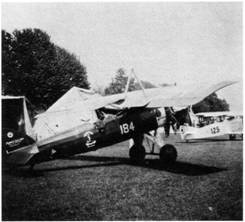
Randolph attended a number of meetings in the CH-184.[28] In 24-25 May 1928, he flew with Weber to a meeting in Lyon. On 12 July 1928, Randolph tried, with Weber, to fly to England. But mechanical failure forced the plane to land at Saint-Inglevert near Calais, after which the plane had to be completely overhauled by the manufacturers. Randolph tried again, this time successfully, the following year. Having flown to Lyon on 13 May 1929 with his mother (getting lost on the way and being forced to land in a field), he then took off two days later to cross the Channel on his own,[29] arriving at Lympne airport on 17 May. It was clearly cold since, according to his diary, on landing he went to bed for the next three days with a cold and neuralgia.[30] May, June and July were spent flying extensively around England, including taking members of his family for rides in his plane.[31] A family cine film exists from this time of the CH-184 taking off and landing.[32] Basing the plane out of Stag Lane airfield (near London)[33] and Gloucester airport, he flew extensively to Michaelchurch and nearby Bacton as well as attending the Cambridge Aero Club Air Display at Connington airfield, near Peterborough on 10-11 June and the Aerial “Garden Party” at Heston on 20 July.[34]
|
|
| Randolph at the Cambridge Aero Club Air Display, 10-11 June 1929[35] |
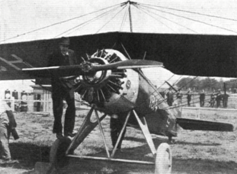
He flew back over the Channel on 28 July, leaving the CH-184 at the Morane works in Vézily-Villacoublay near Versailles until 2 August.[36] He spent the intervening few days relaxing in Paris and going to the Folies Bergère. He returned to Geneva on 4 August. Basel’s photographic archives has a photograph of Randolph next to his plane at Basel airport on his return trip from England.
|
|
| Randolph at Basel, 2 August 1929 [37] |
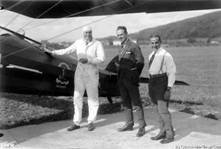
At the start of September 1929, Randolph again flew across the Channel to England, for eight days, accompanied by a friend, Gilliandro. He flew to Bacton (near Michaelchurch) and up to Bakewell in Derbyshire, for lunch with his sister at nearby Stoke Hall. On his return to Geneva, he was forced to land at Dijon due to an oil leak. The plane was subsequently taken by train from Dijon to Geneva.[38]
Randolph was back in Geneva at the end of June 1930. On 14 July, he flew for a third time (solo) across the Channel. July and August were spent flying, principally around Herefordshire and Gloucester, although the log book records six days spent at Edenhall in Cumbria from 20-26 August.[39] The last flight recorded in the log book was from Bacton to Gloucester airfield on 7 September 1930.
3. England in the 1930s: DH60G Gypsy Moth G-ABAM
DH60G Gypsy Moth G-AADD
On 6 November 1928, Randolph registered a de Havilland Gipsy Moth in his name as Topsy II . It was issued with a Certificate of Airworthiness (CofA) on 21 December 1928. However, Randolph sold it less than 6 months later on 5 June 1929 to John R C Quilter[40] of Stag Lane. His diary for 1928 makes no mention of the plane, and although Flight magazine mentions this plane as registered to Randolph,[41] it does not appear that he flew it. The plane was exported the following year to Canada. It overturned in high winds in August 1937 on Blue Sea Lake and was wrecked.
DH60G Gypsy Moth G-ABAM
|
|
|
| Randolph next to his Gypsy Moth | Gypsy Moth at Michaelchurch |
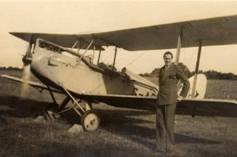

In June 1930, Randolph bought a Gypsy Moth (production number 1263), with the registration number G-ABAM. He called it Topsy III . It received its Certificate of Airworthiness on 19 June 1930 and was insured for £2,000.[42] He immediately registered for the King’s Cup Air Race on 5 July 1930, but was noted as a non-starter.[43] The Gypsy Moth, first produced in 1925, was in many ways the classic biplane of the 1930s. It had a top speed of 102 mph or 164 km/h and a range of 320 miles or 515 km.
|
|
| Gypsy Moth G-ABAM over Michaelchurch, Stanley Orton Bradshaw, 1930 |

Return to Michaelchurch
|
|
|
| Randolph with his rare birds at Michaelchurch Court, 1930s[44] | Gypsy Moth G-ABAM with Mrs Capper on ‘Peter’ at Ross Harriers hunt meeting, November 1930 [45] |
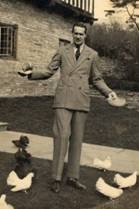
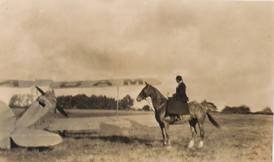
Perhaps the purchase of the Gypsy Moth provided some of the motivation to move back to England on a more full-time basis. 1928 was the year that Randolph came into his inheritance of £60,000 (equivalent to more than £3.6 million today). However, it was not until 1931 that Randolph actually moved back into Michaelchurch Court. Randolph undertook extensive alterations to the Court,[46] knocking down walls to make bigger rooms, pulling down the old stables, building a swimming pool, and, most important of all, building himself an airfield in 1930 in the fields behind the house.[47] From at least 1936, Randolph also leased a flat just off Hyde Park – Marlborough Gate Cottage, Elms Mews, Lancaster Gate.[48]
|
| |
| Michaelchurch Court
| |
|
|
|
| Map of airfield at Michaelchurch [49] | Original 1930 application for airfield[50] |
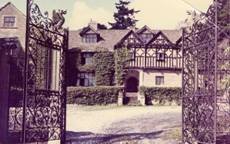
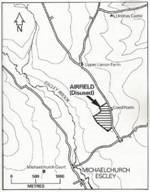
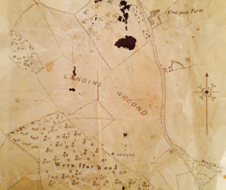
The 1930s were perhaps the golden years of Michaelchurch Court. His niece, Lindsey Baxendale (née Hunter), although only a young child in the late 1930s, remembers her regular visits there as idyllic times. Certainly, there was a lot of entertainment done, as the visitors’ book shows. Visitors came from all over: France, Italy, Switzerland, the United States, even Moldavia. Baron Robert and Baroness Diane Berckheim de Watteville from their beautiful château, Schoppenwihr, near Colmar in Alsace.[51] Baron Robert and Baroness Frideswith de Lyndon from Holland.[52] Actors. And, of course, pilots.[53] Many of the visitors flew in an aeroplane for the first time: Baptême de l’air! ; First flight – longing for more . They left other notes too: The Garden of Eden ; Not wanting to leave at all ; From the way I have been treated, I might have been the Prince of Wales .
|
|
| Silhouette of Randolph |
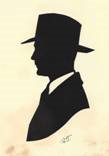
Randolph flew a lot during these years, including back and forth to Geneva.[54] The Hereford Times reported in its columns:
A Herefordshire Airman
In this issue we are able to give an aerial picture of the floods at Hereford - another example of the fact that the Hereford Times is always first with the news and the views.
Mr R.R.W.R. Trafford of Michaelchurch Court, the first individual in Herefordshire to own and fly a machine - he now has a monoplane and a biplane - flew over Hereford on Thursday and was so struck by the scene from the air, with Hereford in flood, that he landed at the Racecourse and came to our office to tell us about it.
Would anyone care to go up to see? Certainly. In a few minutes Mr Trafford had his machine over the St Martin’s district, and the Hereford Times photographer was getting his picture.[55]
In May 1936, he wrote to his mother from the Hotel Scribe in Paris, about a scrape crossing the Channel:
I rang up Croyden yesterday morning and got a fairly good weather report from the Air Ministry so we left Heston at 10 am. We circled Lympne and they gave us the all clear signal. We were also accompanied by another fellow in a moth. Well about five minutes from the coast we ran into thick fog and it really became most unpleasant as we could only see the ground now and then although we were only just over the trees. At last we found a field and I landed still in the fog, but unfortunately I slightly damaged part of the fuselage in landing, however, which prevented us from continuing by air. So after putting the machine in a farm yard (the farmer was very nice and he took great pains) and landing with a very nice Englishman we went in his car to Boulogne, took the train here arriving at 9 pm. We seem to be having a run of bad luck don’t we. The other fellow also got completely lost but landed in a field and nearly ran over the cliff but he didn’t damage anything and went home later I think. I have been trying to telephone Morane all the morning but can’t get through they make moths now I think. Anyhow I am going on to Geneva by Air Union today.[56]
Filling up with petrol
Hedley Wilding,[57] the owner of the garage at nearby Vowchurch, remembers filling up Randolph’s Gypsy Moth. He said that Randolph used to land his plane in a nearby field.
We’d carry the fuel across – it took 28 gallons in all – but Mr Trafford insisted in tipping it in himself. He filtered it through two layers of gauze, but you can’t blame him for being careful. A blocked carburetor is no fun at 1,000ft. [58]
Mr Wilding kept a few hazy photographs of Randolph’s plane being filled up.
|
|
|
| Hedley Wilding’s photographs, circa 1930 [59] | |
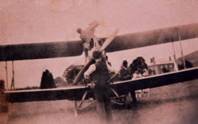

4. Air Rallies
‘German Aviators. Interesting Visit to Michaelchurch Court’, 1 July 1934 [60]
Mixing in these international circles, and with an airfield of his own – reputedly the first in Herefordshire – it was only natural that other pilots would come to visit in their planes. Visits took place each year from 1931-37.[61]
The Hereford Times reported that four ‘machines’ had arrived at Michaelchurch on 1 July 1934. They had been participating in the RAF Air Pageant at Hendon the previous day, as guests of Lord Jeffery Amherst (5th Earl Amherst) and Richard (Dick) L’Estrange Malone.[62]
|
|
| Poster, 1934 |
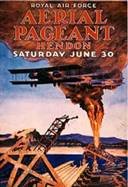
Mr Trafford went into the air to welcome the first of the two visitors, who arrived in two planes, and shortly afterwards two more machines were sighted, and they quickly came to rest on the 20 acres landing-ground which Mr Trafford has had prepared for his own use. …
The German airmen all spoke in the highest terms of the wonderful display of flying they saw at Hendon, and expressed themselves as delighted with the Herefordshire countryside.[63]
The visitors were:
Baron Alexander von Winterfeldt
Herr Zölner
Herr Schechner
Herr Klein
Walter Schumacher[64]
Lord Amherst[65]
Richard Malone
|
|
|
|
| Walter Schumacher | Jeffrey Amherst | Mrs Gladys Calthrop |
|
|
|
|
|
|
|
|
|
| Baron Alexander von Winderfeldt |
|


Baron Alexander von Winterfeldt[68] was the son of a Prussian Major General. As a fighter pilot in 1918, he shot down four planes. During the Battle of Britain, he was a Group Commander of JG 52, the most successful Luftwaffe fighter wing of the war. He had a total of 13 victories and was awarded the Knight’s Cross of the Iron Cross in July 1941. He was killed in a flying accident in May 1942.
|
|
|
| Mrs Calthrop, Margaret Hunter, Mrs Capper and Capt Michael Hunter | Mrs Calthrop, Herr Schechner and Randolph |

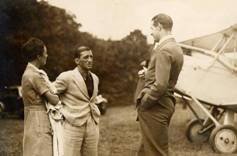
|
|
| Michaelchurch airfield (with hangar behind) From left to right: Jeffrey Amherst, Baroness de Lyndon,[69] ?Baron Robert de Lyndon, u/k, Walter Schumacher, u/k,, Baron von Winderfeldt, Capt Michael Hunter, Margaret Hunter, Herr Schechner,?Dick Malone, Gladys Calthrop, Randolph Trafford |

Photographs in the Hereford Times show Margaret and her husband, Captain Michael Hunter, a Conservative MP at the time, who was in favour of rearmament against a resurgent Germany, next to the tail of one of the planes, replete with Nazi swastika.[70]
Les Rowlands, who was a schoolboy visiting Michaelchurch at the time, later recounted how he was invited by one of the estate’s tenants -
to an aircraft display by three German airman who are on a visit.
We went up the road and joined a small group of spectators and were given a spectacular display of stunts, especially the ‘falling leaf’, equal to anything by the Red Arrows today.
One of the planes had swastikas on its wings: we little thought that those planes would be back in about ten years’ time to rain down bullets on us.[71]
Further visits by German aircraft followed, on 30 June 1935 and again in June 1936.[72]
Three Counties Air Race, 18 September 1936
Randolph did not participate in the Three Counties Air Race, but his airfield at Michaelchurch was used as one of the two turning points for the race, when the race was shortened to avoid clashing with the London-Cardiff race (thus becoming simply the Hereford Air Race). The race was won by Mr R F Hall, in an Avro Cadet, with Mabel and Sheila Glass (the ‘Middlesex Flying Sisters’) coming second, in a de Havilland Moth. The fastest time was put up by Bill Humble,[73] who had come fifth in the King’s Cup, in a Miles Hawk Speed Six. He did the 90 miles at speeds reaching 190 mph.[74] A number of the competitors landed at Michaelchurch airfield[75]
Rallye Aérien International des Grand Vins de Touraine, 24-25 July 1937
|
|
| Photograph of Pierre Parâtre of Air Touraine, given to Randolph, Tours 1937 |

‘Got first prize at Tours Air Rallye last week. Forty entries’. [76]
In July 1937, Randolph participated in the international air rally of the Grand Vins de Touraine at Tours, with Dick Malone as his co-pilot. The competition was a treasure hunt. Numbers were laid out in various vineyards in the Loire Valley. The competitors, who were given a list and the position of the vineyards, had to find the numbers and write them on a piece of paper. They then had to drop their answers at a particular spot at the airfield at Tours. The winner was the person with the correct answers and whose piece of paper landed closest to the spot marked at the airfield. Randolph won, out of 38 competitors. He won a magnificent silver cup, offered by M Dreyfus, the maker of Aviorex parachutes .[77] The competitors spent the rest of the weekend visiting vineyards and attending various dinners.
The Michaelchurch Air Rally, 29-30 August 1937
|
|
|
| Programme of Michaelchurch Air Rally, 1937 [78] | |
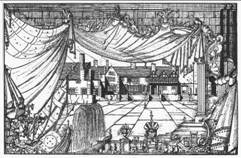

In August 1937, Randolph held a small air rally of his own at Michaelchurch.
The French newspaper, Le Journal La Touraine Républicaine , described the event thus:
Mr Trafford had invited our teams following his visit to Tours for our Rallye Aérien International des Grands Vins de Touraine, where he won the cup. He welcomed our teams in a charming fashion in his magnificant property. The following morning our teams went to Hereford where they were invited to lunch by Mrs Louise Luard, Lord Mayor of the town.[79]
Over a dozen aeroplanes participated in the Michaelchurch rally, coming from the UK, France, Switzerland and Germany. Participating were:
Air Touraine
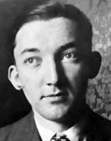
Pierre Parâtre, future President of the Club, with his wife, in a DH-85 Leopard Moth;
M Levy, with his wife, in a Caudron C-600 Aiglon (F-ANVM);
René Roncin, with Alfred Moreau and René Roncin’s mother as passengers;[80]
M Chantreau, with his wife.[81]
|
|
|
| Pierre Parâtre | René Roncin |

Aéro-club de Dieppe
Marcel Legendre, President of the Club, and his wife.[82]
Aéro-club de Genève
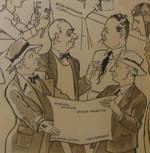
Marcel Devaud, President of the Club, with Carlos Garcia-Palacios,[83] from the Secretariat of the League of Nations, as his passenger.
|
|
|
| Carlos Garcia-Palacios | Marcel Devaud and Carlos Garcia Palacios, Aéro-club de Genève, by Kelen and Derso, 1937 |

Cardiff Aeroplane Club
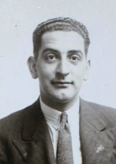
Leslie Arnott,[84] with either Dr Llewelyn or Dr Nicol as a passenger;
Redvers Smith,[85] with Mrs R R Smith;
Capt Geoffrey Jones,[86] with Mrs G Jones;
Flying Instructor Kemp, with either Dr Llewelyn or Dr Nicol as a passenger;
Mr Godfrey (flying solo).
|
|
|
|
| Leslie Arnott | Redvers Smith | Geoffrey Jones |
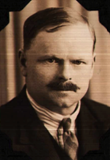
Other British aeroplanes
Richard L’Estrange Malone in a Short Scion;
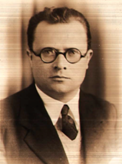
Leslie Castlemaine,[87] of General Aircraft Ltd, in a Monospar.
|
|
| Leslie Castlemaine |

German Luftwaffe delegation
Herr Clausen, with Herr Mostler as a passenger, in a Klemm KL-35.
The rest of the German delegation included:[88]
Major Hans Seidemann (Group Leader in the 1st department of the Luftwaffe
General Staff)
Hermann Brand (Frankfurt);[89]
Herr and Frau Otto Mendl (Vienna);
Count Speck-von-Sternberg;
Herr Fordein;
Herr Nitsche.
Many of the visitors had flown direct from the International Air Rally of the Cinque Ports Flying Club at Lympne, which had been held that weekend. Herr Clausen had won the Wakefield Cup at Lympne, with Hans Seidemann coming fourth.
Other guests included Lord Beauchamp and Lord Trevethin.[90] The 7th Earl Beauchamp Madresfield Court, Worcestershire,[91] previously Lord President of the Privy Council and later leader of the Liberal Party, had gone into exile following his ‘outing’ as a homosexual in 1931. But he had returned the previous month, when the arrest warrant for him had been lifted, following George VI’s ascension to the throne.
The visitors attended a dinner at Michaelchurch Court and the following day they had lunch with the Mayor of Hereford, and a tour in private cars of the Wye Valley, stopping at the houses of various of Randolph’s relatives in the area, including Mrs Guy Trafford at Hill Court, and the Corbett-Winder’s at Handley Cross.
René Roncin’s mother describes the rally as follows:
The following day, we were the guests of Mr Trafford at his private airfield at Michaelchurch. It was a typical calm English Sunday with French sun. The enchantment of the trip began. … Under the sign of the rose of York, we flew towards Wales, soon followed by M Legendre of Dieppe, M et Mme Deveau (sic) of Geneva and two German planes. Never had Michaelchurch seen such a flock of wings. To facilitate the landing, we were obliged to leave our Farman at Heston and to continue the flight in Mr Malone’s 5 seater twin engine Short.
Receptions, official and private dinners, teas, cocktails and more cocktails … how not to abandon oneself to this generous welcome, whose printed programme I have now under my eyes, with a view of Michaelchurch Court on the cover, next to the Trafford coat of arms, set in a theatrical decor. The most authentic and romantic setting you could imagine, with waist-coated servants, family portraits, tapestries, hunting trophies, rare birds and above all flowers in deep halls like those of churches, and in the gardens which prolong the ever green countryside, decorated with ruins, as in the paintings by Hubert Robert, and animated with cattle, as in Corot’s paintings.
That’s how Michaelchurch appeared to us, and the following day, Goodrich Castle and Goodrich Court, owned by Mrs Moffat, and the wonderful house of Mr Corbett-Winder, a great hunter – all more or less related to Mr Trafford and his mother, Mrs Capper, who did the honours with infinite grace – in the vast undulating countryside, with Hereford as its capital.[92]
The German delegation
The German delegation was likely invited by Dick Malone, who translated Seidemann’s speech at the dinner.
Major (later General) Hans Seidemann
|
|
| Major Hans Seidemann |
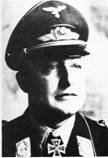
Major Hans Seidemann, the head of the German delegation, had spent much of 1937 participating in air rallies in Europe. By this time, he was already an experienced pilot, having come joint 7th in the 1932 Challenge[93] staged in Berlin, flying a Henkel He 64b,[94] and 3rd in the 1934 Challenge, staged in Warsaw, flying a Fieseler Fi 97.[95] On 16 May 1937, he won the Air Race Challenge Cup in the London to Isle of Man race, flying a Messerschmitt Bf 108 (on winning the race, he said it was ‘better to race in peace than in war’ ). The following day, he then came second in the Manx Air Derby.[96]
On 25 July (while Randolph was winning the Air Rally at Tours), Seidemann won the more prestigious Circuit of the Alps Race in Zurich – a 230 mile race round Alpine peaks - flying a Messerschmitt Me-109 fighter at 240.9 mph.[97]
Then on 28 August, Seidemann was back in England for the International Air Rally at Lympne. He did less well here, flying an Me-108, reaching the final of the Wakefield Cup, but only coming fourth.[98] He must have been slightly disappointed, therefore, when he arrived at Michaelchurch later that day (mitigated only by Herr Clausen’s win for Germany).
But, if Major Seidemann had had a successful 1937 racing aeroplanes, it was his subsequent career that marked him out for fame. In December 1938, he went to Spain to fight in the Spanish Civil War in support of General Franco. He was Chief of Staff of the Condor Legion, a group of ‘volunteers’ from the Luftwaffe who served under the command of the Spanish Falange. Shortly after the Second World War broke out, in December 1939, he was made Chief of Staff of the Luftwaffe’s Fliegerkorps VIII. As soon as the Battle of Britain began, in August 1940, he was transferred to the staff of Luftflotte 2, with its headquarters at Brussels, being promoted to Chief of the General Staff of Luftflotte 2 in October 1940 under Field Marshall Albert Kesselring. Luftflotte 2 was responsible for the bombing of south-east England and the London area during the Battle of Britain.
In June 1941, Luftflotte 2, with Seidemann still as its Chief of Staff, took part in Operation Barbarossa and the invasion of the Soviet Union. The following year, in August 1942, Seidemann, promoted to Major General, transferred to Fliegerkorps Afrika, to support General Erwin Rommel in the Desert War. For a short time in 1943, he was Commanding General of Fliegerkorps Tunis, before they were forced to surrender in Tunis in May 1943. From May 1943, until the end of the war, Seidemann, promoted to Lieutenant General and finally to General der Flieger, was Commanding General of Fliegerkorps VIII. For his efforts, he was awarded the Oak Leaves to the Knights’ Cross of the Iron Cross, the highest award of the Nazi regime.[99] Seidemann surrendered on 8 May 1945, but was not prosecuted at Nuremberg. He died on 27 December 1967.
Herr Clausen and Count Speck-von-Sternberg
|
|
|
| Herr Clausen receiving the Wakefield Cup | Erwin Clausen |


Herr Clausen was described as ‘an experienced race pilot’ when he won the Wakefield Cup at Lympne in 1937. The Folkestone Herald has a photograph of him holding the cup.[100] Clausen is likely Erwin Clausen, one of the ‘aces’ of the Luftwaffe, who is credited with having shot down 132 planes during the Second World War, before he himself was killed on 4 October 1943 in aerial combat over the North Sea. Like Seidemann, he was awarded the Knight’s Cross with Oak Leaves.
Herr Clausen, at Lympne caused
an amusing incident when Mr Noel Coward presented the prizes. Herr Clausen, called upon to receive the Wakefield Cup and the £50 that goes with it, raised his right hand in the Nazi salute. Mr Noel Coward, nonplussed for the moment, smiled and hesitantly followed suit. The distinguished guests on the stand and the hundreds of onlookers were delighted. [101] [102]
Count Speck-von-Sternberg – Oberleunant Johannes Speck von Sternberg – had a less glorious career than either Seidemann or Clausen, but was known to have flown in the Battle of Britain. He was eventually killed on the night of 10-11 May 1941, when his plane crashed south of Birmingham.
Randolph did not realize that these Germans, who he invited to dinner at his house, would two years later be attacking – and come close to defeating – Britain. One wonders, however, what his earlier guest, Francis Biddle, would have thought, later the American judge at Nuremberg, or Geoffrey Lawrence – the younger brother of Lord Trevethin, who sat down to dinner that day at Michaelchurch Court with the German delegation – and who was the main British judge at Nuremberg.
Dick Malone
|
|
| Probable photograph of Dick Malone |

Dick Malone,[103] Randolph’s closest friend in the flying world during the 1930s, was a commercial pilot.[104] He was a regular visitor to Michaelchurch between 1932-37, visiting in various planes no less than nine times.[105]
Malone qualified as a pilot on 21 July 1932 in a Gypsy Moth at the Airwork School of Flying. At the time, his profession was noted as insurance (his father’s profession).[106] But this did not last, and shortly after he appears to have transferred to being a commercial pilot. Already by 1933, he was flying passengers around Europe:
Mr R. L’Estrange Malone left on 25th [August] for Dusseldorf, where he dropped his passenger, Herr Rebling,[107] a very well-known German pianist, who has been fixing up concerts in England. On his return, Mr Malone brought Herr Brengs, a German war pilot, home with him from Cologne.[108]
In 1934,[109] Malone was working for Henlys, the agents for Avro Avian and Spartan Aircraft,[110] moving in April 1935, with the rest of the Henlys sales department, to work for Airwork, where he remained.[111] Flight magazine noted, in its edition of 23 January 1936 :
Mr R L’Estrange Malone, Airwork’s European sales manager, is to tour the Continent for about two months in a D.H. Hornet Moth, for contact and demonstration purposes. He is due to leave in three to four weeks’ time, and will commence with a visit to Spain and Portugal. The tour, which is to finish in Scandinavia, will probably include all European countries excepting Italy. Continental aero clubs, air transport companies, and private pilots interested in any type of British aircraft will be assured of special attention if they write their requirements to the Airwork sales department, Heston airport, London, at the earliest possible date.[112]
In 17 July 1936, Malone was among 12 British planes from four flying clubs who flew to Frankfurt for an air rally.[113] The German magazine, Flugsport , noted :
Mr Malone of the Royal Aero Club thanked [the organisers] for the warm reception and invited the German air comrades to a new flight to England. Through a triple “Hipp, Hipp, Hurrah”, the English guests expressed their eloquent joy”.[114]
Less than two weeks later, on 1 August 1936, Malone, together with Lord Malcolm Douglas-Hamilton,[115] delivered a de Havilland Dragon Rapide[116] to General Franco’s Spanish Nationalists in Burgos. The Spanish civil war had broken out just two weeks earlier. The flight had to be done in secret, since dealing with either side in the conflict was against British government policy, and any pilot caught flying to Spain would have had his pilot’s licence cancelled. The plane they delivered was subsequently used in the civil war against the Republicans as a fighter/bomber.[117] Leslie Castlemaine, a friend of Malone,[118] who had also flown a plane[119] from Heston two days previously, met up with Douglas-Hamilton (and presumably Malone) in Burgos. He described the return journey by car across Spain as rather like a comic opera , flying the red and black Falangist flag, until they had to pass through Republican-controlled areas, when they changed the flag and gave the Republican clenched fist salute to all and sundry.[120]
One of the most important annual air races in Great Britain, the King’s Cup, was held a week after the Michaelchurch air rally in 1937. Although Malone did not compete in it, someone who did was Alex Henshaw. He noted in autobiography,
On the 6th of September Dad and I borrowed a Leopold Moth from Dick Malone of Airwork, and flew over the King’s Cup course to Scotland, Ireland and Wales, and then back to Hatfield.[121]
There is no indication from official records that Malone ever joined the armed forces in the Second World War. On 3 May 1941, he embarked on the MV Sangara , bound for the West Coast, Africa. He gave his occupation as pilot.[122] However, he was clearly subsequently based in the Middle East, working as a pilot, possibly for Airwork.[123] In August 1943, Malone flew to see Noel Coward at the British Club in Basra in Iraq, who was there to perform to the troops. [124]
In his autobiography, Lord Amherst wrote:
During he Second World War Dick had certain assignments in the Middle East where I was able to keep track of him and incidentally supply him with an army revolver, with the identification marks erased. Just after the end of the war he was a passenger in a Misr Airways flight to Alexandria, which crashed, killing everyone on board.[125]
Malone was killed on 24 August 1946. The Londonderry Sentinel reported:
Egypt Plane Crash. Six killed
A British captain and an American newpaper correspondent were among the five passengers killed when an Avro Anson plane of the M.I.S.R (Egyptian) Air Lines made a forced landing and caught fire thirty three miles from Almaza aerodrome on Saturday night.
The wireless operator was also killed.
The dead passengers included Captain R.L. Malone, a Briton, and Mr William Price, correspondent of the American magazine “Time”.
Two other passengers were injured.[126]
According to a separate Reuters/AP article of 26 August,[127] the plane had departed from Lydda in Palestine, bound for Cairo. The pilot was injured, as was William Price’s wife, but both survived.[128]
Malone is buried in Cairo War Cemetery.[129]
|
|
| Dick Malone’s grave in Cairo War Cemetery |

5. Cars and Travel
Although flying was Randolph’s main preoccupation during these years, it was not the only thing he got up to, which included, in 1935, acting in the West End production of Murder in Motle y at the Winter Garden Theatre in Drury Lane. Randolph played the part of Dr Congrieve.[130]
Cars
Randolph was a car enthusiast.[131] His first car was an Amilcar (registration no YK 86)[132] – likely an Amilcar CGS[133] – which Randolph used extensively. His 1926 diary records a trip to Geneva and, later in May, a trip from Paris to Dieppe.
On 23 April 1928, shortly after his twenty-first birthday, Randolph wrote in his diary, whilst he was living in Geneva, “saw Rolls Royce ”. On 30 April, he wrote, “bought Rolls Royce ”.
|
|
| Rolls Royce, Switzerland, May 1928 |

The Rolls in question was a 1922 Silver Ghost, chassis no 2HG.[134] [135] He likely bought it from the Rolls Royce agent in Geneva, Albert Schmidt SA.
|
|
| Rolls Royce record for chassis no 2HG |
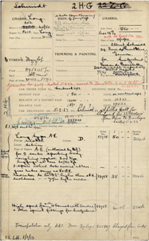
On 1 July 1928, Randolph drove the car to England (“crossed to Dover ”), taking the car to Rolls-Royce on 2 July (presumably in London).[136] He subsequently registered the car at Michaelchurch Escley,[137] the UK registration number being VJ 989.[138] On 31 August, he drove the Rolls to see his sister at Stoke Hall in Derbyshire.[139]
|
|
|
| Randolph ’s Rolls Royce Silver Ghost (VJ 989) at Michaelchurch | |
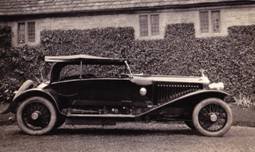
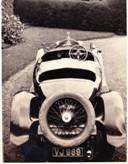
Randolph kept the car just two years, subsequently selling it in April 1930 to University Motors in Notting Hill Gate, London.[140]
|
|
|
| Subsequent owners of Rolls Royce chassis no 2HG | Final DVLA record for VJ989, 1948 |
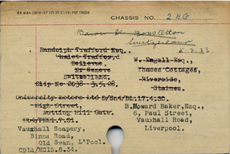

Hedley Wilding, who would have serviced the cars, remembers Randolph owning in addition a Sunbeam,[141] which he likely bought after he sold the Rolls Royce, and a Lagonda,[142] which he dates to 1931-32 and that, according to him, had front wings which moved with the wheels.[143] [144]
|
|
| Hedley Wilding’s garage, Vowchurch |

Randolph also owned a 1935 British-built Hudson Eight Drophead Coupé,[145] with registration number beginning BYH[146] (Wilding remembers it as an Essex Terraplane, the predecessor to the Hudson Eight).[147] Randolph still owned this in 1940 and, given the war, it was likely his final car before he was killed.[148]
|
|
|
| Randolph with his mother (and nieces), 1940 | 1935 Hudson Eight Drophead Coupé |
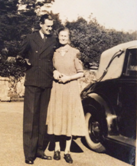

|
|
| 1935 Hudson Eight Drophead Foursome Coupé[149] |
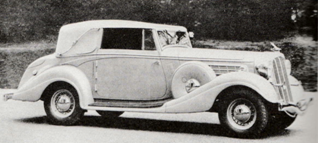
Randolph was President of the Wye Valley Auto Club for a number of years, and hosted various competitions of the club at Michaelchurch Court.[150] According to Wilding, the Auto Club used to hold time trials down the front and back drives of the Court. Somebody was directed to stand at the entrance to the Court to ensure that no cars were coming in the opposite direction when the cars sped out of the drive onto the road.[151]
|
|

A newspaper article, which appears to be dated June 1932,[152] reported:
On Sunday, at the Weir End, Ross-on-Wye, a motor rally was held under the auspices of the Western Centre of the Auto-Cycle Union. Over 100 motor-cycles and cars were present, whose drivers took part in the various sports and competitions such as chasing an aeroplane piloted by Mr RRWR Trafford, egg and spoon motor-cycle race, three-legged football match, and guessing competitions.
Mr Trafford also gave a demonstration to the gathering of how not to fly, an exhibition which provided plenty of thrills and excitement for the onlookers. …
Randolph was also the inaugural member of the Hereford Gliding Club, which was formed in 1936.
Travel
Between 1931-37, Randolph travelled extensively, partly it seems, to avoid the English winters. In 1931, he made a world trip, spending two weeks in Ceylon (including visiting his late father’s old tea estate at Poyston), followed by Singapore, Hong Kong, Japan (whilst in Tokyo, he picked up some mandarin ducks for his ‘zoo’ at Michaelchurch), Vancouver, the Niagara Falls, New York and, finally, home on the Aquitania .
He travelled again in April 1933, this time to New Zealand, returning to England on the RMS Rangitiki with Dr Leslie Utz[153] and his wife, Lorna,[154] who subsequently came to stay with him at Michaelchurch.[155] In 1934, he went on yet another world trip, this time to Australia for the centenary celebrations of the State of Victoria, attended by Prince Henry, the Duke of Gloucester. The Times noted in September 1934,
Mr Trafford has left Michaelchurch Court and is sailing today for Australia. No letters will be forwarded.[156]
He stayed with the Utz’ in Sydney and went with them to Melbourne in October 1934 for the centenary celebrations.[157] He returned back to England in January 1935.[158]
The Utz’s have prepared a lovely time for me; we have four days racing in Melbourne and then go to Sydney, we stay in Melbourne about a fortnight and the other days will be taken up with the Centenary Exhibition and celebrations, theatres, dances, etc.[159]
Despite all the excitement, he had not completely forgotten his flying:
I forgot to tell Cooper about turning over the propeller of the Moth. I only want him to open the doors of the hanger and turn over the prop about ten times slowly about once a fortnight. No need to pull the machine out. Also it wouldn’t hurt to jack up the wheels. Do not run the engine.[160]
Randolph’s presence in Australia did not go unnoticed, the Australian Women’s Weekly commenting on the ‘English visitor’, Mr Randolph Trafford who, along with a couple of others, ‘all towered over their fellow men at this week’s functions .’[161]
Randolph travelled to New York and the East Coast in late 1935.[162] On the way over, he met Katherine Biddle, a minor American poet and the wife of Francis Biddle, going to stay with them in Philadelphia. He wrote to his mother[163]
Mrs Biddle is charming and very clever and writes beautiful poetry. I read some of her own poetry to her and I think she really enjoyed it as much as I. …
She has asked me to spend a few days at their home in Philadelphia so I may go there for a weekend.
The following year, in July-August 1936, Francis and Katherine Biddle visited Michaelchurch with their son, Randolph. In early 1940, Francis Biddle was to become Solicitor General under President Franklin D Roosevelt and then, in 1941, Attorney General, in which position he served for the duration of the war. In 1945, he became the main US judge of the Nuremberg war crimes tribunal.
They stayed in touch thereafter. On 30 March 1940, having seen a photograph of Francis Biddle in the 19 February edition of Life magazine, following his appointment as Solicitor General, Randolph sent a telegram to the Biddle’s in Washington DC: Just seen excellent photo in Life. Many congratulations on appointment. All best wishes to you all. Ever yours Randolph Trafford . [164]
Randolph travelled to New York in April 1937, no doubt visiting the Biddle’s again on that trip, returning once more on the Aquitania .[165]
6. South of France: Randolph’s Yacht, Viva
|
|
| Schooner ‘Viva’[166] |

Towards the end of 1937, Randolph transferred his passion for flying to sailing.[167] He sold his Gypsy Moth (G-ABAM) in August 1938, replacing it with a Puss Moth (G-AAXR), bought from his friend, John Hancock, who lived in nearby Ross-on-Wye.[168] But he sold this again on April 1939.[169]
In August 1937, Randolph wrote to his sister:
I am in the throws of buying a boat in which I propose to sail the seven seas for several years but mostly the Pacific. Mummy says she will come too so I shall be very happy.
I hate this awful climate have got away from the dreadful winters as often as I could, but the so-called summers seem to be as bad.[170]
However, it was not until December 1938 that he finally bought the 70ft (21m) Steel Auxiliary Schooner, Viva , designed by Linton Hope, from the 8th Baron Howard de Walden, for £3,000.[171] Once fitted out, he set sail on 17 December from Hythe, seen off by his mother, without waiting for the Lloyd’s Register of Shipping survey.[172] In the end, he did not sail to the Pacific, but headed for the Mediterranean. He took with him for crew a local man from near Michaelchurch, Trevor Price.[173] Randolph headed first for Gibraltar, with a letter of introduction to George Townshend (the 7th Marquess Townshend and aide-de-camp to the Governor of Gibraltar), asking him to ‘give them a party’.[174] He left Gibraltar on 18 March, heading for Sicily, where his cousin, Ivor Manley, owned a hotel.[175]
|
|
| Randolph sailing |

Randolph was in Cannes with friends between May and August 1939. Letters to his mother sent during this period show a hedonistic time, seemingly oblivious to the impending war. From St Jean-Cap Ferrat, he wrote:
Time loses its meaning here. I should have returned to Cannes today, but now I am staying till tomorrow. Bobby[176] gave the crew a marvelous lunch yesterday, the steward told me this morning that they had eaten nothing since. I have never stayed anywhere where I have been able to feel so at home, and I can always pop back on the boat when I want to. We usually bathe from the yacht each morning and evening. … I just cannot be bothered to write to anyone but you; life is too lovely and languid. …[177]
Randolph’s letters make no mention of the international situation. However, there is a clue that he realized things might not last forever, if only for financial reasons. On 14 June 1939, despite only having bought the boat six months earlier, he wrote to his mother:
The owner of the ‘Marie Galante’ … has been to see Viva and there is a possibility of him making a good offer for her.
If he did do so, I should feel I must sell. I have grown to love Viva and it would be a great wrench, especially as I run her myself but I fear the pocket will not meet the expense of keeping her on.[178]
However, six weeks later, on 28 July, he wrote again to his mother:
I think I can just manage to go on. I have just got so terribly fond of the old ‘Viva’ and everyone seems to think she is awfully nice. When I pretend I want another boat as an excuse and look over one people always say I couldn’t do better than keep what I’ve got. I think she would sell easily around 3 or 4 thousand, but I should hate to part with her at this price. However if I was offered 5 or 6 I should feel I ought to sell, and then I should regret it. ... I’m afraid I’ve got bitten by it and for the first time have not the slightest desire to return to England and its rain and fog. ...[179]
His mother came to stay with him in Cannes in August for two weeks, arriving on around 9 August. After she left, with war all but inevitable, Randolph sailed on 27 August from Cannes, via Marseilles, to Sete. From there, he wrote again to his mother:
I intend to stay here and see what happens. If everything calms down I shall go quielty back to sea to England, calling at lots of ports ‘en route’, if the worst happens I may try and go back across France in the launch through the canals to Bordeaux or further and then by boat, or by bicycle or even train. At all events, although it is dull here, there is a wonderful fishing fleet bringing in fresh fish daily, quite a good market and fairly good meat too so we shall not starve as long as the money lasts. I intend to enjoy myself as much as possible while here sailing in the lake etc so don’t worry about me in the least. ...[180]
Randolph was still in Sete on 3 September, when Britain and France declared war on Germany. He sent a telegram to his mother in Michaelchurch:
Laying up the yacht returning as soon as traffic permits. Please inform crew familie (sic) all very well love Randolph. Inform crew familie (sic).[181]
Randolph left the yacht at Sete, apparently in the hands of Mr T A Lilly[182] and then with Jean Mestres, to whom he agreed to pay Frs 1,000 per month, and made his way back to England.
Exceptionally, Randolph was allowed return to France in 1940. On 30 March, the Naval Attaché at the British Embassy in Paris, gave Randolph permission to travel to Sete on unofficial leave.[183] Germany invaded France just six weeks later on 10 May 1940.
In July 1940, a few weeks after Pétai n’s Vichy government signed an armistice with Germany,[184] Randolph wrote to his mother:
… I have never heard what has happened re the ‘Viva’ did the Frenchman take over?. And where is Jerry? …[185]
In October 1940, Mestres sent Randolph a letter from Vichy France assuring him that the yacht was in good condition and that he was continuing to maintain it. However, on 6 February 1942, the yacht was requisitioned by the French authorities.[186]
6. Second World War
|
|
|
| Randolph , c 1939 | Randolph c 1940 |


What I had once done for pure joy could, at last, be done for duty .[187]
On 2 October 1939, four weeks after leaving Sete, Randolph enrolled as a temporary Sub Lieutenant (A) in the Royal Navy Volunteer Reserve (RNVR) and was posted to the Fleet Air Arm’s Royal Naval Air Station (RNAS) Eastleigh (HMS Raven), near Southampton.[188] The Fleet Air Arm, part of the Royal Navy, would have appealed to him more because of his combined love of flying and sailing.
|
|
| Randolph during the Second World War |

He wrote to his mother on 30 October from the Royal Naval Air Station at Worthington, near Winchester:
It seems that all I and the others do is to sit in a little model aeroplane in a large room (heated fortunately) and learn to fly by instruments only. You are completely shut up in the little box and it gives you all the sensation of flying but all you see are instruments.[189]
He wrote from Eastleigh on 13 November:
This course will take about four weeks and then I shall probably be posted somewhere else.
A few days later he wrote,
I am having a series of lectures on Naval Order and Discipline (including Ranks and punishments etc), Aircraft navigation at sea, prohibited areas now in force in England, instruction in morse and signaling. All this with flying instruction of a special kind, so you see my time is quite full although quite a lot of it is kindergarten stough (sic) to me. … We also have an MP and several people who have given up jobs worth a thousand a year and over and are now living on little more than their pay. (The MP is still getting his £600). [190]
But despite the war, old habits died hard:
… I went to bed at 8.30 last night and ordered some oysters to be cooked in the D[evonshire] cream and some roast chicken and a bottle of bubby. …[191]
He moved from the barracks to the Polygon Hotel in Southampton:
Although the fare was fairly comfortable I did miss my morning bath and it was a bit cold in the morning. I have a nice warm room and bath at the Polygon and am able to have my tea at 7am and get up in a warm atmoshpere and shave comfortably and arrive here in plenty of time for breakfast. ...
Please don’t send me anything unless it is some Port (decanted).[192]
In December 1939, Randolph was flying, taking navigation exams and learning to shoot.[193] In what appears to be handwritten lecture notes amongst Randolph’s possessions, the first few weeks of training are described as,
Generally being shaken out of civilian easy going habits, and smartened up to be snappy, quick off the mark, and in right frame of mind for instantaneous willing obedience to all orders.[194]
On 12 December, still at the Polygon Hotel in Southampton, he wrote to his mother:
This morning some of us went over the Imperial Airways flying boats they are Enormous (sic), we went over to Hythe in a launch from the Quay you saw me off from in the yacht.
We had to rush back to Estleigh (sic) in time for the fifth sea Lord who flew down and spoke to us at 11.30.
This afternoon I flew with myself for a bit in a Vega Gull, this at least was warm.[195]
A week later he wrote that he was flying a Hart.[196] And then on 20 December,
I am rather pleased with myself because I am first of this course to go solo, so I have got on I feel.[197]
A report by his superiors of 4 January 1940 appears to justify Randolph’s optimism:
This officer has considerable private means and has had no previous service experience. He has the responsibility of his age and has shown himself very anxious to accustom himself rapidly to service procedure. He is recommended for early promotion as soon as he has gained a little more service experience.
On 24 January 1940, Randolph was transferred to 755 Squadron at RNAS Worthy Down (HMS Kestrel), near Winchester and promoted to temporary Lieutenant (A).[198]
On 26 January, a couple of days after arriving at Worthy Down, he suffered an engine failure flying a Blackburn Shark (a trainer). He was obliged to make a forced landing at Hucclecote in Gloucestershire. Neither he, nor his passenger, Naval Airman J T Beach, were hurt.[199]
In April 1940, he moved to Worthy Down, taking a house at 59 Kingsgate Street in Winchester:
I have engaged an elderly but, I gather, active couple who are just free and have been five years running a home for a local Doctor. Mrs Maidment my daily woman says she has seen them at the doctor’s and thinks I am very fortunate. So I hope all will be well. They are or seem most superior people ...[200]
Whilst he was at Worthy Down, he went house-hunting, viewing a house on the Hamble that he thought he would like to buy. His search continued into late 1941 and May 1942[201]
Further courses continued. Randolph attended the Tactical Surveillance and Reconnaissance course at RAF Abbotsinch, near Glasgow, in June-August, learning to fly the Swordfish and the Shark, and where he was assessed as a torpedo pilot:
Very keen officer who should do well in the service. Good personality. Four dummies and three runners were dropped during course.
In August 1940, he moved to the Royal Naval Air Station at Arbroath, where he took the DLT (Deck Landing) course with 767 Squadron:
Passed 78% Swordfish and Albacore. A very keen and adept officer and a good pilot. Should do well.
On 14 August , a German aircraft was brought down about three miles from Arbroath. Randolph wrote to say that he had been to see the only German survivor (one of three) in hospital:
… he is so thankful to feel there is someone friendly. I sat for an hour with him yesterday. He is a bad patient as leg badly broke up and terribly horrid all over. I shall go and see him again this afternoon. He was born in Africa Tanginyka in 1914 and his parents went back to Berlin when the colonies were taken from the Germans.
It must be awful to be so ill in enemy country. He hasn’t smiled once, although I have tried, but he is verry grateful to me for the little I have done.[202]
On 26 August, he wrote to his mother:
Two young fellows who crashed here last Friday were buried today. As Richard would have said the Pilot was too young and venturesome. In other words, he was inexperienced and trying to be clever. It is a warning to others. It is easy to get killed nowadays without doing it unnecessarily. …[203]
The initial training over, Randolph was posted to his first operational squadron, 828 Squadron, which was formed on 16 September 1940. 828 Squadron would prepare themselves for operational deployment abroad and, whilst in training, operate under RAF Coastal Command. Initially based at RNAS Lee-on-Solent (HMS Daedalus) and then RNAS St Merryn (HMS Vulture) in Cornwall, 828 Squadron moved to RNAS Campbeltown on the Mull of Kintyre in Scotland in mid November 1940.
From now I shall have my own aeroplane which no one else will fly except in very special circumstances. Also when our squadron is formed I shall be the leader of one of the subflights, which I was recommended for, also I am third in seniority. This entails more responsibility but less strain on long formation flights. But in Torpedo attacks my efforts good or bad will make a big difference to the results of the other two pilots in my subflights. We shall be busy here for a fortnight and then our squadron will go to Devonshire to train for 3 weeks and back to Campbeltown an outlandish part of Scotland.[204]
It was at this time – October 1940 – that Randolph’s mother moved out of Michaelchurch Court to another building on the estate, The Cottage. The Court was let to the Canadian Air Force.
Randolph’s love for flying did not abate. Whilst at RNAS Campbeltown, he wrote,
If it were not for my great love of flying I would be fed up. But I adore the flying passionately.[205]
828 Squadron’s diary for the period September 1940 – June 1941[206] provides a detailed account of the squadron’s training. Initially equipped with just two Albacores (just one of which was usable), they were eventually allotted a full complement of ten planes. The other nine pilots in the squadron at the time were:
- Lt Cdr L A Cubitt (Commanding Officer)
- Lt R Ross-Taylor
- Lt Eric Arthur Greenwood
- Lt Williamson
- Lt (A) L E R Bellairs
- S/Lt Howard
- S/Lt Head
- S/Lt Brigden
- S/Lt (A) Donald Richard Mckay
|
|
| 828 squadron (Randolph front row, centre)[207] |

The training involved deck landing, dive bombing, wreck bombing, glide bombing, dawn and dusk attacks, night flying and, of course, lectures. Not everything went smoothly. One plane was written off in a crash on 4 December. Another crashed on landing on 8 January 1941.
Throughout all this, Randolph appeared to thrive. His report from 828 Squadron for 1940 noted that he was an above average steady pilot with much experience of civil flying .
Things were clearly starting to become serious, as their training came to an end, as an undated, censored letter that he sent from Campbeltown makes clear:
I believe we are going to do some (next few words cut out) in about (cut out) days but I do not know if this means we shall go off for good or not …
It seems that (next two lines cut out) after that I hope to see you again.[208]
Unfortunately, at the very moment that 828 squadron was about to become operational, Randolph’s operational flying days were over. On 3 February 1941, he went to RNAS Prestwick (HMS Gannet) with Bellairs and Bridgen for ‘compass swinging’. The flying training and administration offices and Watch Office caught fire and were completely gutted.[209] Seven people died in the fire which was believed to have been started in a waste paper bin.[210] Randolph, who was in the building at the time, was forced to jump from a third floor window.[211] He suffered a fractured heel, burns to his face and hands, and laceration of the face. The squadron diary recorded it simply: No swinging done due to fire. CO to Prestwick to investigate. By the end of the month, Randolph had already been replaced by Lt (A) Edward Eryl Hughes-Williams.[212]
Randolph was in and out of hospital until July. A medical opinion dated 8 April 1941 by a Dr Robert Stirling of Edinburgh described his injury:
I would say that the fracture you have had of the heel bone is of a very severe nature; the bone was not only shortened and driven up but was also split so that the joint below the ankle joint, has been broken into in several places. …[213]
On 6 July, he wrote to his mother from R N Hospital, Barrow Gurney, near Bristol:
… I am now able to walk with only one stick but only a short distance and I get rather tired, but I am alright again as soon as I sit down.[214]
When he was finally discharged, he went to stay for a few days with his sister at Gissing Hall in Norfolk. His mother came too. A united family. A happy stay. Perhaps I can come again – one day. [215] On 8 August, the medical board noted: Shore ground duties only .[216] His flying allowance was also discontinued.[217] Randolph was deployed to 781 Squadron, where he sat on the selection boards in Oxford under Admiral Arthur Bedford. Finally, on 6 February 1942, the medical board instructed that Randolph should be permitted non-operational flying only .
Randolph’s report for the period 30 August 1941 – 12 April 1942 noted:
This officer is a very capable and reliable pilot and has shown much commonsense and good judgment in connection with communications and ferry trips carried out by him whilst in this squadron. He is a most superior and pleasant personality and is well above average in intelligence. He is, however, apt to fraternize somewhat freely with junior officers, thus reducing to some extent his powers of leadership … By virtue of his charm of manner he is an excellent officer for interviewing Y scheme candidates.
Randolph’s injuries meant that the medical board would never allow him to fly operationally again. Randolph must have been disheartened. Whilst he was confined to England, 828 Squadron embarked in July 1941 on HMS Victorious for the ill-fated attack on Kirkenes, Finland, and then in September 1941 on HMS Ark Royal to Malta, where they operated from Hal Far against enemy shipping to Libya.[218]
In a sense, perhaps, Randolph was lucky – though he is unlikely to have seen it that way – since 828 Squadron were hard hit. Of his nine colleagues, Cubitt was injured on 1 April 1941, when his plane crashed in Sutherland during an anti-submarine search.[219] McKay was killed in the disastrous Kirkenes strike on 31 July 1941, when the Luftwaffe shot down 15 British aircraft; Bellairs, Ross-Taylor and Howard were taken prisoners of war.[220] And finally, Greenwood, together with the new CO of 828 Squadron, Lt Cdr Langmore, were lost on 18 December 1941, when their Albacore crashed into the sea.
In August 1942, Randolph was finally released from selection boards in Oxford, and released to start training cadets, initially flying round the various areodromes giving lectures to University Air Squadrons and ATC units. By September, however, he was back to flying:
… Flying on the Beam requires a high degree of concentration and after an hour or two my shirt would be absolutely soaking. But it is an excellent thing and eliminates one of the greatest dangers of flying in all weathers – fog. It is also very fascinating. After a week’s course my report says that I am a good safe and Beam approved Pilot and my instrument flying is good and safe. So I am pleased and personally I feel that it has been excellent for me both from the flying point of view and meeting new people. …[221]
In October 1942, Randolph narrowly avoided an accident:
… I had a rather interesting experience yesterday. I had flown four Cadets and was about to land the fifth when one of my wheels failed to come down so I flew about for half an hour more trying to get the wheel down with all the special emergency devices but it refused to move so it became apparent that I would have to land on one wheel. I flew low phoned the control tower and indicated the spot where I intended to land. All eyes were looking up and an extra fire engine was brought out. Then I made the final approach and was fortunate enough to bring off a really perfect emergency landing only doing the absolute minimum of damage to one wing. The Group Captain who was on the control tower was charming. And I was told this morning that an involuntary round of applause went up from those watching on the control tower. Everyone congratulated me and I feel quite the little hero. I believe the Group Captain has written a nice letter about it to the Commodore at Lee. [222]
In October 1942, Randolph applied for permission for occasional leave in 1943 to take up the post of High Sheriff of Herefordshire. His record notes:
Not likely to be required for Service abroad during 1943 and that thus could normally be no objection to his being granted unpaid leave during the period he could be required for Sheriff duties.
Around this time, he took the decision to sell Michaelchurch Estate:
Mr Barnett will have told you of my telephone conversation with him. I have asked him to let me have a valuation of the whole Estate preparatory to selling it during or after the war.[223]
Randolph’s final report for the period 1 August – 21 December 1942 notes:
This officer was first employed in 781 Squadron, but is now engaged in lecturing on the FAA to University Air Squadrons and ATC units. In 781 Squadron he was a very adequate and safe pilot. Very cautious in everything he does and never takes risks. Reports indicate that he is being highly successful in his present employment and that his lectures are very much appreciated. Possesses a very charming personality and whilst not overly energetic can be relied upon to carry any work through to its conclusion.
Randolph killed in an air crash
|
|
| Painting of Fairey Fulmar II serial number X8812 6F [224] |
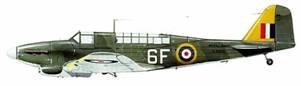
Randolph spent his last Boxing Day with his mother at Michaelchurch.[225] On 30 December, he wrote to his mother from the Royal Naval Barracks in Lee-on-Solent:
... I go to RAF Station Zoyland today it is in Somerset and then to RAF Exeter on the 4th January for about three days. After that I do not know exactly where but it will be somewhere in Cornwall. I am back here on the 17th or 18th . ...[226]
On 18 January 1943, Randolph was returning from RNAS St Merryn (HMS Vulture), near Padstow in Cornwall to RNAS Yeovilton (HMS Heron) – the Naval Air Fighter School in Somerset. He was flying a Fairey Fulmar II, serial number X8812 (coded 6F from its time on board HMS Victorious).[227] In the plane with him was Air Artificer John Tyrrell.[228] In low visibility, the plane crashed into high ground on Dartmoor and burnt out a quarter of a mile west of Okehampton at Yelland Farm, Tanner Hill, Holsworthy Road.[229] [230] Both Randolph and Tyrrell were killed.[231]
The Hereford Times recorded Randolph’s funeral:
In the burial ground of the little church of Michaelchurch Escley, in view of his home, Michaelchurch Court, nestling in the foothills of the Black Mountains, the remains of the late Mr R.R.W.R. Trafford were laid to rest on Saturday afternoon. Mr Trafford, a lieutenant in the R.N.V.R., serving in the Fleet Air Arm, was killed while flying the previous Monday. He was … a pioneer of aviation in Herefordshire, and was to have been High Sheriff of Herefordshire this year.…
The coffin, which recorded that Mr Trafford was killed on war service, bore the family crest, and was draped with the Union Jack. Brought to Hereford by train, it was accompanied to Michaelchurch Escley by Mrs Capper (Mr Trafford’s mother), and Mrs M J Hunter (sister).[232] [233]
|
|
| Randolph’s memorial, St Michael’s Church, Michaelchurch Escley |

7. Epilogue
Following the Second World War, and Randolph’s death, everything that was associated with the Flying Years disappeared relatively quickly.[234] The airfield at Michaelchurch was dismantled and returned to agricultural use. In March 1947, Randolph’s mother received compensation (£4,563.15.5) for Randolph’s yacht, Viva , which had been requisitioned by the French during World War Two, and it appears to have been renamed Cassiopee .[235] None of Randolph’s cars appears to have survived. Randolph’s chalet in Bellevue was sold in May 1948, when circumstances made it easier to travel again,[236] and the gardener’s cottage in September 1959.[237] [238] Eventually, in 1976, Michaelchurch Court itself was sold.
|
|
| Chalet at Bellevue, June 2007 |

The Morane-Saulnier MS-137 CH-184 ended its days in the UK. Although it appears in the Aéro-Revue Suisse as registered in Switzerland up until January 1934,[239] the log book records that its last flight was to Gloucester on 7 September 1930 – shortly after Randolph had bought his Gypsy Moth. A photograph, inscribed 17 September 1930, exists of an Air Union pilot, René Charpentier, in front of the CH-184, although it is likely that the photograph itself was taken in May 1929[240]
|
|
| René Charpentier, in front of the CH-184, dedicated to Roger Maury, [241] 17 September 1930 |
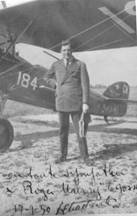
Bill Boddy (known as ‘W.B.’), the editor of Motor Sport , recounted the CH-184’s end in the April 1975 edition of the magazine:[242]
When it was pensioned off, the Mourane-Saulnier was brought from Gloucester, probably from the aerodrome that is now Staverton, on a lorry, with the wing removed, to be stored in a shed at the mansion. The wing was taken, probably on a horse-drawn cart, to another shed some distance away. It was not until 1959, they say, that Trafford’s grandmother,[243] requiring the space, had the ancient aeroplane removed by scrap dealers. The wooden propeller is all that remains, although when it was scrapped the machine was complete, except perhaps for the sparking plugs. That propeller has metal strips on the leading edges, surely not bullet-deflectors of a machine used in the 1914/18 war?
The propeller for many years used to stand against the wall of the porch to the Victorian wing in Michaelchurch Court. It bears the serial number ‘32627’, type ‘1155’ and date of manufacture 18 March 1927. It has recently been restored and (along with the log book) is a proud reminder of the CH-184.[244]
|
|
| Propeller belonging to CH-184 |
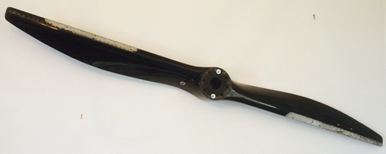
Randolph sold the DH60G Gypsy Moth G-ABAM in August 1938 to Malling Aviation Ltd.[245] The following year, on 18 August 1939, a couple of weeks prior to the outbreak of the Second World War, the Gypsy Moth crashed at Borough Green, and seems to have be en written off.[246]
James Baxendale
Revised August 2018
Acknowledgements
I would like to thank the following, who gave generously of their time in helping me write this article:
Jean-Claude Cailliez, Pionnair-GE, Geneva, for the information on Randolph ’s time in Geneva and his Morane-Saulnier MS-137. He has since published an article on Randolph on his www.pionnair-ge.com website ;
Didier Lecoq, Air Touraine, France, for information on the 1937 rally at Tours and for putting me onto the trail of the 1937 Michaelchurch rally. He has since published an article on the 1937 Michaelchurch Air Rally on his www.aeroplanedetouraine.fr website;
Jean-Pierre Weber, for his recollections of Randolph and his father;
Hedley Wilding, for his recollection of Randolph ’s planes and cars;
Andrew Pentland, for information on Randolph ’s Gypsy Moth;
Lindsey Baxendale, for her memories of her uncle and the 1927-28 photograph album;
Andy Hunter, for the Stanley Orton Bradshaw watercolours and the Hedley Wilding photographs;
Anne Hunter, for the propeller to the Mourane Saulnier MS-137 CH-184;
Rosemary and James Gunn for the CH-184’s log book and other family documents relating to Randolph;
Guy Sheppard, for Randolph’s letters and book of visitors to Michaelchurch airfield;
Francis Sheppard, for Randolph’s letters;
Michael Sheppard, for the portrait of Randolph;
Marianne Percival of Hereford Library, for searching out the Hereford Times and Hereford Bulletin articles;
Janice Williams of Maidstone Library, for locating the articles on the International Air Rally at Lympne;
Sheila Gaunt of Folkestone Library, also for locating articles on the International Air Rally at Lympne;
Tom Barclay, Library Services, South Ayrshire Council, for information on the fire at Prestwick;
Louise Bloomfield of Lloyds Register, for the information on Randolph ’s yacht;
Nicholas Scheetz of Georgetown University, Washington DC, USA, for the telegram from Randolph to the Biddles;
Gordon Smith of Naval-History.net , for providing the information on Randolph ’s passenger when he crashed; and
Don Kindell, naval researcher, Ohio, USA, for the information on Randolph ’s plane crash.
[1] Portrait in the possession of James Baxendale.
[2] From final poem written by Randolph on his last leave, Christmas 1942.
[3] Margaret Hunter, An octogenarian looks back (unpublished memoirs) (1982).
[4] Camille Allaz, The History of Air Cargo and Airmail from the 18th Century (2004), p 24. Védrines was one of the pioneers of early aviation. Born on 21 December 1881, he died on 21 April 1919, when his plane crashed. It is interesting to note that Randolph’s first plane, a Mourane-Saulnier MS-137, was a successor to the Mourane-Borel, which Randolph had seen in 1911, aged four.
[5] Jules Védrines, La Vie d’un Aviateur (2002), pp 462-465. Translated from the French.
[6] From Randolph – A Memory , by Margaret Hunter, January 1943.
[7] Margaret Hunter, op cit .
[8] Randolph’s 1926 diary, in the possession of Guy Sheppard.
[9] 340 route de Lausanne, 1293 Bellevue. Deed of purchase, 2 December 1926. The house is on the borders of the communes of Genthod and Bellevue. Whilst it is technically in the commune of Genthod, it is always referred to as being in Bellevue, including its address and in bills of the period. In July 1933, Randolph bought a second plot of land with a small house on the corner of route de Collex and chemin de la Cressonnière, in Genthod (now 2 chemin de la Cressonnière, 1294 Genthod), for the gardener and his wife, M and Mme Alfred Lavanchy, for Swiss Francs 15,000.
[10] Painting in the possession of Anne Hunter. Possibly painted by Randolph.
[11] The wine festival at Vevey is only held four times a century.
[12] Randolph’s decision to fly was not supported by all of his family. His brother-in-law, Michael Hunter, wrote to him on 6 April 1927, “I am very sorry to hear that you have more or less decided against the Welsh Guards .… I am quite certain that if you go on drifting aimlessly, you will ultimately be bored to death with yourself and everything else. I feel too that if you don’t take the Welsh Guards you will never settle to anything serious. It is no use trying to imagine that flying in your case is any more a job in life than hunting shooting racing or anything else of that kind that you like to think of. … ”
[13] The plane was registered in the name of ‘Topsy Club’. Whilst a search of the Annuaire Genevois and company records in Geneva for the period reveal that no company of this name was ever registered, nine other planes, which have no connection with Randolph, appear also to have been registered in the name of Topsy Club. According to Jean-Claude Cailliez, Topsy Club was likely the company used by Marcel Weber to import planes for himself, the Aéro-club de Genève, and – for tax reasons – his clients who were not resident in Switzerland. It is, however, clear from the plane’s log that between 1927-30, the plane was only used by Randolph. Randolph calls the plane Topsy in the 29 July entry of his 1929 diary (I left Topsy at Morane works ). Randolph’s second plane, the Gipsy Moth G-AADD, was registered as Topsy II . Randolph’s third plane, G-ABAM, was called Topsy III (label accompanying a picture of the Gipsy Moth in Randolph’s handwriting).
[14] www.aviafrance.com . A beautifully restored version of the MS-138 is on display at the Musée Volant de l’Amicale Jean-Baptiste Salis, near Paris.
[15] Letter in the possession of Francis Sheppard.
[16] Letter in the possession of Francis Sheppard.
[17] Randolph’s 1928 diary, in the possession of Francis Sheppard. ‘Got Brevet ’.
[18] Aero Club of Switzerland certificate no 295 (information from his Royal Aero Club Aviator certificate).
[19] Aéro-Revue Suisse , January 1929, p 18.
[20] Flight magazine, 20 December 1928 (p1067).
[21] Interview with Jean-Pierre Weber, 23 July 2007.
[22] Margaret Hunter, op cit . According to Randolph’s 1928 diary (in the possession of Francis Sheppard), the date was 28 May.
[23] Stanley Orton Bradshaw was a well-known painter of aeroplanes. In 1930, he painted a number of pictures of the Duchess of Bedford’s (‘The Flying Duchess’) Gypsy Moth, which are on display at Woburn Abbey.
[24] Randolph’s 1928 diary, in the possession of Francis Sheppard.
[25] Randolph’s 1928 diary.
[26] 30 June, according to Randolph’s diary.
[27] Club Neuchâtelois d'Aviation, 1927-1977 , p.34
[28] Weber also used the CH-184 to attend the Concours Suchard in Lausanne on 5-6 May 1928.
[29] He followed another plane, called Goliath , which a few days later made a forced landing and burnt out, although no one was hurt. Randolph’s 1929 diary, in the possession of Guy Sheppard.
[30] Randolph’s 1929 diary.
[31] On 25 June 1929, he took his sister, Margaret Hunter, and Uncle Windy (Uvedale Robert Corbett-Winder), up in the air.
[32] The Hunter family film of the CH-184, in the possession of the Baxendale family, was likely taken during Michael and Margaret Hunter’s stay at Michaelchurch between 20 June-2 July. The film bears the caption, ‘Bacton, Herefordshire. Randolph Trafford takes the air ’. Randolph also flew up to the Hunter’s family home, Stoke Hall, in Derbyshire, on 11 September.
[33] Where he may have met the pioneering English aviator, Amy Johnson, who was learning to fly there, with the London Flying Club. She gained her pilot’s ‘A’ licence at Stag Lane Airfield on 6 July 1929. Johnson flew her Gypsy Moth from England to Australia the following year, in May 1930.
[34] Flight magazine, 25 July 1929 (p805).
[35] Flight magazine, 13 June 1929.
[36] Randolph’s 1929 diary.
[37] Basel State Archives, http://query.staatsarchiv.bs.ch/query/detail.aspx?ID=81658 .
[38] Randolph likely stayed on with his mother in Switzerland for a short while. Receipts dated October 1929 show that central heating was installed in the chalet in Bellevue in time for winter.
[39] Possibly staying with the Musgrave family. Eden Hall Mansion was demolished in 1934.
[40] (Later Sir) (John) Raymond Cuthbert Quilter (25 February 1902 – 7 February 1959). Royal Aero Club certificate 8516, issued on 7 March 1929 at Henderson Flying School, Brooklands. Quilter lived at Bawdsey Manor, Woodbridge, Suffolk. Although he worked for the family stockbroking business, he was an aviation enthusiast and manufacturer of static-line parachutes widely used by British troops during and after the Second World War.
[41] Flight magazine,13 June 1929.
[42] Insurance certificate, dated 25 June 1930, with British Aviation Insurance Group.
[43] Flight magazine, 4 July 1930 (p737) and 11 July 1930 (p768). Randolph had instead flown to Geneva a week earlier, in order to fly the CH-184 back to England.
[44] Possibly the mandarin ducks that he picked up whilst in Japan in 1931.
[45] The Hereford Times , 15 November 1930 reported that ‘a feature [of the opening meet] at present somewhat unusual was the attendance of a subscriber who came by aeroplane. He was Mr Raymond (sic) Trafford, of Michaelchurch, and he flew from home, bringing along with him his mother, Mrs Capper.’
[46] An accounts book exists of the purchases Randolph made at auction during this period for the Court.
[47] There is an undated application by Randolph for a licence for a civil aerodrome at Michaelchurch Escley. However, a letter dated 21 September 1930, makes clear the year: ‘The aerodrome is quite satisfactory but a bit wet after all the rain; when it is finished though I think it will be quite good enough. ’
[48] He later leased a flat in a newly-built apartment block in Mayfair – 55 Chesterfield House .
[49] From Philip Hughes, Wings Over the Wye (1984), p 83.
[50] In the possession of the Baxendale family.
[51] Randolph had first stayed with the de Watteville’s in 1922, aged 15, in order to learn French. The château was destroyed by the Germans during the Second World War, but the gardens have been restored.
[52] Baron Robert Aernout van Lyndon (10 February 1882 – 8 July 1953) and Baroness Caroline Sophia de Lyndon (née Frideswith Huddart) (1880-1964) . They were probably living in London at the time at 37 Pont Street, SW1 (Anna Melissa Graves papers, Swarthmore College Peace Collection, Pennsylvania, USA). Frideswith Huddart was a minor artist. Her drawings, for instance, appear in The Hound of Heaven (1914).
[53] To some, he even lent his plane. See letter dated 17 November 1932, from a friend at RAF, Hendon. I was very sorry to miss you yesterday when I returned your little appareil safe and sound … I enclose a list of flying time which reveals queer “goings on”. The 601 “Millionaires” Squadron were based at RAF Hendon at the time.
[54] The 22 April 1932 issue of Flight magazine (p361), noted that on 12 April, ‘Mr Trafford, accompanied by his mother, cleared Customs [at Heston] and set off for Geneva in his “Moth” G-ABAM ’.
[55] Hereford Times , undated article.
[56] Letter, dated 23 May 1936, in the possession of Francis Sheppard.
[57] Hedley Henson Wilding (30 December 1917 – 7 February 2008).
[58] The Daily Telegraph , 27 December 2003. Wilding later corrected the story to say that Randolph filtered the petrol using chamois leather, not gauze. Randolph also insisted on using Shell petrol. In the 1920s, the Wildings had imported Russian petrol. (Interview with Hedley Wilding, 16 August 2007).
[59] The photographs (‘refuelling Randolph’s Gipsy Moth at Turnastone about 1930’ ) have been identified as follows: Left hand photograph : Randolph (pouring in petrol) ; Arthur Wood (Whiteside, at the side), Hedley Wilding (back to the camera). Right hand photograph : Randolph (sitting on the engine) ; Hedley Wilding (passing up petrol cans) ; Raymond Wilding (carrying cans)
[60] Hereford Times , 7 July 1934.
[61] According to Randolph’s visitors book which he kept for aircraft visiting Michaelchurch (now in the possession of Guy Sheppard).
[62] Walter Schumacher (see below), as a German living in London, may also have played a part in inviting the four Germans. As a pilot flying out of Heston, he was very likely a friend of Dick Malone.
[63] Apart from von Winterfeldt and Schumacher, it is not possible firmly to identify any of the Germans. Klein may have been identical with Alfons Klein, who was credited with 39 ‘kills’ and was also awarded the Knight’s Cross of the Iron Cross in April 1945.
[64] Walter Schumacher (born 24 July 1901, Dusseldorf). He was a German national. Royal Aero Club certificate 11359, issued on 27 August 1933 at Airwork School of Flying. He lived at 50 Gloucester Gardens, Hyde Park, London. He gave his profession as Business Manager.
[65] Jeffrey Amherst (5th Earl Amherst) (13 December 1896 – 4 March 1993). Royal Aero certificate 8736, issued on 20 August 1929 at Household Brigade Flying Club, Heston Air Park. He lived at 1 Wilton Crescent, Knightsbridge. He listed his ocuupation as journalist. He was a close friend of Noel Coward. In 1946, Lord Amherst became manager of British European Airways, which later merged to form British Airways.
[66] Gladys Edith Mabel Calthrop (née Treeby) (29 March 1894 – 7 March 1980). Royal Aero certificate 11296, issued 4 August 1933 at Airwork School of Flying, Heston. She lived at 2 Spencer Street, Westminster, London. Her occupation was listed as painter. In her pilot’s licence and other documents, she listed her year of birth as 1897. In addition to being an artist and a lesbian, she was a leading British stage designer, best known as the set and costume designer for many of Noel Coward’s plays and musicals. She was close to both Noel Coward and Jeffrey Amherst, which is why she would have participated in the air rally at Michaelchurch. On one occasion, she and Amherst flew to Germany and met Hitler in Berlin.
[67] According to Randolph’s visitors book (see above), they flew in the following planes:
- Klemm L32 D-2587: Baron A Von Winterfeldt and Herr Zölner
- Heinkel Kadett D-EXUV: Herr Schechner and Mrs Calthrop
- Avro 656 G-ABRK : Lord Amherst and Herr Klein
- Avro Cadet G-ACJX : Richard L E Malone and Walter Schumacher
[68] 11 December 1898 – 16 May 1942.
[69] According to the Michaelchurch guest book, the de Lyndon’s stayed at Michaelchurch from 30 June – 2 July 1934.
[70] Captain Hunter was narrowly to lose his parliamentary seat in 1935 to the Labour candidate by a couple of hundred votes.
[71] In Our Age, Living local history , issue 27, winter 2013, p3 (www.herefordshire lore.org.uk ).
[72] According to Randolph’s visitors book (see above), the visitors were:
30 June 1935:
- Focke Wulf D-EKDA : Kurt Tank (Bremen) and Kirus Gunge(?)
- Focke Wulf D-EVOH : Hans Schubert (Bremen) and Biglieter R Blaser
- Klemm 32A D-EBEF : Fus Beinam(?) (Hanover) and Wolfgang Kahuk
- Avro Cadet G-ACZA : R L E Malone and Dr A W Brange
28 June 1936:
- Focke Wulf D-EVOH : Hans Schubert and Andreas von Faehlmanm
- Focke Wulf « Hieglitz » D-EKRO : Kurt Tank and Gottfold Hurtfius(?)
- Tiger Moth OE-DAX : Mus Nikrienb(?) (Vienna) and Julius V…(?)
- Avro Cadet G-ACXJ : R L E Malone and Mark Watson
A Hans Schubert was noted as having 8 kills during his time in the Luftwaffe in World War Two.
[73] William Humble (born 14 April 1911, Doncaster, died 1 March 1992). Royal Aero Club certificate 9049, issued 12 April 1930 at Yorkshire Aeroplane Club. He lived at Skellow Grange, Carcroft, Doncaster.
[74] Hereford Bulletin , 26 September 1936, p 5.
[75] According to Randolph’s visitors book, the following aircraft landed at Michaelchurch airfield:
- Miles Hawk G-ADDK : Kenneth Davis and C H Keen
- Puss Moth G-ABPB : R Lindsay Keale, H L Pewtress and Daphne M Pewtress
- D H Moth G-AAAS : R L E Malone
- Miles Hawk G-ACYO : S C Richards and Myles Bickerton (‘started 21st , finished 12th’ )
[76] Letter from Randolph to his sister, Margaret, 6 August 1937.
[77] La Dépêche , 25 July 1934.
[78] The drawing was by David Ffolkes (born 12 October 1912, Worcestershire) who stayed at Michaelchurch Court between 25 July – 31 August 1936, along with Francis Biddle and others. Ffolkes went to the US as a set designer before World War II. During the war, he was a prisoner in a Japanese prison camp in Burma. He returned to the US after the war, where he became a well-known costume and set designer, including for such films as You Only Live Twice (1967).
[79] Journal La Touraine Républicaine , 4 September 1934. Translated from the French.
[80] Roncin, Moreau and Mme Roncin flew from Tours to Lympne in a Farman 402 ‘Ville de Tours’ (F-AMYZ). But they were obliged to leave their plane at Heston, and fly to Michaelchurch in Malone’s Short (which had five seats), due to the size of the airfield at Michaelchurch.
[81] Likely Victor Chantreau, who was the first President of Air Touraine. M and Mme Chantreau may have arrived by car, since neither of the articles in the Journal La Touraine Républicaine or la revue Air Touraine mention them and speak of only three planes.
[82] Legendre may have flown in his Caudron C.282/8 Phalene (F-AMST), which was registered on 21 March 1934.
[83] Carlos Garica Palacios (1896-1968) had an interesting life. He did the Tour du Monde several times, and in 1936 was the first American to cross the Sahara in a car. A fighter pilot in both the First and Second World Wars, he was also friends with Antoine de Saint Exupery (author of The Little Prince ), with whom he crossed many remote mountains in South America. In his old age, he became close friends with the actor, Marlon Brando (Cuaderno de Difusion Historica, Serie Historia de Bulnes , no 1 (July 2005), pp 13-14).
[84] Leslie Ivan Arnott (born 8 July 1904, Radyr, Glamorgan). Royal Aero Club certificate 13992, issued on 30 June 1936 at Cardiff Aeroplane Club. He lived at Claremont, Monmouth. His profession was Lieutenant.
[85] Redvers Robert Smith (27 February 1900 – 1962). Royal Aero Club certificate 13400, issued on 24 November 1935 at Cardiff Aeroplane Club. He lived at 17 Caedelyn Road, Whitchurch, Cardiff. His profession was film salesman.
[86] Geoffrey William Jones (8 July 1901 – 1988). Royal Aero Club certificate 13788, issued on 2 May 1936 at Cardiff Aeroplane Club. He lived at Vallon House, Machen, Monmouthsihre. His profession was insurance official.
[87] Leslie Robert Ernest Castlemaine (1910-1978). He was a member of the sales department and flew for General Aircraft Ltd from 1935-42. His Royal Aero Club certificate was issued on 21 March 1936. In July 1936, he flew a Monospar ST12 (G-ADDY) to the Spanish Nationalists in Burgos. Dick Malone did so as well two days later and likely travelled back with him to England. Their friendship was probably the reason why Castlemaine was invited to the Michaelchurch Air Rally. In the Second World War, Castlemaine joined the Fleet Air Arm, rising to the rank of Temporary Lieutenant Commander. In the mid 1960s, he became the commercial and sales manager for Cambrian Airways Ltd. He lived latterly at Alderley Edge in Cheshire.
[88] Mme Roncin’s article in La revue Air Touraine mentions two German planes arriving at Michaelchurch. It is likely that Hans Seidemann was flying the second plane, since he had competed in the Air Rally at Lympne earlier that day. Presumably, the rest arrived by car.
[89] Hermann Brand presented the Hermann Brand Prize – an aeroplane stop watch – at Lympne to the first full flying member of the Cinque Ports Flying Club to finish in the final of the Wakefield Cup. The winner was Mr A.J.S. Morris (Folkestone Herald , 4 September 1937).
[90] Baron Charles Trevethin lived also nearby in Monmouthsire. He had stayed at Michaelchurch a few days earlier on 25-26 August 1937. Lord Trevethin’s father had been the Lord Chief Justice of England and his younger brother, Geoffrey Lawrence, Lord Oaksey, later served as the main British judge at Nuremberg.
[91] Lord Beauchamp had been the Lord Warden of the Cinque Ports, the only post that he had not relinquished on going into exile. The International Air Rally at Lympne was hosted by the Cinque Ports Flying Club. Lord Beauchamp is generally supposed to have been the model for Lord Marchmain in Evelyn Waugh’s Brideshead Revisited .
[92] La revue Air Touraine , November 1937. Translated from the French.
[93] Challenge Internationale de Tourisme .
[94] Registration number D-2260.
[95] Registration number D-IPUS. Marian Kryzan, Miedzynarodowe turnieje lotnicze 1929-1934 (1988, Warsaw), quoted in Wikipedia .
[96] Gordon N Kniverton, Manx Aviation in War and Peace (1986).
[97] Don Berliner, A Concise History of Air Racing in www.airrace.com.
[98] Kent Messenger , 4 September 1937; Folkestone Express , 4 September 1937.
[99] Broadly equivalent to the Victoria Cross.
[100] Folkestone Herald , 4 September 1937.
[101] Kent Messenger , 4 September 1937.
[102] Noel Coward appeared in the Nazi’s Black Book, due to his being a homosexual. Had they succeeded in invading Britain, he would have been arrested and liquidated. On learning of the existence of the Black Book, the novelist, Rebecca West, is said to have sent a telegram to Noel Coward saying, My dear - the people we should have been seen dead with .
[103] Richard Vincent L’Estrange Malone (born 2 February 1910, Cricklewood, London. Died 24 August 1946, Egypt).
[104] Malone’s parents were Henry L’Estrange Malone (1872-1951), a European General Manager for Fidelity insurance company, and Ethel Gertrude, née Vincent. His sister was Iris L’Estrange Malone (5 May 1903-1980), who married Herbert Evan Henry Roberts (1870-1938) in 1929. In 1927, she published a book called The Secret Flower .
[105] The planes Malone flew to Michaelchurch were a Spartan (G-ABWR), Avro Cadet (G-ACJX or G-ACXJ and G-ACZA), D H Moth (G-AAAS) and 5 seater Short Scion.
[106] Royal Aero Club certificate 10635. Flight magazine of 15 July 1932 (p 671) noted, Thursday [July 7]. – There were two first soloists among the pupils to-day, those realising their ambition being Mrs Monica Fitzclarence and Mr R. L. Malone . Monica Fitzclarence, known as “Moke”, was the wife of the Earl of Munster. Malone lived with his parents at 7 Bryanston Court, London W1 at the time (Electoral Registers 1931 and 1933). This was also the address he gave when he travelled with his father from Plymouth to New York on the Ile de France in October 1930.
[107] Eberhard Rebling. He left Germany for Holland in 1936, returning to East Germany in 1952. He married a Jew, Lin Jaldati, and was active in the resistance movement against the Nazis during the war.
[108] Flight magazine, 31 August 1933 (p888).
[109] Possibly from 1932. Malone flew to Michaelchurch in a Spartan Arrow, registration number G-ABWR, in both October 1932 and June 1933, but this plane was registered in his name. By contrast, when he flew to Michaelchurch for the air rally in July 1934, it was in an aircraft registered to Henlys (an Avro Cadet G-ACJX). Subsequent planes in which he visited Michaelchurch were owned either by Henlys or Airwork (or Lord Amherst).
[110] Flight magazine, 6 December 1934 (p1312), where he was noted taking delivery of the Earl of Essex’s new C30 Autogiro in bad fog, despite only fifty minutes of previous experience flying this type of machine.
[111] Keith McCloskey, Airwork, a History (2012), p98. Airwork and Heston Aerodrome were owned by Sir Nigel Norman and Alan Muntz. Sir Nigel Norman was the grandfather of the author’s brother-in-law, Nigel Norman.
[112] Flight magazine, 23 January 1936 (p91).
[113] It is not known whether Randolph was among the 30 British participants, but he may well have been, three German planes (and Malone) having landed at Michaelchurch airfield three weeks earlier on 28 June 1936. According to letters in the possession of Francis Sheppard, he flew to Germany on at least one occasion with Malone.
[114] Flugsport , no 15 (1936), p366.
[115] In May 1941, Hitler’s deputy, Rudolf Hess, flew to Scotland for a meeting with the Duke of Hamilton, Lord Malcolm Douglas-Hamilton’s brother, allegedly to try to negotiate a peace treaty.
[116] Registration number G-ADCL. http://www.ab-ix.co.uk/dh89.pdf .
[117] Airwork sold planes to both the Republican and Nationalist sides. Keith McCloskey, Airwork, A History (2012), pp 101-102. The flight was the subject of a BBC Radio 4 programme Franco’s British Friends , broadcast 29 January 2007. Douglas-Hamilton’s son, Alasdair Douglas-Hamilton, in his biography of his father, Lord of the Skies (2015), chapter 9, dismisses the fact that his father might have had any pro-Franco sympathies.
[118] See above. Castlemaine participated in Randolph’s air rally at Michaelchurch the following year in August 1937.
[119] Monospar ST12, registration number G-ADDY.
[121] Alex Henshaw, The Flight of the Mew Gull (1980), p98. Henshaw (1912-2007) did not win the 1937 King’s Cup, but did so the following year (1938), flying at an average speed of 236.25 mph. In 1939, he made a record breaking return trip from England to Cape Town. He was a test pilot in the Second World War, principally for Spitfires and Lancaster heavy bombers.
[122] His address at the time was 134 Bath Road, Hounslow, Middlesex.
[123] Airwork had operations both in Egypt (Misr-Airwork) and Iraq. They had up to five DH 89A Rapides based at Abadan.
[124] Noel Coward, Middle East Diary (1944), p93.
[125] Jeffrey Amherst, Wandering Abroad (1976), p133.
[126] Londonderry Sentinel , 27 August 1946.
[127] Birmingham Daily Gazette , 26 August 1946.
[128] Misr-Airwork was commonly known as Misr Airlines. They had run the Cairo-Lydda service since 1934. It is very possible, therefore, that Malone was working for Misr-Airwork at the time of his death.
[129] At the time of his death, Malone was living in Cairo at 61 The Union Vie Buildings, Fuad el Awal. He gave his London address as 32 St Swithins Lane.[129] He was unmarried. In his will dated 13 March 1936 he left all his possessions (£4,537 1s 9d) to his mother. National Probate .
[130] Murder in Motley by Fenn Sherie and Ingram D’Abbes was not to become a classic of English theatre.
[131] He held motor licence number 166666.
[132] ‘YK’ indicates that the registration number was issued in the London area between June-July 1925.
[133] According to Rod Martin, of the Amilcar Register, the car was likely an Amilcar CGS, similar to one with registration number YK 98, which was registered on 22 June 1925.
[134] Identified thanks to extensive help from Sharron Bland of the Records Department of the Rolls Royce Enthusiasts Club (RREC).
[135] Chassis no 2HG ; Model: Silver Ghost ; Type: Alpine Eagle ; Body: 4 seater open touring by Gangloff (initially shipped as a sporting 2 seater) ; Horsepower: 40/50 ; Engine no: P446 ; Tyres: Dunlop. The car was initially sold on 18 October 1922 to Albert Schmidt SA, 29 Quai du Mont Blanc, Geneva, the Swiss agent for Rolls Royce. The cost of the chassis was £1,850. Albert Schmidt sold the car to Baron Jean-Jacques (Johann Jakob) von Bonstetten.[135] The car was shipped from the Rolls Royce showroom, Lillie Hall, in Fulham on 5 February 1923 to Boulogne.
[136] 1928 diary, entries for 1 and 2 July.
[137] Either Michaelchurch Court or The Cottage. Randolph lived with his mother in The Cottage between 1929-1931.
[138] ‘VJ’ was the series for the Herefordshire area between June 1927 –April 1937, numbers being issued in sequence from 1 to 9999.
[139] 1928 diary.
[140] University Motors sold the car in July 1931 to Walter Sherwin Engall (1888-1936) of Thames Cottages, Riverside, Staines. Engall had been the chauffeur to the Prince of Wales (later George V), and subsequently established a car dealership. He sold the car in August 1934 to Brian Howard Baker (1892-1987), a renowned amateur all round sportsman (principally in football and high jump) and later businessman in Liverpool in the family firm, Vauxhall Soapery, which produced soap and chemicals. The car’s history between 1934-48 is not known. However, in December 1948 it is recorded in the vehicle tax registration records as a Rolls Royce Silver Ghost with a P446 engine, with a weight of 2 tons 1 cwt 91 lbs. The owner is noted as John William Barrett (1895-1975), a dairy farmer of Mill House Farm, 92 New Street, Halsall, nr Ormskirk in Lancashire (Herefordshire Records Office ). It is not known for how long Mr Barrett owned the car. He was still living at Mill House Farm when he died in September 1975. The car’s history since 1948 is not known. Registration number VJ 989 is no longer held at the DVLA (letter from the DVLA, 18 May 2018).
[141] It has not been possible to identify this car. Sunbeam ceased production in 1935. The models produced between 1930-34 were the 25hp, the 16hp (known as “18.2”), the 20hp (known as “23.8”), Speed 20, the Twenty, Dawn and the Twenty Five.
[142] Information also from Motor Sport , April 1975, p 362.
[143] Interview with Hedley Wilding, 16 August 2007.
[144] According to the Lagonda Club, there were four models in production in 1931-32: 2lt T2 tourer; 3 lt T3 tourer; 2lt Continental; and the 16/80. All four models had cycle wings which turned with the front wheels. Lagnda’s factory records were lost during the war. Emails from Len Cozzolino to the author, 19-20 June 2018.
[145] The cars were assembled by Hudson Essex Motors Ltd, Great Western Road, London, from parts shipped over from the US. The coachwork on Randolph’s car was likely by Coachcraft.
[146] The registration number, ‘BYH’, indicates that it was registered in London between May 1935-June 1936.
[147] Interview with Hedley Wilding, 16 August 2007. Randolph’s ownership of an ‘Essex Terraplane’ was also noted in the April 1975 edition of Motor Sport (p362).
[148] In Switzerland, Randolph owned a Citroën.
[149] Don Butler, The History of the Hudson (1982), p189. Thanks to Paul Butler, the webmaster of the Hudson-Essex-Terraplane Club, for identifying the model.
[150] Obituary, Hereford Times , 23 January 1943.
[151] Interview with Hedley Wilding, 16 August 2007.
[152] In the possession of Guy Sheppard.
[153] Dr Leslie Utz (1895, Glen Innes, New South Wales – 22 December 1944, Sydney). He lived in Sydney. He was a medical practitioner and prominent in racing circles, being a member of the Australian Jockey Club and a committee member from 1939-41. He was also a member of the New South Wales Tennis Association. The Age newspaper, 26 December 1944.
[154] Lorna Mabel Utz (born c1904, New South Wales). Married 1924. She raced horses under the name of ‘Lorna Doone’.
[155] Leslie and Lorna Utz stayed at Michaelchurch on 27-29 May 1933 and 19-22 August 1933. They returned for a second trip in 1936, staying on 24-25 May and 5-15 July 1936. Leslie Utz wrote in the visitors book, “Of all the very many pleasant experiences I have had of the British Isles the memory of those passed at Michaelchurch will leave longer than any other”. www.ancestry.co.uk and Michaelchurch Court visitors book.
[156] Court Circular page, The Times , 21 September 1934.
[157] The Sydney Morning Herald of 18 October 1934 noted that “Dr and Mrs Leslie Utz and Mr and Mrs Barney Utz intend going to Melbourne next week. They will stay at the Windsor Hotel” .
[158] Letters of his stay in the possession of Guy Sheppard and www.ancestry.co.uk .
[159] Letter from Randolph to his mother, 22 October 1934, in the possession of Guy Sheppard.
[160] Letter from Randolph to his mother, 22 October 1934.
[161] Australian Women’s Weekly, 1 December 1934, p 29.
[162] Randolph appears to have cancelled his earlier crossing to Montreal on 31 October 1935.
[163] Letter dated 21 November 1935, in the possession of Francis Sheppard ; letter dated 10 December 1935, sent from Randolph to his mother, from New York, in the possession of Guy Sheppard.
[164] Katherine Biddle papers, Georgetown University, Washington DC. The photograph shows Francis Biddle walking past a painting of himself on his way to work.
[165] www.ancestry.co.uk .
[166] Photograph in the possession of Francis Sheppard. Randolph’s sister, Margaret Hunter, has written on it, ‘I think this must be the “Viva” ’. The yacht is similar to the Mollihawk currently in Antigua (see below).
[167] Randolph was a member of the Royal Aero Club until 6 September 1938 (holding Air Touring Card no 687), but there is no evidence that he renewed his membership for 1939.
[168] John Henry Hancock (born 19 February 1895, Newcastle-upon-Tyne). Royal Aero certificate 10241 issued 31 August 1931 at Hanworth Club. He lived at Woodlands, Bridstow, Ross-on-Wye.
[169] Randolph bought the plane on 13 January 1938. John Hancock had flown the same plane to Michaelchurch in both May and June 1933. Randolph sold the plane again on 14 April 1939.
[170] Letter from Randolph to his sister, Margaret, 6 August 1937.
[171] The yacht was sold through The Solent Yacht Agency. Originally called the Mollihawk III , it was built in 1911. A similar 70 ft Schooner, the Mollihawk , also designed by Linton Hope, but built in 1903, survives in Antigua, owned by Nicholson Yachts Worldwide. The Howard de Walden family are one of the major landowners in London, with 92 acres of real estate in Marylebone, including much of Harley Street. Lord Howard de Walden’s house at the time was Seaford House in Belgravia Square, now leased by the Defence College. de Walden owned a number of racing yachts. For price of purchase of the yacht, see letter from Anthony Duke (family lawyer) to Mrs Capper, 19 February 1960.
[172] Letter from Randolph to his mother, 12 December 1939. Correspondence from Lloyd’s Register of Shipping to their agent in Gibraltar, 16 March 1939. The absence of the necessary screwshaft survey led to considerable subsequent correspondence from Lloyd’s Register.
[173] Interview with Hedley Wilding, 16 August 2007.
[174] Letter dated 27 January 1939. The letter noted that Randolph would be picking up his mother at Gibraltar.
[175] At Taormina. The cable from the agent in Gibraltar said ‘Viva sailed eighteenth voyage unstated’ . But Mr Barrenger, the family lawyer, knew that he would be calling in at Sicily.
[176] Bobby Howard.
[177] Undated letter in the possession of Guy Sheppard.
[178] Letter in the possession of Guy Sheppard.
[179] Letter in the possession of Francis Sheppard.
[180] Letter in the possession of Francis Sheppard.
[181] Telegram in the possession of Francis Sheppard. Separately (in the Baxendale family possession), there is a statement of account dated 22 August 1939 from T Coppin & Son, Cannes and a letter from W B L Steinthal, sent from the City of London, dated 22 November 1939, enclosing some photos (not found) on board the Viva off Cannes in August 1939. William Bodo Leopold Steinthal (born 25 September 1912, died 13 June 1991) worked in the City and lived at 7 Abbey Lodge, Regent’s Park in the 1930s. In the Second World War, he was a Lieutenant in the Intelligence Corps. He married Pauline Judson in 1956. He lived latterly at Glenmore House, Richmond Hill, Richmond.
[182] Mr Lily sent Randolph a letter on the condition of the yacht on 28 April 1940, enclosing at the same time a list of the alcohol on board (‘2 cases of gin and 13 bottles, 2 cases of rum and 10 bottles, 29 bottles of whisky, 9 sloe gin, 2 champagne’).
[183] Naval Attaché’s letter dated 30 March 1940 and French visa issued in London on 26 March 1940 in the possession of Guy Sheppard.
[184] 22 June 1940.
[185] Randolph’s letter to his mother, 22 July 1940, in the possession of Guy Sheppard. The Frenchman is a reference to Marechal Pétai n. Jerry was the nickname for Germans during World War Two. The letter was written during a time of censorship, when commenting on politics was forbidden.
[186] Telegram to Randolph from Jean Mestres, 6 February 1942. The French Riviera was part of Vichy France in June 1940. In 1942, it was occupied by the Italians and the Germans and, following the Italian surrender in 1943, by the Germans, until they were expelled by Allied Forces in August 1944.
[187] Margaret Hunter, op cit .
[188] Royal Navy’s records of Randolph Trafford.
[189] Letter in the possession of Francis Sheppard.
[190] Letter from Randolph to his mother, 16 November 1939, in the possession of Guy Sheppard.
[191] Letter from Randolph to his mother, 20 November 1939, in the possession of Guy Sheppard.
[192] Letter in the possession of Francis Sheppard.
[193] Randolph’s exercise book and examination papers from this period, in the possession of Guy Sheppard.
[194] In the possession of Guy Sheppard.
[195] Letter from Randolph to his mother, 12 December 1939. The Vega Gull was a military trainer, manufactured by Percival Aircraft Ltd.
[196] Letter from Randolph to his mother, 18 December 1939. The Hart was a Hawker Hart trainer, manufactured by Hawker Aircraft Ltd.
[197] Letter from Randolph to his mother, 20 December 1939.
[198] His letter of appointment is in the possession of Guy Sheppard.
[199] E-mail from Catherine Rounsfell, Curatorial Administrator, Fleet Air Arm Museum, 10 August 2007. The Blackburn Shark had serial number K8501.
[200] Letter dated 12 April 1940 in the possession of Francis Sheppard.
[201] Letters from Randolph to his mother, 22 April 1940 and 14 May 1942, in the possession of Guy Sheppard.
[202] Letter dated 18 August 1940 in the possession of Francis Sheppard.
[203] Letter from Randolph to his mother, 26 August 1940, in the possession of Guy Sheppard.
[204] Letter dated 14 October 1940 in the possession of Francis Sheppard.
[205] Letter from Randolph to his mother, undated, in the possession of Guy Sheppard.
[206] National Archives .
[207] Photograph in the possession of Francis Sheppard.
[208] Letter in the possession of Francis Sheppard.
[209] Peter Berry, Prestwick Airport and Scottish Aviation (2005), p36.
[210] Dougal McIntyre, Prestwick’s Pioneer : A Portrait of David F McIntyre (2004), p95.
[211] Hereford Times , 23 January 1943.
[212] Hughes-Williams was killed in the Kirkenes strike on 31 July 1941.
[213] Letter from Dr Robert Stirling, 19 Cluny Drive, Edinburgh, to Randolph, 8 April 1941, in the possession of Guy Sheppard.
[214] Letter from Randolph to his mother, 6 July 1941, in the possession of Guy Sheppard.
[215] Visitors’ book, Gissing Hall, 24-27 July 1941.
[216] According to his niece, Lindsey Baxendale, Randolph was told that he would never walk again, but was determined to do so.
[217] Note from the Director of Navy Accounts, dated 30 September 1941, in the possession of Guy Sheppard.
[218] 828 squadron played an active role in the siege of Malta and performed nightly bombing attacks against Sicily and southern Italy, and anti-shipping strikes against Axis convoys throughout the central Mediterranean.
[219] His position as Commanding Officer was taken by Lt Cdr D E Langmore.
[220] Fleet Air Arm Archive, Raid on Kirkenes and Petsamo .
[221] Letter from Randolph to his mother, 13 September 1942, in the possession of Guy Sheppard.
[222] Letter from Randolph to his mother, 20 October 1942, in the possession of Guy Sheppard.
[223] Letter dated 12 November 1942 in the possession of Francis Sheppard.
[224] Fleet Air Arm Archive ( www.fleetairarmarchive.net/aircraft/Fulmar.htm ).
[225] Randolph’s niece, Lindsey Baxendale, had last seen him at her sister, Betty’s, 21st birthday party in London in December 1942. Randolph would have spent Boxing Day at his mother’s house, The Cottage, since Michaelchurch Court had been taken over by the Canadian Air Force.
[226] Letter from Randolph to his mother, 30 December 1942, in the possession of Guy Sheppard.
[227] The same Fairey Fulmar II X8812 (6F) had first been flown on 10 November 1941. It was delivered to 809 Squadron at RNAS Crail (HMS Jackdaw) on 18 November 1941. On the night of 11/12 August 1942, Sub/Lt (A) Hugh Morrison, RNZNVR, flew the X8812 (6F) from the aircraft carrier, HMS Victorious, shooting down a Me-109, south of Sardinia, and damaging a second plane.
[228] Air Artificer 4th Class, John William Tyrrell (service number FX 77457). Originally from Fareham, he was aged 20 when he died.
[229] Located on Ordnance Survey map (OSGB36) : SX 5490 9427. According to what the family was told, locals saw the plane circling several times, apparently looking for a place to land. The Fire Brigade had already been alerted and was on hand when the plane crashed.
[230] In 2012, Peter Heard, the owner of Yelland Farm, told Paul Hubbard of Dartmoor News that his father had been told by the previous owner (who had owned the farm during the war years), that the aircraft had crashed about 400 yards from the farmhouse in a field used for grazing. Wreckage had been buried at the site. According to Mr Heard, in probably the 1980s, a group of people (likely the Devon Aircraft Research and Recovery Team, based on Torquay). had dug up the engine, with the intention of putting in a museum. However, the museum never materialized and the all the material they had collected over the years went for scrap. Email from Paul Hubbard to James Baxendale, 15 January 2014.
[231] Fleet Air Arm Death Ledgers (message from RNAS Lee-on-Solent (HMS Daedalus) 1800/18/1/43) and repeated in Ray Sturtivant and Mick Burrow, Fleet Air Arm Aircraft 1939 to 1945 (1995).
[232] Hereford Times , 30 January 1934.
[233] The RNVR cross, in memory of Randolph’s death in service, is in the possession of Michael Sheppard.
[234] In his will, dated 11 September 1940, Randolph left everything to his mother, except for £3,000 which he left to his friend, Peter Warrington Hallett. The estate was valued at £97,000.
[235] Correspondence between W.G. Barrenger (family lawyer) and Mrs Capper, 1946-47. The boat does not appear in Lloyds Register of Yachts after 1939. It is possible that something happened to the yacht in October 1943 – shortly after the Italians surrendered (in September 1943) and the Germans occupied the French Riviera – since the compensation claim included payment for hire of the yacht at 11% per annum from 6 February 1942 to 5 October 1943.
[236] It was sold to Madame Jenny Louisa de la Geneste, née Boillat, for Swiss francs 260,000 (the equivalent of £15,000) – Deed of sale, 29 May 1948. There may have been some link here too. Jenny was married to Joseph Charles de la Geneste, who appears also to have gained his pilot’s licence under the instruction of Marcel Weber in 1932.
[237] Randolph had tried to sell the chalet in July 1941 for £8,000 (without cottage or furniture), but the sale clearly fell through. Randolph’s letter to his mother, 13 July 1941, in the possession of Guy Sheppard.
[238] The cottage was sold for Swiss francs 57,000. Mrs Capper, Randolph’s mother, had allowed the gardener and his wife, M and Mme Lavanchy, to remain in the cottage, rent free, for the duration of M Lavanchy’s life.
[239] Aéro-Revue Suisse , no 2, February 1934, p 44. It does not appear in the 1 January 1935 list (Aéro-Revue Suisse no 2, February 1935).
[240] The log book for the CH-184 notes that Charpentier made a short flight in the plane in Lyon on 13 May 1929.[240] Located by Jean-Claude Cailliez in the French periodical, Icare , no 104 (1983).
[241] Maury was also an Air Union pilot.
[242] Motor Sport , April 1975, p 362. It is likely that the story was recounted to him by Randolph’s nephew, Michael Hunter, or by Hedley Wilding.
[243] The author means Randolph’s mother.
[244] For many years in the possession of Andrew Hunter. Given in January 2018 to James Baxendale.
[245] Malling Aviation Ltd was linked to West Malling airfield near Maidstone in Kent, later RAF West Malling.
[246] Randolph’s Puss Moth (G-AAXR), which he had bought in 1938 from John Hancock and which he sold in April 1939, appears to have finished its life with Marlborough College’s Air Cadets’ 525 ATC Squadron.
Ref: rs_mic_0162